The patient is L.T. H. (15 years old, residing in Nhon My commune, An Giang province), admitted to the hospital in a state of prolonged shortness of breath. According to her family, while lying in a hammock eating peanut almond cake, she suddenly coughed violently accompanied by vomiting. In the following days, the child showed signs of fatigue and mild shortness of breath but no fever, little cough.
The family took the child to a local medical facility for examination and was diagnosed with bronchitis, treated with injections. However, the shortness of breath did not improve, the child was more tired, so he was taken to An Giang Obstetrics and Pediatrics Hospital. Here, the patient was diagnosed with pneumonia, had to breathe oxygen and use antibiotics. CT scan results later revealed a foreign object in the left lung, so the patient was transferred to Children's Hospital of Ho Chi Minh City for further treatment.
The results of a CT scan of the airway at the hospital showed that the foreign object was located at the end of the left root bronchiobronchium, causing fecal collapse, back of the left lung, and mediastinum pneumothorax. Doctors diagnosed the child with a foreign object in the airway on the seventh day.
After inter-specialized consultation in respiratory medicine and otolaryngology, the team decided to perform an endoscopy of the airway to remove the foreign object. During the endoscopy, doctors discovered that the left root bronchiobronchium contained a lot of cloudy phlegm and the foreign object was located in a deep position, surrounded by a congested mucosa and inflammatory granular tissue, making it difficult to remove the foreign object with conventional tools.
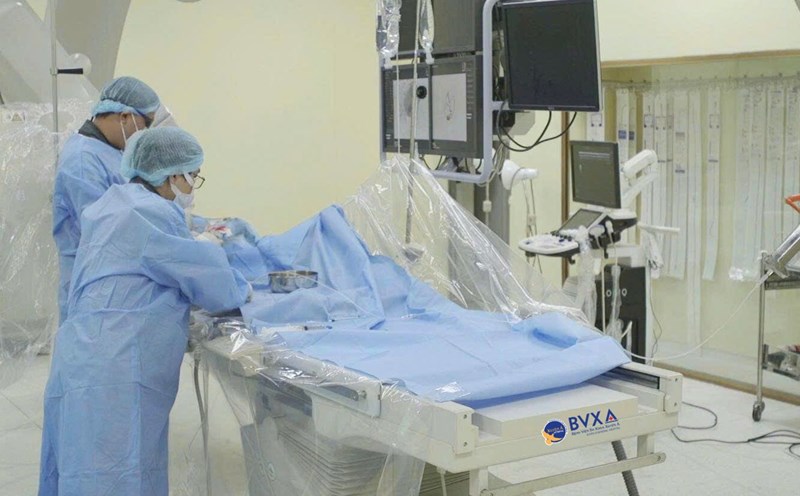
The team coordinated with the cardiovascular intervention team to use a specialized instrument, a 4-8 mm snare. Under the guidance of the brightening screen, the doctor inserted the snare into the back of the foreign object and pulled out half of the foreign object block. The rest fell into the upper left lobe of the bronchi and was successfully removed with a specialized crocodile grip of the respiratory system.
The removed foreign object was identified as an almond. After the procedure, the child was awake, no longer had shortness of breath and his health was stable.
According to BSCKII Nguyen Minh Tien - Deputy Director of Children's Hospital of Ho Chi Minh City, this is a case where a foreign object in the airway lay for a long time in the bronchi, causing a strong inflammatory reaction, creating granular tissue and pseudomembranes, increasing the difficulty of the procedure.
A noteworthy point in the intervention case is that the foreign object was not opaque, while the conductor of the cardiovascular device could not be inserted through the respiratory endoscopy system. Doctors proactively pumped opaque directly into the bronchi containing the foreign object, helping to accurately locate it on the brightened screen to guide the noose to approach the foreign object.
Through this case, doctors recommend that parents pay special attention when feeding children nuts or small foods that easily cause choking. Young children should not eat while running, jumping, talking or playing, because it can increase the risk of foreign objects falling into the airway, causing obstruction and threatening life.