
Out-of-reach drugs, patients exhausted
At the age of 19, patient N.T. M in Ho Chi Minh City had to enter a harsh battle with nasopharyngeal cancer. For more than 2 years, Ms. Dao Thi Hoa - the patient's mother - has not had a single day of real peace. "Since my child developed the disease, my husband and I have been forced to quit our jobs, taking turns being on duty in the hospital, putting all our time and effort into taking care of our child," Ms. Hoa choked up.
Treatment costs are increasing day by day, becoming a burden beyond the ability of a family living in a cramped rented room. Previously, each prescription was priced from 25 million to nearly 30 million VND. After that, she continued to undergo many other treatment courses, in which radiation therapy alone cost more than 40 million VND.
Currently, the doctor has prescribed a new medicine, one prescription per three weeks, costing nearly 63 million VND. A total of about 35 prescriptions may be needed for treatment. My family is renting a room, and there is still a young child going to school, so the money for medicine, rent, living expenses and tuition fees are piled up. We really have no ability to manage," Ms. Hoa said.
To maintain treatment for their child, the family had to borrow money everywhere, from relatives and friends to small loans. However, with prolonged and increasingly expensive costs, resources are gradually running out. Each prescription of medicine to keep life is a constant worry about the money that they do not know where to find.
When she learned that many new generation cancer drugs were proposed to be added to the health insurance coverage list, Ms. Hoa, as well as many families with cancer patients, could not hide their joy and hope. This is considered an important step forward, helping patients access advanced therapies, reduce financial burdens and improve long-term treatment effectiveness.
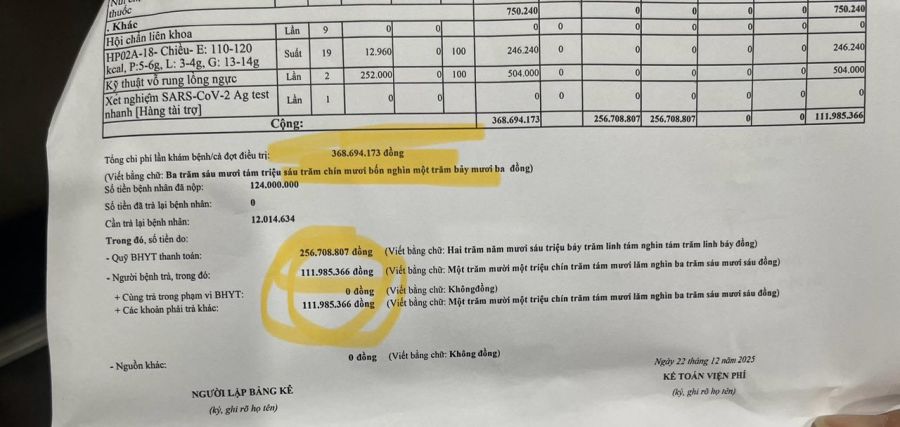
Mr. L.T. C (77 years old, in Phu Tho) was diagnosed with stage 4 lung cancer. In his old age, he entered a journey of arduous and costly treatment. Doctors advised on treatment with immunostimulants - a modern method that brings many hopes of prolonging life - but the cost for each 21-day course is up to about 60 million VND. The most recent treatment course at the end of 2025, the total cost of examination and treatment was 36,8694,773 VND. Fortunately, because patients with health insurance cards have been paid 256,708,807 VND by the health insurance fund, the rest is paid by patients. However, many drugs are not on the health insurance list, so patients have to buy them outside. With a multi-cycle regimen, the total estimated cost is nearly 2 billion VND, far exceeding the financial capacity of the family.
Faced with that huge burden, his family has held many meetings, considering between continuing treatment or accepting to give up. The final decision was to sell the land accumulated for many years to have money to pursue hope. The patient's story shows the accumulated difficulties that many late-stage cancer patients are facing: the pain of illness, psychological anxiety and the burden of treatment costs that are too high compared to the economic conditions of most families.
Patients can rest assured to follow the regimen
Talking to a reporter of Lao Dong Newspaper, Dr. Diep Bao Tuan - Director of Ho Chi Minh City Oncology Hospital - said that the Ministry of Health's addition of new generation cancer drugs to the health insurance payment list is very practical. This not only expands treatment options but also creates conditions for patients to access modern therapies such as targeted drugs, immunotherapy or antibody-drug combinations (ADCs).
According to Dr. Diep Bao Tuan, many new drugs are currently recommended for use right from the first treatment steps for suitable disease groups, helping to increase disease control, prolong life and improve quality of life. "This is not only more treatment options, but also more life opportunities - especially for patients in difficult circumstances. When covered by health insurance, patients can rest assured to follow the regimen, maintain continuous treatment and optimize effectiveness," Mr. Tuan emphasized.
In reality, drug costs are always a major factor affecting the selection of regimens. Although there are no accurate statistics, hospitals still record many cases of being forced to choose other treatment options, not optimal, due to inability to pay for drugs outside the health insurance list. This may affect the effectiveness of disease control and long-term prognosis. Therefore, expanding the payment list will help patients receive treatment according to professional recommendations, while reducing financial pressure for families.
To effectively deploy new drugs, Ho Chi Minh City Oncology Hospital has synchronously prepared many solutions. In terms of expertise, the hospital updates treatment guidelines based on scientific evidence and strengthens multi-specialized consultations to ensure correct indications. In terms of personnel, doctors, pharmacists and nurses are trained in monitoring side effects, toxicity management and health insurance payment regulations. The testing and treatment monitoring system is also strengthened, helping to accurately select drugs and evaluate effectiveness closely.
However, according to Dr. Diep Bao Tuan, the biggest challenge today is balancing the increasing demand for access to new drugs and the affordability of the Health Insurance Fund. Advanced drugs are often costly and require long-term use, so they require clear indication criteria, monitoring actual effectiveness and a reasonable price negotiation mechanism. Close monitoring of drug indications and use not only ensures the rights of patients but also contributes to the rational and sustainable use of the Health Insurance Fund.
From the perspective of a leading specialized hospital, Dr. Diep Bao Tuan proposed to strengthen screening programs, early detection of cancer; build a roadmap to update the list of drugs based on scientific evidence; improve indication criteria and promote digital transformation in treatment management. When solutions are implemented synchronously, HI policy will continue to be an important fulcrum, helping cancer patients access advanced treatment, improve survival opportunities and quality of life.
30 cancer treatment drugs proposed for supplementation
Ms. Tran Thi Trang, Director of the Department of Health Insurance (Ministry of Health) said that the Ministry of Health is developing a draft to add 84 drugs to the list of pharmaceuticals and biological products paid for by the Health Insurance Fund. Among them, there are 30 cancer treatment drugs, accounting for 35.7% - which is the most proposed group. According to data from the Department of Health Insurance, drug spending still accounts for a large proportion of total health insurance medical examination and treatment expenditures. In 2022, the Health Insurance Fund spent 40.01 trillion VND on drugs (33.41%); in 2023 it was 45.841 trillion VND (32.82%); in 2024 it increased to 50.784 trillion VND (31.22%). Although the rate tends to decrease, the actual amount still increases year by year, creating no small pressure on the fund.
Currently, the health insurance drug list includes 1,037 active chemical drugs, biological products and 59 radioactive drugs, markers, mainly inherited from 2018. Meanwhile, many new drugs, especially drugs for severe diseases, have been researched and put into use.
According to the draft, the 30 cancer drugs proposed to be added are mainly newly invented drugs such as target treatment drugs, monoclonal antibodies, immune drugs - a group with high costs. However, putting these drugs into the list is considered necessary for patients to access advanced protocols and reduce payment from their own pockets.
In addition, the draft also supplements 24 drugs for treating common chronic diseases and 18 drugs for treating rare diseases (including 14 drugs belonging to the cancer group). At the same time, 52 current drugs are proposed to adjust conditions and payment rates, many drugs are expanded in scope of use and increased benefits.
The new list is expected to be completed by the end of Q1/2026 and issued in 2026, to help people better access medical advances and reduce the burden of treatment costs.


