Unusual double storm in the Pacific Ocean, East Sea under new pressure

Khánh Minh |

The double typhoon operating simultaneously in the two Pacific hemispheres has led to widespread weather fluctuations, including the East Sea.

On April 11, a pair of tropical storms including storm Maila and storm Sinlaku are attracting special attention from meteorologists. This is a "dual storm" phenomenon - when two storm systems form almost simultaneously on both sides of the equator, symmetrically opposite each other.

Although not unprecedented, their appearance in a sensitive global climate context makes the risk of spillover effects even more worrying.

Storm Maila formed from the beginning of April in the Solomons Sea, northeastern Australia. It is noteworthy that this system has been almost "stuck" for many days, causing the storm's forecast path to expand abnormally. Despite moving slowly, Maila still strengthened into a Category 4 storm - a rare level in this area - before weakening and starting to drift westward.

Twin storms Maila and Sinlaku from April 3-10, 2026. Video: Pacific Satellite

On the other side of the equator, Sinlaku tends to develop faster. According to the latest storm news from the Philippine Atmospheric, Geophysical and Astronomical Services Administration (PAGASA), at 4 am on April 11, the storm center was located at 8.1 degrees north latitude; 151.0 degrees east longitude, 2,715km northeast of Mindanao. The strongest wind near the storm center is 110 km/h, gusting 135 km/h.

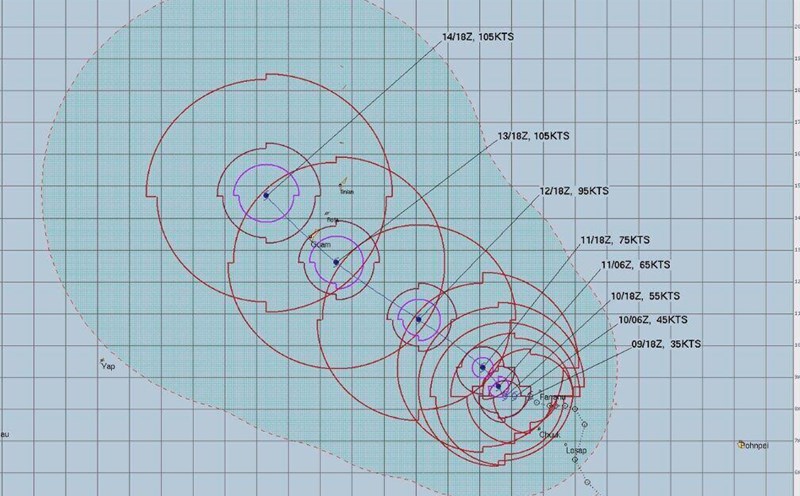
Storm forecasts show that this system may strengthen into a Category 3 or 4 storm as it approaches Guam island early next week. If this scenario occurs, the area may experience heavy rain over 300mm along with strong typhoon-level winds, even approaching super typhoons.

The mechanism of formation of a double storm originates from a strong and humid wind moving eastward at low latitudes. When encountering the equator, this air flow is "divided in half", forming two symmetrical monsoons. Under the influence of the Coriolis effect, the two storms will rotate in opposite directions - a typical feature of this phenomenon.
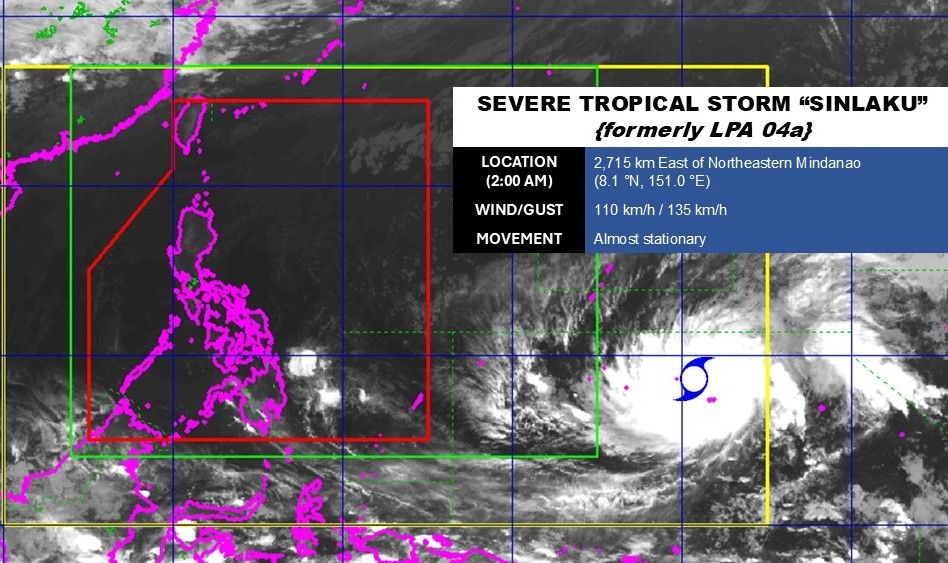
Vị trí tâm bão Sinlaku lúc. Ảnh: PAGASA
Location of Typhoon Sinlaku's center at 2:00 AM on April 11, 2026. Photo: PAGASA

According to experts, strong winds related to this pair of storms may contribute to promoting the formation of El Nino this year. Western winds will push warm water masses from the central Pacific region eastward, towards the South American coast - an important starting step of the El Nino process.

As warm water spreads in the eastern Pacific, more thunderstorms will form, leading to an increase in winds from the west. This process creates an amplified loop - called Bjerknes feedback - making El Nino increasingly strong and difficult to reverse.

History has recorded the role of storms in strengthening El Nino. Before El Nino 1997-1998, a series of major storms in both hemispheres contributed to creating unusually strong west winds. Similarly, in 2015, major storms in the Pacific also contributed to amplifying "super El Nino" causing global weather fluctuations.

In the current context, although there are no signs of direct impact on the East Sea, experts warn that this region is unlikely to stand outside climate fluctuations if El Nino forms and strengthens. This means the risk of increased heat, changing rain distribution and the storm season may become more complicated in the coming months.

Khánh Minh
RELATED NEWS

El Nino forecast overwhelms storm season 2026, more oceans emit unpredictable signals

|

The first forecast for the 2026 hurricane season has been announced and the mark of El Nino is clearly present.

Typhoon Sinlaku: Forecast of peak time, the first mainland area to be directly affected

|

Typhoon Sinlaku is heading towards the time of reaching maximum intensity, Guam and the Northern Mariana Islands are forecast to be in the earliest dangerous zone.

Typhoon Sinlaku forms, could become the strongest storm since the beginning of the season

|

Typhoon Sinlaku may strengthen into a strong typhoon of level 3 or 4 with winds of about 193 km/h when approaching Guam Island on the night of 13 or 14. 4.

24,000m2 of resettlement land left vacant, wasted

|

Hanoi - Tens of thousands of square meters of resettlement land are being left vacant for many years due to mechanisms, procedures and lack of market appeal.

Gold price today 11. 4: SJC gold bars and gold rings simultaneously decrease

|

Gold price today April 11th slightly decreased in both SJC gold bars and gold rings, while world prices edged up. High buying and selling spreads increase investment risk.

Number of students suspected of food poisoning in Ho Chi Minh City increases to 184

|

Ho Chi Minh City - As of the morning of April 11, there were 184 cases of suspected food poisoning at Binh Quoi Tay Primary School, coming for examination and treatment at 5 medical facilities.

US President admits it is not easy to open the Strait of Hormuz

|

US President Donald Trump admits opening the Strait of Hormuz is not an easy task in the context of escalating regional conflict.

Real Madrid drops important points in La Liga

|

In the early morning of April 11 (Vietnam time), Real Madrid was held to a 1-1 draw by Girona in La Liga and faced the risk of Barcelona widening the gap in points.

El Nino forecast overwhelms storm season 2026, more oceans emit unpredictable signals

Thanh Hà |

The first forecast for the 2026 hurricane season has been announced and the mark of El Nino is clearly present.

Typhoon Sinlaku: Forecast of peak time, the first mainland area to be directly affected

Thanh Hà |

Typhoon Sinlaku is heading towards the time of reaching maximum intensity, Guam and the Northern Mariana Islands are forecast to be in the earliest dangerous zone.

Typhoon Sinlaku forms, could become the strongest storm since the beginning of the season

Thanh Hà |

Typhoon Sinlaku may strengthen into a strong typhoon of level 3 or 4 with winds of about 193 km/h when approaching Guam Island on the night of 13 or 14. 4.