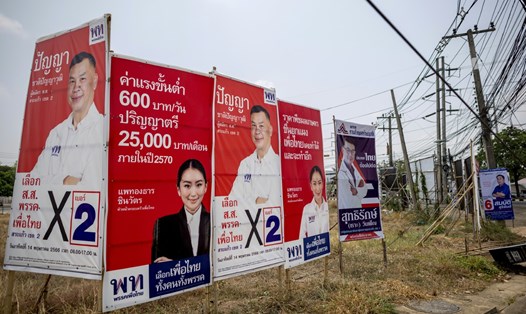
The upcoming Thai election on February 8th is showing significant changes in the voting behavior of rural voters in this country, especially in the northeastern provinces, a region that is a traditional stronghold of the populist Pheu Thai party backed by former Prime Minister Thaksin Shinawatra.
For decades, Pheu Thai has almost dominated the agricultural province of Ubon Ratchathani and neighboring localities. However, the influence of the party backed by Mr. Thaksin is weakening as more and more voters are shifting to support well-known local individual candidates, instead of being loyal to one party.
According to a survey conducted by Khon Kaen University in January, Pheu Thai currently has a support rate of 30.1% in this region, behind the People's Party, the leading force nationwide. Prime Minister Anutin Charnvirakul's conservative Bhumjaithai Party ranks third with 27.2%.
In the 2023 election, Pheu Thai won 73 out of 133 seats in direct polling districts in 20 northeastern provinces of Thailand, home to about 4 million out of a total of 8.56 million registered farmers nationwide.
Many Pheu Thai candidates from the 2023 election to now have maintained support, reflecting the "sponsoring political network" that this party has built. However, some candidates have switched to other parties, especially after Mr. Thaksin's daughter - Ms. Paetongtarn Shinawatra - was dismissed from the position of prime minister for ineffectively handling border tensions with Cambodia.
Mr. Thaksin is serving a prison sentence in a non-related case. At the same time, the wave of nationalism rising in Thai politics has further weakened Pheu Thai's position. This party has also faced much criticism for failing to implement the financial support promised when it came to power in 2023.
Ms. Pinittaya - a rubber farmer - said she is considering supporting the ruling Bhumjaithai party, not because of its guidelines or policies, but because she has sympathy for the local candidate - a former Pheu Thai MP who just transitioned to the party. "I choose candidates. The party is no longer as important," she said.
Six other farmers interviewed in Ubon Ratchathani and a neighboring province also expressed similar views. This shows that agricultural communities are under heavy pressure from falling agricultural prices, rising costs and accumulated debts, gradually abandoning party loyalty, to place their trust in candidates they believe can directly help them.
However, not all rural voters have left Pheu Thai. At Ubon Ratchathani, Ms. Ubon Thanomsup (53 years old) - a cassava farmer - said that she can still continue to support the party she has been associated with for many years, mainly because of local candidates.