Under shifts of only a few millimeters per year, a giant crack is tearing Africa into two continents. Scientists say this slow process will eventually open up a completely new ocean on Earth.
According to new studies, Africa is gradually separating along the East African Rift (EAR), where the eastern part of Somalia is moving away from Nubia - the rest of Africa - to move towards forming a new ocean in the distant future.
This "separation" process takes place extremely slowly. On average, each year, the formations only move a few millimeters. It will take tens of millions of years for a gap wide enough for seawater to flood in, forming a complete ocean basin, to truly appear.
EAR originates from the Afar region in Ethiopia - one of the rare places in the world called the "intersection of three plates". Here, three large fault systems including the Ethiopian fault, the Red Sea and the Gulf of Aden meet, forming a Y-shaped structure.
Not only are the Somali and Nubian blocs separating, but both blocs are also gradually moving away from the Arab bloc in the north.
The East Africa fault system formed in the Miocene, about 25 million years ago. Currently, it stretches more than 3,500km, from the Red Sea to Mozambique.
The eastern branch runs through Ethiopia and Kenya, while the western branch bends through Uganda, Rwanda, Burundi to Malawi. This is considered the "lifeline" of Africa, still operating strongly.
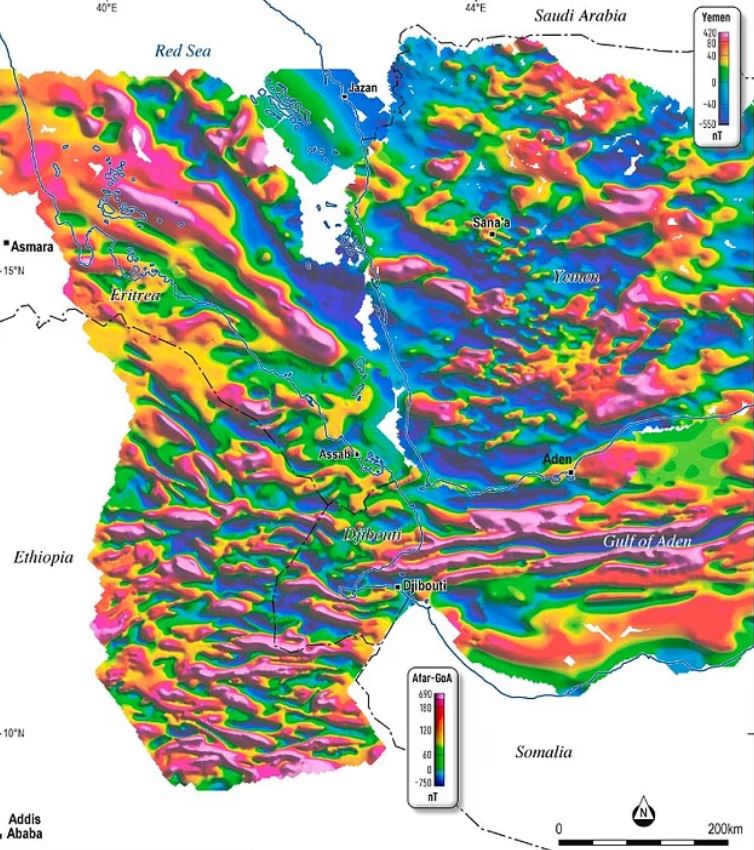
Notably, the Earth's crust in the Afar region has become unusually thin, in many places lower than sea level. The two "arms" of the broken system have submerged in the Red Sea and the Gulf of Aden.
Scientists believe that when the valley connecting these two regions sinks further, seawater will rush in, opening the way for the birth of a new ocean between two separate continents.
The expansion process takes place fastest in the north, so the new ocean will form there first" - geophysicist D. Sarah Stamps (University of Virginia Tech) said.
The Earth currently has about 15-20 large formations, floating on the melting mantis beneath. For a long time, geologists have believed that the Afar region is located on a "mantis column" - a stream of hot matter rising from deep underground, contributing to tearing apart the upper shell and promoting the process of continental separation.
Research published in the Journal of African Earth Sciences recently provided additional evidence of the magnetic structure of the Earth's crust in Afar, showing that Africa and the Arabian Peninsula were separated before, then the breakdown process spread deep into the African continent and has been maintained to this day.
Although the new ocean is still tens of millions of years away from humanity, short-term consequences such as earthquakes and volcanoes in East Africa could directly impact human lives right in the present.