
At first glance blue as a sapphire in the middle of the universe, this planet once reminded scientists of Earth. But behind that blue color is a real hell, where rain is not water but molten glass, blown across the sky by supersonic wind.
The planet named HD 189733b looks mesmerizingly beautiful from afar, but is classified as one of the harshest environments ever observed by humans. According to NASA, there are winds here with speeds up to 8,700 km/h - many times faster than any atmosphere system ever recorded in the Solar System.
HD 189733b is located about 64 light-years from Earth, in the constellation Vulpecula. This planet first attracted attention when NASA's Spitzer telescope discovered extremely high surface temperatures. Subsequent observations by the Hubble telescope revealed a sparkling blue atmosphere, making many people initially compare it to "Second Earth". However, that comparison was quickly rejected.
Unlike Earth, the blue color of HD 189733b does not come from water. NASA confirms that it is the result of clouds rich in silicate in the intensely heated atmosphere. These silicate particles diffuse blue light similar to how the Earth's sky reflects sunlight, creating an illusion of an ocean planet - although in fact, there is no liquid water at all.
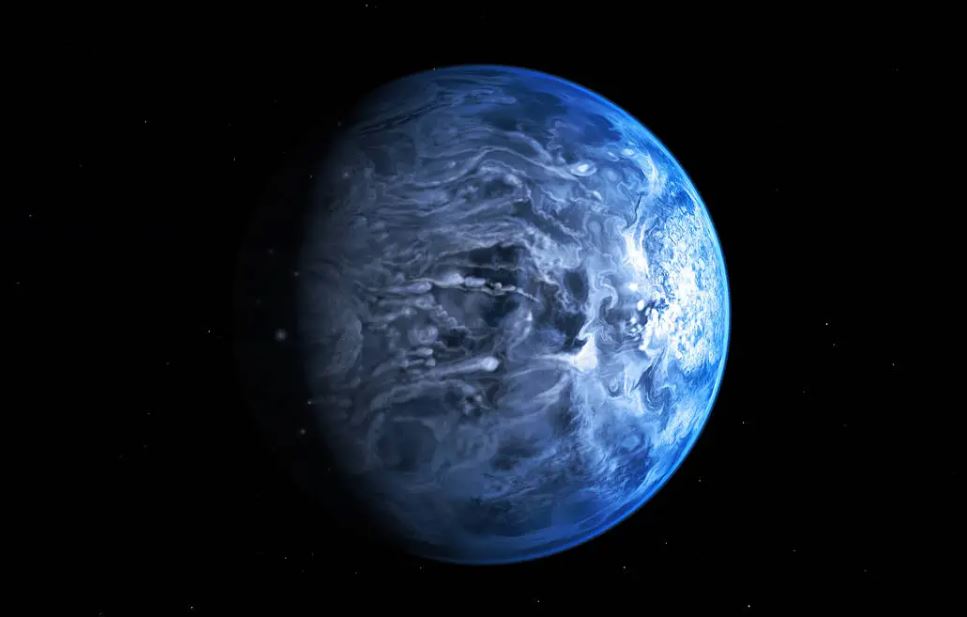
The temperature on the planet's day side is estimated to be about 1,093 degrees Celsius. Meanwhile, the night surface is significantly "cooler", creating a huge temperature difference - the main factor triggering unprecedented violent wind systems.
Observations by Hubble show that winds on HD 189733b can reach 8,700 km/h, fast enough to transport matter around the planet in just a few hours. NASA said this speed far exceeds all atmosphere records in the Solar System, where even the strongest storms are incomparable.
The combination of high temperatures, terrible wind speeds and chemical compounds in the atmosphere has created an environment likened to an interplanetary destructive whirlwind, where no structure or matter can last long.
If supersonic winds are not scary enough, HD 189733b is also famous for a bizarre weather phenomenon: Glass rain. In the hot atmosphere, silicate particles condense into tiny glass fragments, falling from clouds to the surface.
But unlike rain on Earth, these glass shards do not fall vertically. They are blown across by supersonic winds, rushing away at speeds of thousands of km/h. NASA once described that if it "hits rain" on this planet, it is not just an inconvenience, but "death by thousands of cuts".
Glass particles flying at such speed are powerful enough to tear apart any surface, whether metal or organic matter. This is considered one of the most dangerous and bizarre weather forms ever recorded by humans outside Earth.


