
The Bank of Australia - New Zealand (ANZ) has just strongly raised its gold price forecast for the second quarter, saying that this precious metal could reach 5,800 USD/ounce, significantly higher than the previous target of 5,400 USD/ounce.
The adjustment move took place in the context that gold prices are fluctuating around the 5,000 USD/ounce mark after leaving a record high of nearly 5,600 USD last month.
According to ANZ commodity experts, although recent fluctuations have raised questions about whether gold has peaked, the current price increase is "not ripe enough to reverse in the short term".
This bank believes that the current macroeconomic context is different from the deep correction cycles that took place after the peak of 1980 or 2011.
One of the key factors is the monetary policy outlook of the US Federal Reserve (Fed). ANZ forecasts that the Fed will cut interest rates at least twice this year, each time by 25 basis points, around March and June. As inflationary pressure cools down, the market is also considering the possibility of another wave of interest rate cuts at the end of the year.
The continued reduction in real interest rates is seen as a favorable environment for gold - an unprofitable asset. According to ANZ, this will support capital returning to precious metals in the context of investors seeking safe haven.
In addition, global geopolitical and economic instability is forecast to continue, including US President Donald Trump continuing to use tariffs as a tool to put pressure.
Not only US monetary policy, ANZ believes that the global financial system is undergoing a structural shift.
US Treasury bonds - once considered the safest asset in the world - are facing a problem of confidence as public debt rises sharply, concerns about the Fed's independence arise, and sanctions risks increase.
Investors therefore demand a higher level of risk compensation for long-term bonds, as shown by the increasingly widening yield difference.
ANZ believes that strategic allocation to gold remains appropriate until the geopolitical environment is more stable, US structural fiscal issues are addressed and the Fed's credibility is strengthened - things that are unlikely to be achieved soon.
Regarding supply and demand, this bank forecasts that the gold buying demand of central banks will continue to be strong until 2026. However, the main driving force this year is expected to come from private investment, especially gold-guaranteed exchange-traded funds (ETFs).
ANZ believes that capital inflows into gold ETFs may continue to increase, with total global holdings likely to exceed 4,800 tons this year.
In addition to Western markets that account for a large proportion, significant growth is expected from emerging economies such as China and India. Currently, the proportion of gold ETF holdings in these regions is only about 10% globally, showing that the room for expansion is still large.
According to ANZ, just minor adjustments in the portfolio structure - if geopolitical or political risks escalate - can also have a significant positive impact on gold prices.
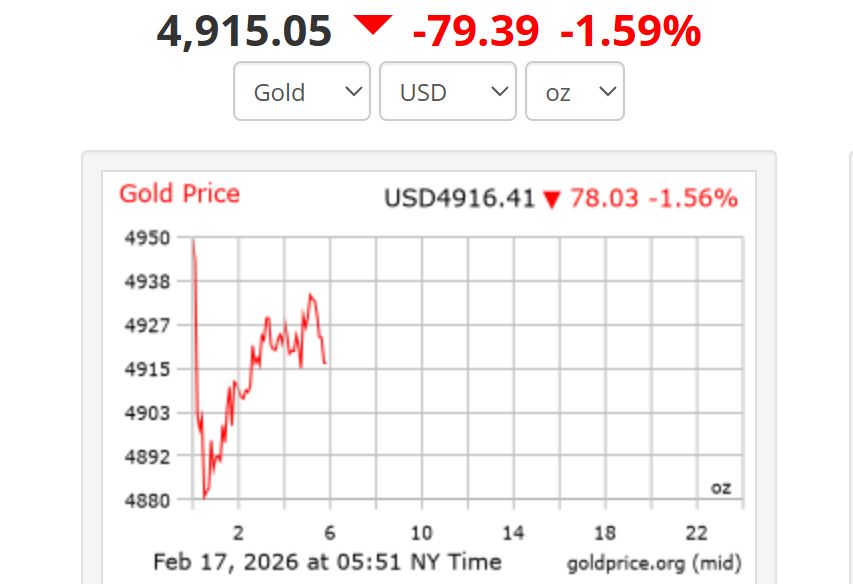
World gold price at 5:51 pm on February 17 Vietnam time traded at 4,915.05 USD/ounce, down 79.39 USD, equivalent to a decrease of 1.59%.
Regarding domestic gold prices in the Vietnamese market, SJC gold bar prices and Bao Tin Minh Chau 9999 gold ring prices before Binh Ngo Tet both traded around 178 - 181 million VND/tael (buying - selling), at 9:00 AM on February 15, 2026.


