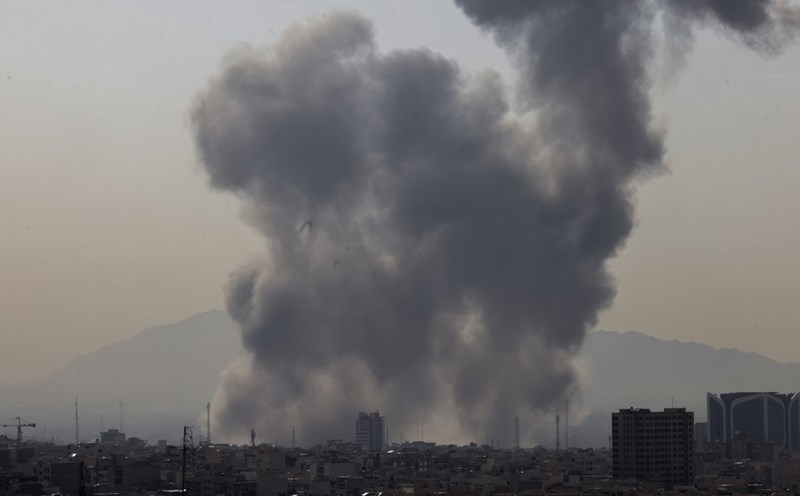
Iran's semi-official Tasnim news agency described the Hormuz Strait as basically closed, saying that the country's Revolutionary Guards warned ships that passing through Hormuz was unsafe. Subsequently, the German container shipping company Hapag-Lloyd AG announced a temporary suspension of transportation through Hormuz due to "official closure".
Traffic volume has decreased significantly after the Iranian attacks. Oil tankers are gathering both inside and outside the entrance to the strait. Oil tankers are stopping on both sides of the Hormuz Strait, with 3 ships temporarily stopping their journey out of the Persian Gulf and a small fleet of at least 8 oil tankers gathering in the past 2 weeks outside the Gulf of Oman. Some other ships have canceled trips midway while moving through this waterway route.
Despite reduced traffic flow, some oil and gas tankers seemed to continue their journey in the afternoon of February 28, according to ship tracking data compiled by Bloomberg. By 8 pm on February 28, London time, the automatic tracking system showed a large oil tanker leaving the Persian Gulf through the Strait of Hormuz and another ship passing in the opposite direction.
Hormuz is also a vital transit route for liquefied natural gas. According to ship tracking data, at least 3 ships carrying gas to or from Qatar have temporarily stopped their journey to avoid passing through this route.
Qatar is the second largest LNG exporter in the world, accounting for about 20% of global supply last year, and its shipments are required to pass through the straits to reach customers in Asia and Europe.
The US has warned transport ships that ships in the area should keep a distance of 30 nautical miles from its military assets.
Japan's Nippon Yusen KK group previously asked the group's fleet not to pass through the Strait of Hormuz, while Greece asked its giant merchant fleet to re-evaluate its passage. A ship owner said they understood the US recommendation to close this waterway route.
A warning from the Greek Ministry of Maritime also requires ships to be ready to use conventional positioning methods, not to use electronic devices, citing the risk of wave interference when passing through this area.
The Strait of Hormuz is very important for oil and gas flows. Traffic disruptions strongly affect from crude oil tankers to container ships carrying furniture. The Strait of Hormuz is a strategic maritime route with an energy market, with about 1/5 of the world's crude oil and liquefied natural gas transported by sea passing through here every day.
It is not yet clear how long the disruption will last, and some ships continue to pass through this strait but much less than usual.
However, prolonged disruptions will strongly impact global oil trade. Futures markets closed on Saturday and Sunday, reducing the ability to grasp how traders actually value risks. However, a retail trading product operated by IG Group quoted West Texas Intermediate oil as 8% higher on the evening of February 28, London time.