
World gold prices continue to form an upward trend in recent sessions as the global financial market closely follows interest rate developments in the US. The focus is on the yield of 10-year US government bonds - an important measure reflecting monetary policy expectations and risk appetite.
Real developments show that gold prices are tending to closely follow interest rates. When interest rates slightly decrease, precious metals have more pushing power to go up. Conversely, each increase in interest rates creates adjustment pressure. This relationship is becoming the main dominant factor, instead of traditional shelter factors.
Notably, the 10-year US yield is currently seen as a "risk appetite measure". When interest rates cool down, cash flow tends to shift to assets like gold. However, recent developments are paradoxical: Gold does not fully react as a safe-haven asset, but is more influenced by fluctuations in interest rates and cash flow in the bond market.
An important reason comes from the geopolitical context, especially tensions in the Middle East related to the US-Iran conflict. Fluctuations related to conflict and ceasefire negotiations are making the financial market more sensitive, overshadowing the traditional role of gold in the short term.
In terms of technical levels, the 5,000 USD/ounce threshold is gradually becoming a major psychological target for the market. This is a price range that has repeatedly played the role of support and resistance, so it is of special significance to investors. If the upward momentum is maintained, the possibility of gold prices reaching this level is a noteworthy scenario.
In the opposite direction, the 4,600 USD/ounce zone is considered an important support "floor". Every time the price adjusts to this area, bottom-fishing buying power tends to appear, further strengthening the upward outlook in the medium and long term.
However, risks still exist when the market is affected by many unpredictable variables. Interest rate developments, bond market trends and especially the Middle East situation will continue to be the main driving factors. Information related to ceasefire negotiations or escalating conflicts can cause gold prices to fluctuate sharply in the short term.
Overall, the long-term trend of gold prices is still positively assessed in the context of interest rates showing signs of cooling down. However, in the short term, the market is likely to continue to fluctuate according to the fluctuation of US interest rates, instead of playing a traditional shelter role as before.
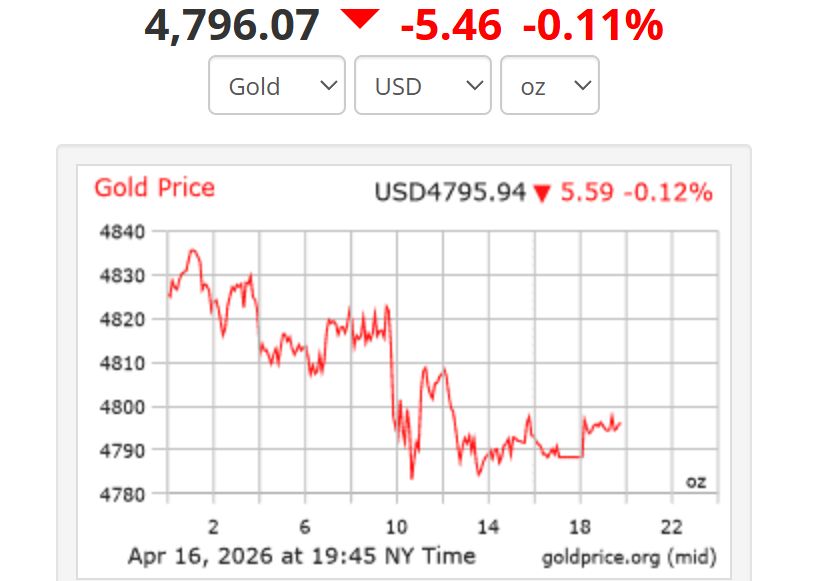
World gold price at 6:45 AM on April 17 Vietnam time traded at 4,796.07 USD/ounce, down 5.46 USD, equivalent to 0.11%.
Regarding domestic gold prices in the Vietnamese market, SJC gold bar prices are traded at 167.7 - 171.2 million VND/tael (buying - selling). Bao Tin Minh Chau 9999 gold ring prices are traded at 167.5 - 170.7 million VND/tael (buying - selling).


