Greenland reveals worrying "Achilles' heel

Song Minh |

Below the kilometers-thick ice blocks of Greenland, a "deadly weakness" is silently promoting the melting process faster than expected.

For decades, scientists have believed that the giant icebergs of Greenland mainly slide on hard rocks, helping to partially curb the speed of ice flowing into the ocean.

However, a new discovery is forcing researchers to look back at this assumption. Earthquake data shows that under many ice areas of Greenland there are soft sediment layers, up to about 200m thick - a factor that could cause the ice to slide much faster.

This discovery is of particular importance, because Greenland is currently one of the largest contributors to global sea level rise. As long as the melting speed of ice increases over a long period of time, the consequences for coastlines around the world can be very serious.

The study was conducted by a scientific team at the University of California, San Diego (UCSD), led by researcher Yan Yang. Instead of drilling through kilometers of ice - an extremely costly and complex option - the team took advantage of seismic waves emitted from large earthquakes far away.

When these waves spread across the Earth, enter Greenland, penetrate the ice layer and reach the bottom, they leave very small "time marks". Earthquake detectors placed on the ice surface record the delay of waves, thereby allowing scientists to determine whether the material beneath the ice is hard rock or soft sediment.
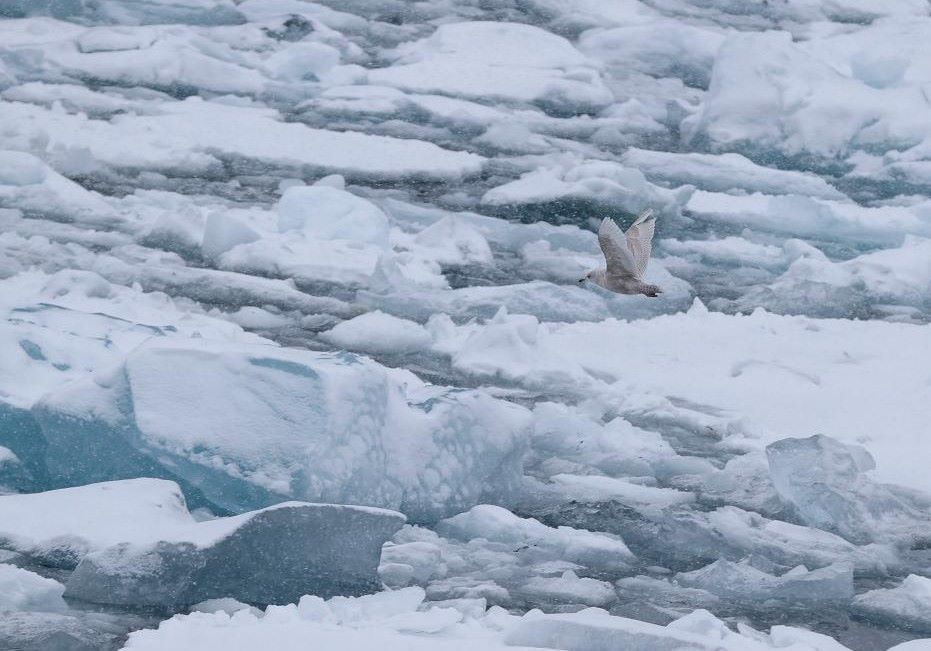
Duoi nhieu khu vuc bang cua Greenland ton tai nhung lop tram tich mem, day toi khoang 200m. Anh: Xinhua
Under many ice areas of Greenland, there are soft sediment layers, about 200m thick. Photo: Xinhua

Data analysis from 373 seismic stations across Greenland shows that in many areas, especially at the border between ice and soil, there exists a layer of material with low wave velocities - a typical sign of soft sediment.

It is noteworthy that these sediment layers are not only located near the coast, where ice usually melts quickly, but also appear deep inland, under seemingly stable ice areas.

This "irregular" distribution worries scientists, because strong ice flows at the outlets can be energized from areas inside, where the surface is less volatile but the ice bottom is very prone to slippage.

Not all areas under the Greenland ice are in the same heat state. Ice thawed areas often coincide with thicker and softer sediment layers.

However, the study also found soft sediment pockets located in areas that the thermal model believes are still frozen, suggesting that geological conditions and local temperatures may vary very complicatedly.

According to estimates, Greenland contributed more than 1cm to the global sea level in the period 1992-2018. This number could increase rapidly if the "Achilles' heels" under the ice continue to have an impact in the context of global warming.

Scientists believe that, to narrow that uncertainty, it is necessary to expand the seismic observation network and closely combine it with satellite data on ice melting speed. Only by understanding the ice of Greenland can humans more accurately predict the future sea level and the risks that coastal communities are facing.

Song Minh
RELATED NEWS

Greenland is getting hotter, Denmark is more worried about Russia than the US

|

While Greenland is returning to the geopolitical focus, the Danish Commander declared that the focus of defense is to deal with Russia, not the US.

Greenland heats up again: France leads Europe in warning of retaliation against Trump

|

Regarding Greenland, the French President declared that Europe will have a coordinated response to Mr. Trump's tax threats to 8 NATO countries.

Greenland and the new verbal war on Russia's intentions

|

Greenland became the focus of controversy as Russia denied all US accusations of "intentions" to seize control of the island.

School spreads the meaning and spirit of the 14th Party Congress

|

From high schools to university lecture halls, many practical activities are being implemented synchronously, contributing to spreading the spirit and meaning of the country's important political event.

Effectively mobilizing resources, promoting potential and advantages - The driving force for Ca Mau to develop quickly and sustainably in the new era

|

In the atmosphere of excitement and belief of the entire Party, people and army, we are heading towards the 14th National Party Congress - a major political event, a historical milestone opening the era of national development and rise, today (January 20), in Hanoi Capital, the Congress enters the second working day with important agenda items.

Building a strong working class, contributing to the prosperous and happy development of the country

|

Building a strong working class is identified as an important requirement, contributing to the aspiration to develop a prosperous and happy country.

Ukraine deploys new air defense system

|

Ukrainian President Volodymyr Zelensky announced a new air defense system using interceptor drones.

Hanoi Police patrol overnight, ensuring security during the 14th Congress

|

Hanoi - Functional forces strengthen night patrols and controls, ensuring security, order, and traffic safety during the 14th Party Congress.

Greenland is getting hotter, Denmark is more worried about Russia than the US

Song Minh |

While Greenland is returning to the geopolitical focus, the Danish Commander declared that the focus of defense is to deal with Russia, not the US.

Greenland heats up again: France leads Europe in warning of retaliation against Trump

Khánh Minh |

Regarding Greenland, the French President declared that Europe will have a coordinated response to Mr. Trump's tax threats to 8 NATO countries.

Greenland and the new verbal war on Russia's intentions

Song Minh |

Greenland became the focus of controversy as Russia denied all US accusations of "intentions" to seize control of the island.