
NASA said a newly discovered asteroid, designated 2025 PN7, is maintaining a rare orbital relationship with Earth and may continue to "follow" our planet for the next 50 years. Such objects are often called mini-moons, or mini-lunars.
2025 PN7 was discovered in August 2025 by the Pan-STARRS survey system in Hawaii and quickly confirmed by international observation stations. According to NASA's Center for Near-Earth Object Research (CNEOS), this is a quasi-satellite, i.e. half-satellite of Earth.
Unlike the Moon - the only natural satellite of Earth, the minor moons are not "bound" by the gravity of the blue planet. In fact, 2025 PN7 still orbits the Sun, but has an orbital cycle that almost coincides with Earth. This synchronization makes it, when observed from Earth, look like it is orbiting our planet.
According to published orbital data, 2025 PN7 has an estimated diameter of about 19m. The large radius of the orbit is about 1.003 astronomical units, eccentricity 0.1075 and inclination less than 2 degrees.
These parameters create an orbit almost parallel to Earth around the Sun, helping the object maintain its proximity for decades.
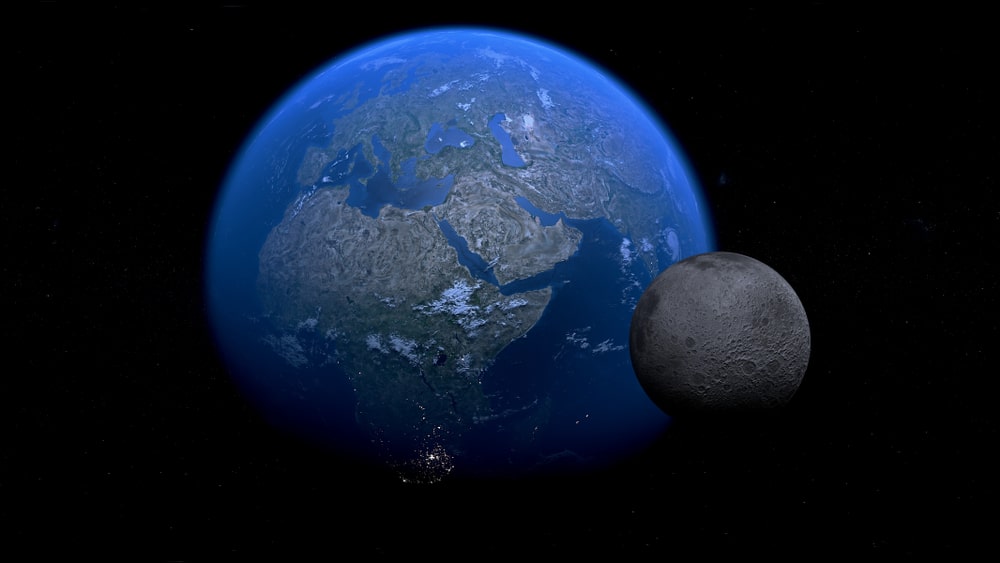
The closest approach distance between this sub-Moon and Earth is about 360,000 km - equivalent to the distance from Earth to the Moon. Although it sounds close, NASA claims there is no risk of collision.
With a absolute brightness of 26.36, 2025 PN7 is a small and quite faint object, only observable with specialized telescopes.
The noteworthy point of 2025 PN7 is not its size, but its long-term orbital stability. Scientists say this object is in a state of dynamic resonance with the Earth - a rare dynamic phenomenon in which two gravitationally attracting objects pass back and forth in a regular cycle but do not fall into a real satellite relationship.
Sub-Moons like the 2025 PN7 are of particular interest to scientists because they help verify predictive movement models of near-Earth objects.
This is also a "natural laboratory" for studying small but important forces, such as the Yarkovsky effect - the change in orbit due to heat radiation from the asteroid surface.
Not only of academic value, semi-satellites are also considered potential targets for future space missions. Thanks to their stable orbit and relatively slow speed compared to Earth, they are suitable for near-access flight tests, spacecraft navigation, or even sampling missions at lower costs than many other asteroids.
With 2025 PN7, many physical characteristics such as surface composition, shape or rotation speed have not yet been determined. NASA said it will continue to monitor this object in the near future, as observation conditions remain favorable.
Each newly collected data will help people better understand Earth's "silent companion" - and about the space environment near our planet itself.


