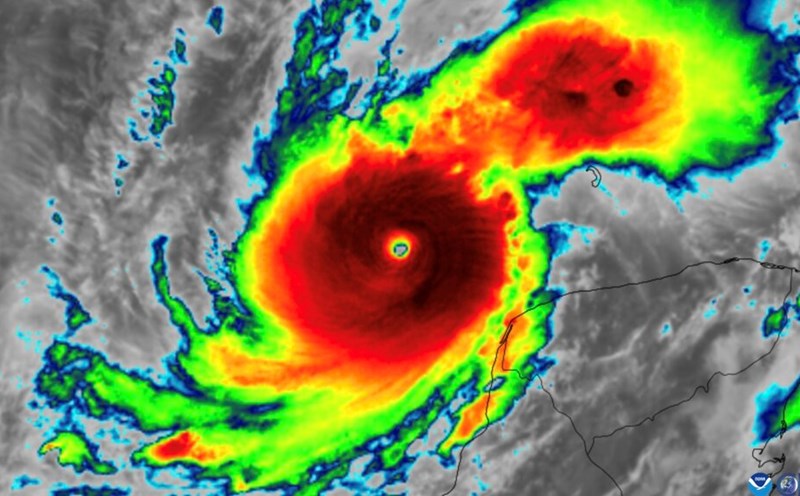
The New York Times' latest storm news said that in just a few hours on October 7, Hurricane Milton increased from level 1 to level 5, the strongest level on the Saffir-Simpson scale - a scale that classifies storms based on wind speed.
Milton became a tropical storm on the afternoon of October 5 and became a Category 1 hurricane around 2:00 p.m. ET on October 6. The storm remained a Category 1 hurricane until the early morning of October 7.
According to the storm report at 5:00 a.m. on October 7 from the US National Hurricane Center, the storm has strengthened into a category 2 hurricane.
Just two hours later, the US National Hurricane Center said Milton had become a Category 3 hurricane, with winds of 120 mph.
By about 9 a.m. the same day, Milton had strengthened into a category 4 hurricane.
By noon on October 7, Milton had officially strengthened into a Category 5 super typhoon, with winds of 257 km/h, according to data from the US Air Force Reserve Hurricane Hunters.
Milton's wind speeds increased by 90 mph in 24 hours. Only two hurricanes have intensified faster than Milton: Hurricane Wilma in 2005 and Hurricane Felix in 2007, according to the U.S. National Hurricane Center's Atlantic hurricane season database.
At 8 p.m. on October 7, the storm's maximum sustained wind speed increased to 290 km/h, making Super Typhoon Milton one of the strongest Atlantic hurricanes ever.
Based on wind speeds, Milton could rival the strongest Atlantic hurricane ever recorded: Hurricane Allen of 1980, named Allen, which had peak winds of 195 mph before making landfall along the US-Mexico border.
As a compact system, however, Hurricane Milton is more similar to Hurricane Wilma of 2005. Wilma holds the record for lowest pressure in a hurricane — another measure of a storm's intensity.
Milton's small size, extremely warm waters in the Gulf of Mexico and calm atmospheric conditions allowed it to "explode," as hurricane center forecasters noted in an update early on the afternoon of October 7.
Hurricane Rita, which hit Louisiana with winds of 180 mph in 2005, caused extensive damage. Rita delivered a devastating blow despite weakening to a Category 3 storm before making landfall. This is the likely scenario for Milton as it approaches Florida.
According to the latest hurricane forecast from Colorado State University hurricane expert Phil Klotzbach, Hurricane Milton will stop intensifying at some point through an eyewall replacement cycle.
The 5 hurricane levels on the Saffir-Simpson wind scale include:
Category 1: 119-153km/h. Category 1 hurricanes are considered very dangerous and are expected to cause some damage to power lines and poles.
Category 2: 154-177km/h. These wind speeds are expected to cause major damage.
Category 3: 178-208km/h. Storm damage is expected to be extensive at this level. Trees may be snapped and uprooted, and power and water supplies may be disrupted.
Category 4: 209-251km/h. Officials warn of catastrophic damage with a Category 4 storm.
Level 5: 252km/h or higher. Roof and wall damage or collapse expected. Extended power outages expected.