
On August 29 (local time), according to the Chinese Ministry of Irrigation, one of the two bottlenecks formed after the landslide on August 26 in the Nepal - China border area is draining itself and has basically dried up. This development helps reduce the risk of lake breaches, but functional forces are still monitoring other water storage areas upstream.
The lake formed after a large amount of ice, soil, rocks and landslide material blocked the river, forming a natural dam. In the early days, water continued to pour in, causing the lake to be at risk of overflowing or breaking the barrier block, threatening to create another flood downstream area.
According to updates from the Chinese Ministry of Irrigation on the evening of August 29, water in the lake is naturally draining out and the lake has basically dried up. This agency continues to use monitoring data and models to monitor water volume, flow developments and the risk of new bottlenecks in upstream.
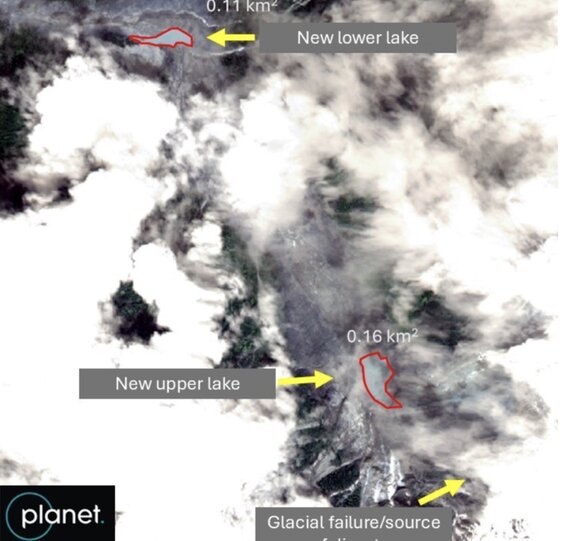
However, the remaining lake, another low-lying area containing water, still exists near the landslide area. Water continues to accumulate here, with water volumes reaching millions of cubic meters. Chinese authorities are monitoring the possibility that the low-lying area will continue to be full of water, overflowing the blocking area or creating a new flow downstream.
According to the US Geological Survey (USGS), the flood on August 26th likely started from a rapid landslide involving a glacier in Langtang National Park, Nepal, near the Chinese border. The flow of rocks and water then moved nearly 100km along the Lende Kholā and Trishuli Kholā rivers, causing widespread damage.
Analysis by the US Geological Survey (USGS) shows that the landslide created a seismic signal equivalent to a magnitude 5.2 earthquake. About 3 hours later, a second seismic signal, equivalent to a magnitude 4.2 earthquake, was recorded. The USGS is using satellite images to map the flooded area and the area affected by the mud and rock flood.
Currently, rescue work in the border area is still facing many difficulties due to rain and cut off terrain. According to updated data as of the evening of August 29, 682 people have died in Nepal and China, and nearly 3,000 people are still missing.
Chinese authorities continue to maintain rescue forces in the Gyirong area, while monitoring rain, water levels and currents to promptly respond if unusual developments occur.


