
The People's Bank of China has just increased its gold reserves for the 13th consecutive month.
According to data released on December 7, the People's Bank of China (PBOC) continued to add gold reserves in November. Gold holdings increased by 30,000 ounces, bringing total reserves to about 74.12 million ounces. The buying cycle started in November 2024 and shows no signs of stopping.
This move comes as world gold prices have consolidated firmly above $4,200/ounce. With a strong increase this year, gold is on track to record its best year of price increase since 1979.
According to the World Gold Council (WGC), central banks' gold purchases have increased since October after a period of stagnation in the middle of the year. This trend was strongly promoted after Russia was frozen on foreign exchange reserves and the West increased sanctions, making gold a protective against geopolitical risks and dependent on the USD.
China, in an ambition to increase global financial influence, even invited foreign central banks to deposit gold in its reserves. Cambodia is one of the first countries to accept the offer.
Krishan Gopaul, senior expert at the WGC, said October was the strongest period of gold purchases since the beginning of the year by central banks. Total purchases reached 53 tons, up 36% compared to September.
However, purchasing activities are mainly concentrated in a few countries.
The National Bank of Poland bought 16 tons after a break in May, bringing its reserves to 531 tons, equivalent to 26% of total reserves.
Brazil continues to buy for the second consecutive month, an additional 16 tons after buying 15 tons in September.
Central banks of Uzbekistan (9 tons), Indonesia (4 tons), Turkey (3 tons), Czech Republic (2 tons), Kyrgyzstan (2 tons), Myanmar (over 1 ton), China (over 1 ton), Kazakhstan (over 1 ton) and the Philippines (over 1 ton) also stepped up gold accumulation in October.
Russia's gold reserves have hit a new record, estimated by the Russian Central Bank to be up to 310 billion USD as of early December. The WGC said Russia is currently the world's fifth largest gold consumer, behind only the US, Germany, Italy and France.
In the first 10 months of 2025, the net gold purchases of central banks reached 254 tons.
The 2025 WGC survey results show that 95% of central banks expect global gold reserves to continue to increase next year, strengthening the trend of shifting to safe-haven assets in the context of prolonged economic and geopolitical instability.
The National Bank of Serbia aims to increase gold reserves to at least 100 tons by 2030, nearly double the current level. Japan and South Korea also said they are considering increasing their gold holdings, although they have not yet released a specific roadmap.
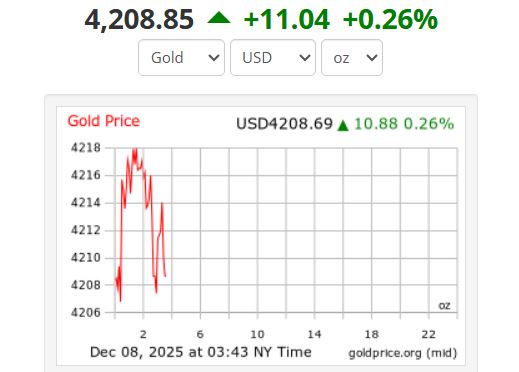
The world gold price at 3:43 a.m. New York (15:43 a.m. Vietnam time) on December 8 was trading at 4,208.85 USD/ounce, up 11.04 USD, equivalent to 0.26%.
Regarding domestic gold prices, SJC gold bar prices at 9:00 a.m. on December 8 traded around 153 - 154.5 million VND/tael (buy - sell). The price of 9999 Bao Tin Minh Chau gold rings is trading around 150.8 - 153.8 million VND/tael (buy - sell).
Increased demand for shelter will promote fluctuations in gold prices
Investment institutions point out that gold prices this week will depend largely on economic news from central banks. Australia, Canada, the US and Switzerland all make interest rate decisions, although only the US is expected to adjust key interest rates.
FP Markets expert Aaron Hill assessed that the upcoming trend depends heavily on whether the Fed continues to cut interest rates or not and the global economic situation. He said that for gold to re- hit a historical peak, the market needs to simultaneously have factors such as sharp interest rates, a weak USD and increased safe-haven demand.


