
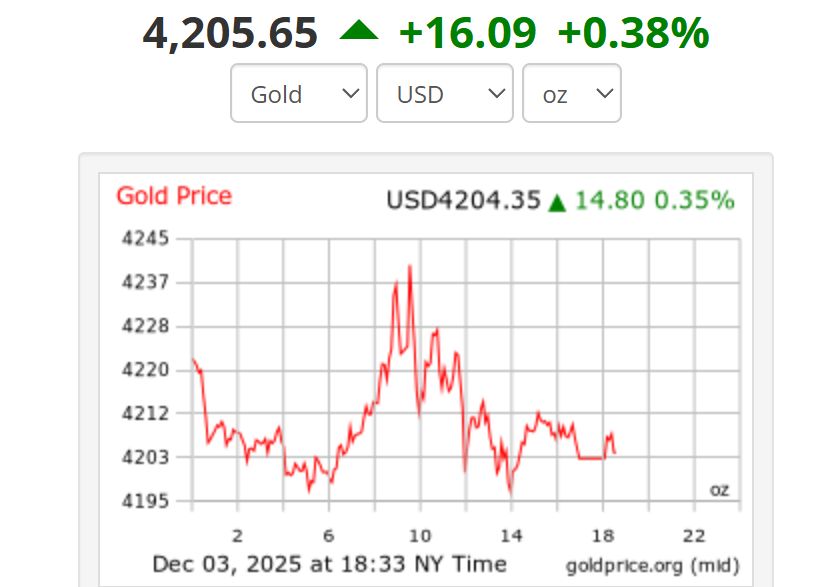
World gold prices opened in December with a solid increase after a period of adjustment in November. The trading session on December 3 recorded prices fluctuating around $4,200/ounce - the resistance zone that analysts considered an important test before the market reached the historical peak of nearly $4,400 set in October.
Although it has not been able to overcome this barrier, technical indicators show that gold is accumulating to prepare for a stronger uptrend.
Expert Marek Rogalski (BossaFX) explained that, in the context of the market starting to price the possibility of the Fed cutting interest rates on December 10, the uptrend is still the main one and "the new peak is only a matter of time".
Technical analysis shows 2 main target thresholds in the uptrend:
5,000 USD/ounce: A psychological mark, and at the same time a gold price forecast for many major financial institutions.
5,700 USD/ounce: This is considered an "ideal" technical target for the next breakthrough.
However, according to analysts, the above targets are still a cautious version. Some systematic risks could cause gold to be completely revalued.
Two scenarios that can push gold prices up to 6,000 - 10,000 USD
In the report Outrageous Predictions 2026 (Se la du doan 2026), UK bank Saxo Bank pointed out two extreme but feasible events that could change the way the market prices gold.
Scenario 1: Q-Day - quantum computers break security, gold skyrockets to 10,000 USD/ounce.
Neil Wilson, market strategist at Saxo Bank, warned about the time when a quantum supercomputer strong enough to break the current cryptography layers. At that time, confidence in digital assets, banking systems and online transactions was seriously shaken.
Bitcoin could fall to near zero as its security infrastructure is disabled. The money flow panicked to find physical shelter, not depending on encryption.
In this scenario, gold prices could soar to $10,000 an ounce, becoming a passwordless asset that is safeest when confidence in digitalization collapses.
Scenario 2: China issues Gold yuan, pushing gold above $6,000/ounce
Another forecast from Saxo Bank shows the possibility of Beijing using gold to secure a version of the commercial yuan to challenge the leading position of the USD.
A gold-backed currency will strongly attract emerging economies. The global financial system must re-evaluate gold as a basic asset.
As a result, gold prices could rise above $6,000 an ounce, as central banks across the country's demand for gold accumulation spikes.
Why is gold so explosive in 2026?
There are 3 factors considered "fuel" for the gold price increase trend in 2026: Expectations of the Fed lowering interest rates, weakening the USD in 2026; increasing geopolitical risks and the decentralization of the supply chain; confidence in digital assets stagnates, causing investors to find physical collateral assets.
In this context, the 4,400 USD area becomes a key threshold. If it is broken, the goal of 5,000 - 5,700 USD will open up, and the two extreme scenarios mentioned above can push gold much further.
The world gold price at 6:33 a.m. on December 4, Vietnam time, was trading at 4,205.65 USD/ounce, up 16.09 USD, equivalent to an increase of 0.38%.
Regarding domestic gold prices, SJC gold bar prices are listed around 153 - 154.5 million VND/tael (buy - sell). The price of 9999 Bao Tin Minh Chau gold rings is trading around 150.8 - 153.8 million VND/tael (buy in, sell out).
Gold prices may be affected in the short term
New developments related to the peace plan for the Russia-Ukraine conflict and other geopolitical information often affect safe-haven cash flow and may affect gold prices in the short term.
In some other countries such as Singapore or Japan, gold is currently being sold at or above the standard price of about 2.5 USD/ounce. The widespread high gold price, combined with the trading disruption at CME Group in the US, is making the Asian gold market cautious, although gold is forecast to continue to increase in the long term, thanks to expectations that the US Federal Reserve (Fed) will cut interest rates in December.


