
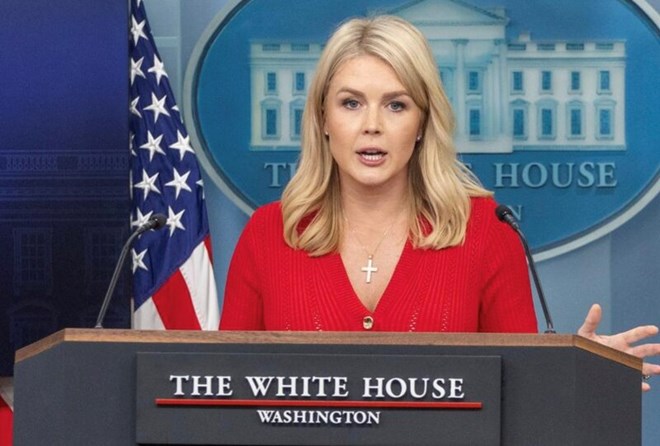
In an interview with Fox News on March 8, White House spokeswoman Karoline Leavitt said that sending infantry into Iran is not yet planned. However, she emphasized that President Trump is still leaving open all options to be ready to respond to unpredictable fluctuations in the Middle East.
This statement was made in the context that international public opinion is focusing attention on the next step of the US after a series of airstrikes on Iran recently. The White House's lack of urgency in deploying troops on land shows efforts to curb conflict, avoiding getting bogged down in a prolonged conflict.
Previously, on February 28, the US-Israel coalition unexpectedly launched a large-scale military operation targeting Iran. Key cities, including the capital Tehran, have suffered many heavy attacks.
The White House gave the reason for this action as aimed at eliminating threats from the nuclear and missile programs that they accuse of originating from Tehran. Notably, airstrikes killed Iranian Supreme Leader Ali Khamenei and many key figures in Iran's leadership apparatus.
In response, the Iranian Islamic Revolutionary Guard Corps (IRGC) announced the deployment of a widespread retaliatory operation. A series of US facilities and targets as well as allies in Bahrain, Jordan, Qatar, Kuwait, UAE and Saudi Arabia were attacked by missiles and unmanned aerial vehicles.
The rapid escalating conflict in the Middle East has raised concerns about a full-scale war with the participation of infantry, which could plunge the region into decades of instability.

The fact that the Trump administration has not yet outlined a plan to send infantry into Iran at this time shows a strategic calculation to avoid the "rut" of past muddy wars. Instead, the US seems to be prioritizing air power and long-range strikes to weaken the enemy's military capabilities without having to trade too many American soldiers' lives on the ground.
However, Ms. Leavitt's message about being ready for all scenarios is still a harsh warning to Tehran. Experts say that if the IRGC's retaliation strikes cause heavy casualties to US forces in the Gulf, the boundary between an air campaign and a full-scale ground offensive will become more fragile than ever.


