
A very long journey
Vietnamese women's football has gone a long way. Looking back at history from the time it began to appear in the 1990s, it has been more than 3 decades. From the days of training on dirt to the peak of a ticket to the 2023 World Cup, that is a truly very long journey, not just long.
With the national women's football team - starting in 1997, the story of nearly 30 years has been progress and full of imprints. Before the 2023 World Cup were 8 SEA Games championships, 3 Southeast Asian championships, a record that men's football must be envious of. Vietnamese women's football has rapidly progressed to surpass Thailand, becoming the number 1 team in Southeast Asia.
It must be said that, despite the context of many difficulties, not being invested like men's football, but with the passion and qualities of Vietnamese women, Vietnamese women's football creates special imprints. Thanks to that, since 1999, the team has regularly participated in continental tournaments (AFC Women's Asian Cup) or Asian Games (ASIAD).
Over time, the results at the Asian tournament have also improved, with the peak being reaching the quarter-finals in 2022, and then winning a ticket to the World Cup through the play-offs. That achievement did not come naturally, but from the continuation of generations of persistent players and from the perseverance of women's football people.
Coach Mai Duc Chung once said after winning a ticket to the World Cup that Vietnamese female players "fought with everything they had". That is a compliment, but it also reflects the reality that Vietnamese women's football is rising mainly thanks to willpower.

Therefore, like many other fields, angles, and aspects of life, when the wave reaches its peak, it will crash down. The problem is that in countries with developed women's football, they also have other waves to continue. As for Vietnamese women's football, there is succession but it can only be called "waves".
Asia and the distant world
As a result, after failures in an overscale playground like the World Cup, where the gap in physical strength, speed and international competition experience is quite clear, a domino has appeared at the 2025 Southeast Asian Championship (third place), SEA Games 2025 (second place) and most recently the Asian Cup (eliminated from the group stage).
Looking at the FIFA rankings, Vietnamese women's football usually ranks around 35th in the world. This is not a low ranking, but there is still a gap compared to strong teams in Asia. Japan, North Korea, Australia, China, and South Korea are often in the Top 20 strongest teams in the world. They not only have strong teams but also possess a system of professional tournaments, well-trained academies and a stable playing environment.
Expert Doan Minh Xuong assessed: "Watching Japan, North Korea, China, Australia play, we are still far away". The gap is not in a few matches but in the gap of an entire women's football development system.
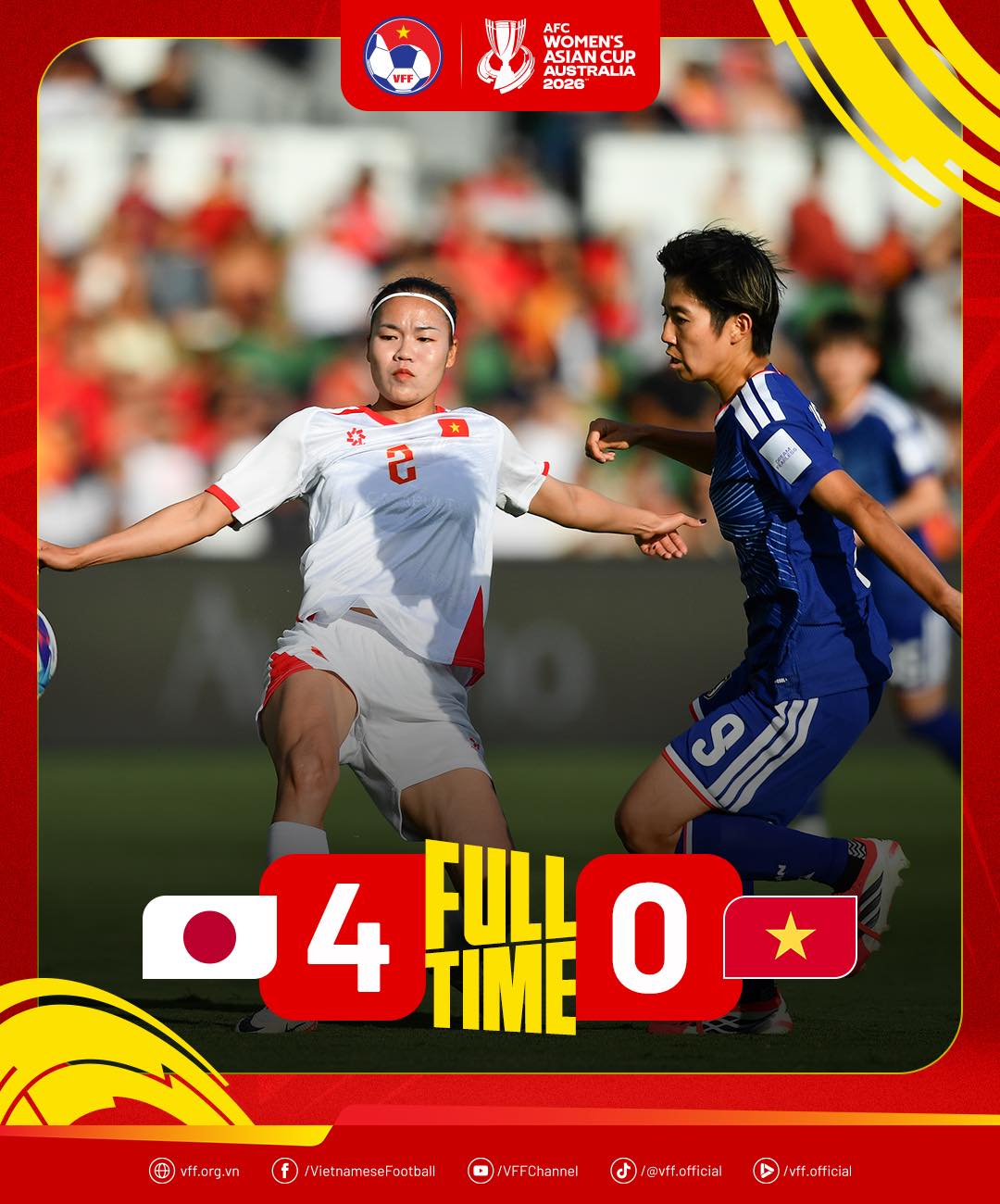
Chairman of the Vietnam Football Federation (VFF), Tran Quoc Tuan, once said that the World Cup ticket is a major step forward for Vietnamese women's football, but the development journey is still long. According to him, the important thing is to build a domestic training and tournament system so that women's football has a more solid foundation in the future.
That assessment reflects the reality that the World Cup is a proud milestone, but not the end of the journey.
Southeast Asia is also changing
Vietnamese women's football is currently ranked 6th in Asia. Very high position but in reality is seriously threatened. Even in Southeast Asia, women's football is also entering a new phase.
For many years, regional competition has mainly taken place between 3 teams: Vietnam, Thailand and Myanmar. A careful assessment can also show that Vietnamese women's football has developed and progressed rapidly partly because of that period of little competition.
But in recent years, the Philippines has emerged very quickly. They naturalized many players who grew up from the US football system, invested heavily in the national team and quickly achieved results. The Philippines reached the semi-finals of the 2022 Asian Cup, won the right to participate in the 2023 World Cup and once won the Southeast Asian Championship, won the most recent SEA Games and is the only Southeast Asian representative to reach the quarter-finals of the 2026 Asian Championship.
That changes the regional balance. Vietnam is still one of the strong teams, but the gap is no longer as clear as before. With sports, when opponents advance faster, your position also changes. That is the rule.
Vietnamese women's football once created a very special generation of players. But as this generation gradually steps through the peak period, the next part of the story will begin with the new generation. But whether success can be maintained or not, time will tell.
Expert Doan Minh Xuong: "The national team or any team has a cycle, after a successful cycle it goes down, the issue is whether it goes down quickly or slowly. Maintaining stable performance for Vietnamese women's football is not simple. The main tasks of football when the core generation goes down must have a young talented generation to supplement to maintain that achievement".


