
Domestic pepper prices: Price increases in some areas
As of 11:30 am today (May 12), domestic pepper prices increased in some areas, averaging 143.100 VND/kg. Currently, key areas are trading in the range of 141.500 - 144,000 VND/kg.
Domestic pepper prices, after many days of stagnation, have slightly fluctuated. Currently, the listed prices in the regions are as follows:
Gia Lai province raises the price by 500 VND/kg, trading at the mark of 141. 500 VND/kg.
Dong Nai and Binh Phuoc recorded an increase of 500 VND/kg, listed at 143,000 VND/kg.
Meanwhile, Dak Lak and Lam Dong remained unchanged, respectively offering for sale at the highest purchase price of 144,000 VND/kg.
World pepper prices: Sharp increase
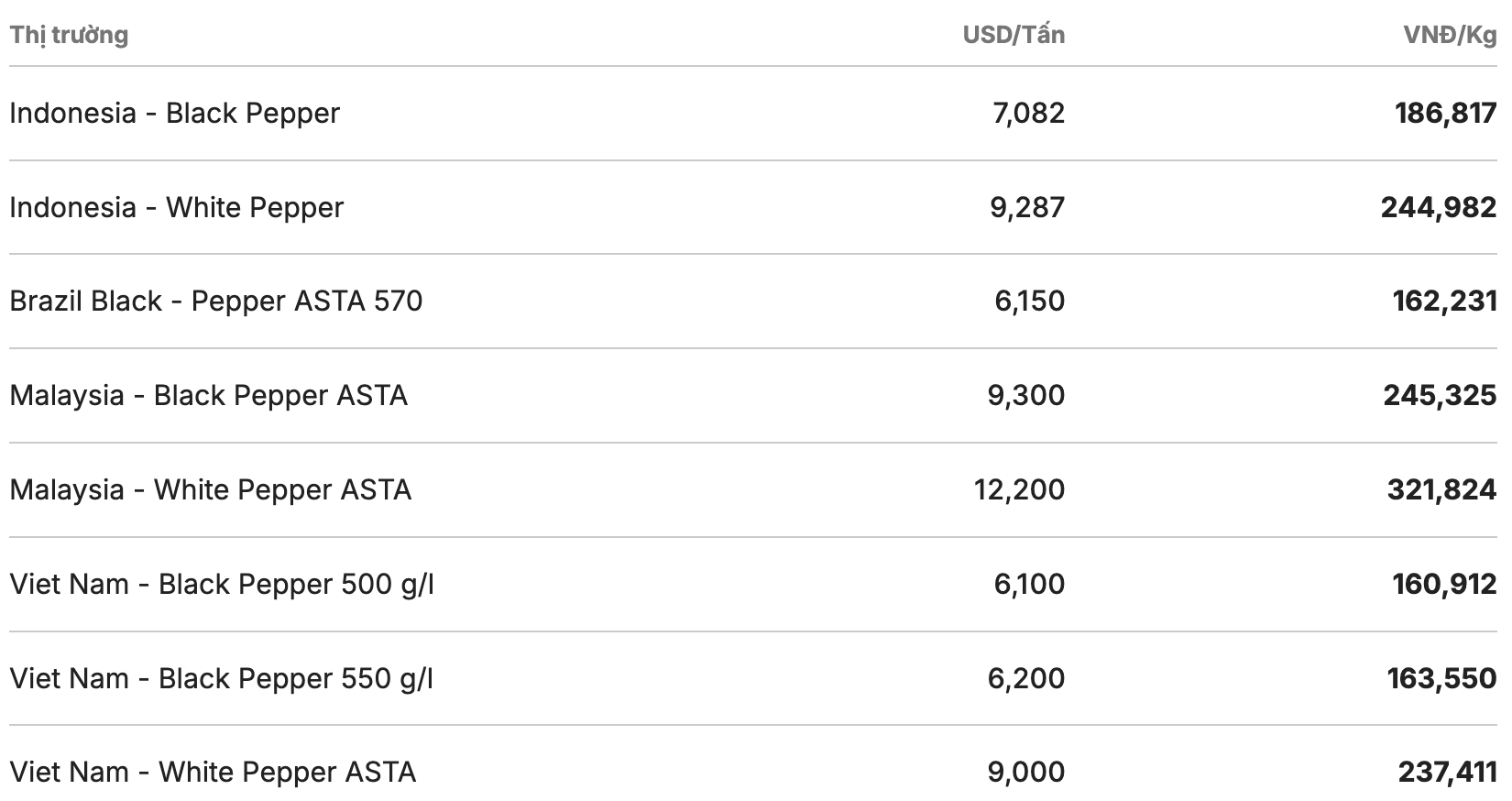
In the world market, pepper prices are mostly stable in countries. The two items of black and white pepper in Indonesia are unchanged, trading in the range of 7.082 - 9,287 USD/ton (equivalent to 186,817 VND/kg - 244,982 VND/kg), increasing by 127 USD/ton and 123 USD/ton respectively.
The Brazilian market increased by another 50 USD/ton, listed at 6,150 USD/ton (about 162,231 VND/kg). Meanwhile, black and white peppers remained unchanged, trading at 12,200 USD/ton and 9,300 USD/ton.
In Vietnam's pepper export market, the price of black pepper of 500 g/l and 550 g/l remains at 6,100 - 6,200 USD/ton. In the same direction, ASTA white pepper is offered for sale at 9,000 USD/ton (equivalent to 237,411 VND/kg).
Assessments and forecasts
According to the International Pepper Corporation (IPC), in the second week of May, the global pepper market fluctuated, but in general prices remained stable in major producing countries.
The Indonesian pepper market recorded a decrease last week, mainly due to the Indonesian Rupiah depreciating by 1% against the USD, affecting both the domestic and export markets. Malaysian domestic pepper prices recorded an increase in the 2nd week of May, while export prices remained stable, reflecting solid external demand.
Domestic black pepper prices in Vietnam recorded a slight increase last week, while other types remained stable, reflecting the balanced supply and demand foundation of the market.


