
Domestic pepper price: Reaching 140,000 VND/kg
As of 11:30 am today (April 13), domestic pepper prices have increased, averaging 139,200 VND/kg. Currently, key areas are trading in the range of 138,500 - 140,000 VND/kg.
Domestic pepper prices recorded an increase of 500 - 1,000 VND/kg with the closing session of the previous week, listing prices as follows:
Gia Lai and Dak Lak provinces recorded the lowest increase of 500 VND/kg, listed at 139,000 VND/kg and 140,000 VND/kg respectively.
Notably, Lam Dong is currently the area with the highest asking price in the country with a threshold of 140,000 VND/kg, an increase of 1,000 VND/kg.
Dong Nai and Ho Chi Minh City are the 2 regions that maintain the price range, anchored at the threshold of 138,500 VND/kg.
World pepper prices: Calm
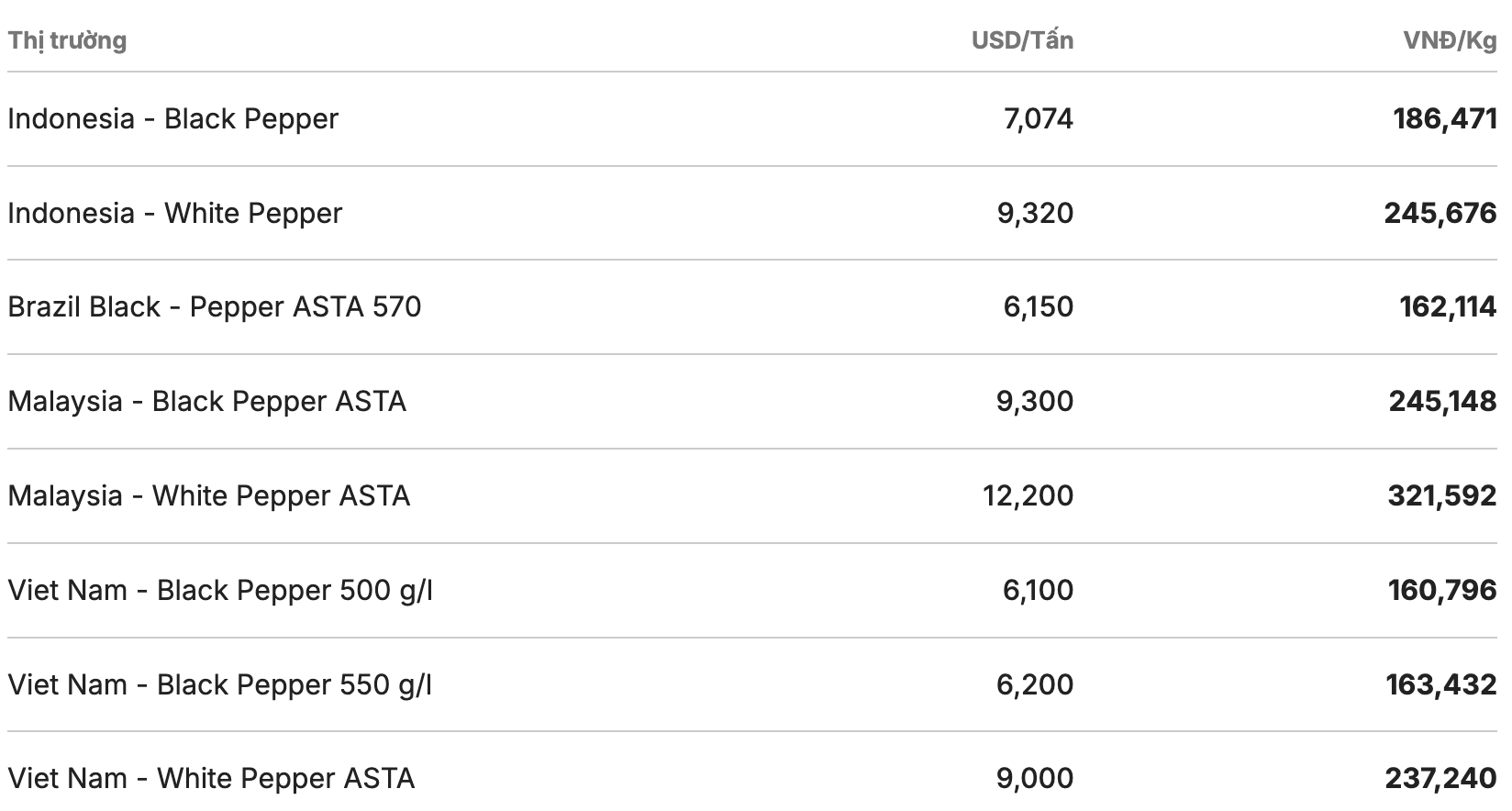
In the world market, pepper prices mostly maintain a stable state. The two items of black and white pepper in Indonesia are also no exception, trading in the range of 7,074 - 9,320 USD/ton (equivalent to 186,471 VND/kg - 245,676 VND/kg).
The Brazilian market maintained an increase of 50 USD/ton, listed at 6,150 USD/ton (about 162,114 VND/kg). Notably, black and white pepper kept increasing from 100 - 200 USD/ton, trading at 12,200 USD/ton and 9,300 USD/ton.
In Vietnam's pepper export market, the price of black pepper of 500 g/l and 550 g/l remains at 6,100 - 6,200 USD/ton. In the same direction, ASTA white pepper is offered for sale at 9,000 USD/ton (equivalent to 237,240 VND/kg).
Assessments and forecasts
Although the domestic pepper price market is showing signs of recovery, the market still contains many risks. Domestic production is forecast to decrease due to the impact of weather and old area, while global consumption demand is not really stable.
According to forecasts, the trend of pepper prices in the coming time will largely depend on the supply-demand balance, transportation costs and export developments in key markets. If supporting factors are consolidated, pepper prices can completely exceed the 140,000 VND/kg mark, but the risk of adjustment is still present.


