
Domestic pepper prices: Reversal to increase
As of 11:30 today (December 16), domestic pepper prices reversed and increased, averaging 148,900 VND/kg. Currently, key areas are trading in the range of 148,000 - 150,000 VND/kg.
Provinces and cities recorded an increase of 500-1,000 VND/kg, the price list on the market in specific areas is as follows:
Gia Lai recorded an increase of VND 500/kg, while Dong Nai was the only province that remained unchanged, listed at VND 148,000/kg.
Similarly, Ho Chi Minh City and Dak Lak both increased by VND 500/kg, respectively anchored at VND 148,500/kg and VND 150,000/kg.
Lam Dong province alone recorded the strongest increase of VND 1,000/kg, bringing to the market a price of VND 150,000/kg.
World pepper prices: Slight decrease
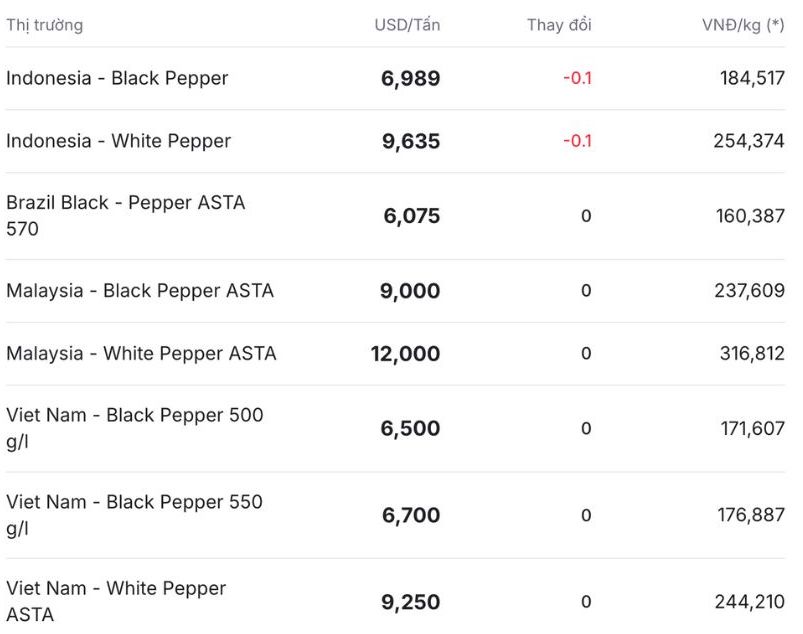
In the world market, pepper prices continue to fluctuate in some regions. The Indonesian exchange - one of the most vibrant markets - "turned around" and dropped prices. Currently, these two items are traded between 6,989 - 9,635 USD/ton (equivalent to 184,517 VND/kg - 254,374 VND/kg), down slightly by 0.1%.
Meanwhile, the Brazilian market remained unchanged at 6,075 USD/ton (about 160,387 VND/kg). In the same direction, black and white pepper traded at 12,000 USD/ton and 9,000 USD/ton.
Notably, in the Vietnamese pepper export market, the price of 500 g/l and 550 g/l black pepper remains in the price range of 6,500 - 6,700 USD/ton. ASTA white pepper prices are currently at 9,250 USD/ton (equivalent to 244,210 VND/kg).
Assessment and forecast
According to experts, the world pepper market in the period of 2025-2026 will continue to move cautiously. Reduced output in 2025 could create upward pressure on prices, while the recovery outlook for 2026 still depends largely on climate conditions, an increasingly unpredictable factor in the context of climate change.
The downward adjustment in the past 2 days is more technical than long-term supply and demand fluctuations. The current price is nearly 70% higher than the same period last year (2024). Supply for the new 2026 crop is expected to decrease due to the impact of climate change (La Nina) by the end of this year, while consumption demand during the Lunar New Year and Spring Festival in China is a solid factor preventing prices from falling sharply.


