
Domestic pepper prices: Unchanged in the first session of the week
As of 11:30 am today (January 19), domestic pepper prices remained unchanged in all areas, averaging at 148,100 VND/kg. Currently, key areas are trading in the range of 147,500 - 148,500 VND/kg.
The average price marks a downward trend of the domestic pepper market. Compared to the average price level at the end of November, this is the first time in more than 1 month that domestic pepper has been put on the market at 148,100 VND/kg, down 300 VND/kg.
After days of deep decline, the pepper price list for specific areas is as follows:
Ho Chi Minh City and Gia Lai listed at 148,000 VND/kg.
Dong Nai province is the purchasing area with the lowest price of 147,500 VND/kg.
Dak Lak and Lam Dong are still the two provinces with the highest prices. Currently, these 2 areas are put on the market at 148,500 VND/kg.
World pepper prices: Stabilized
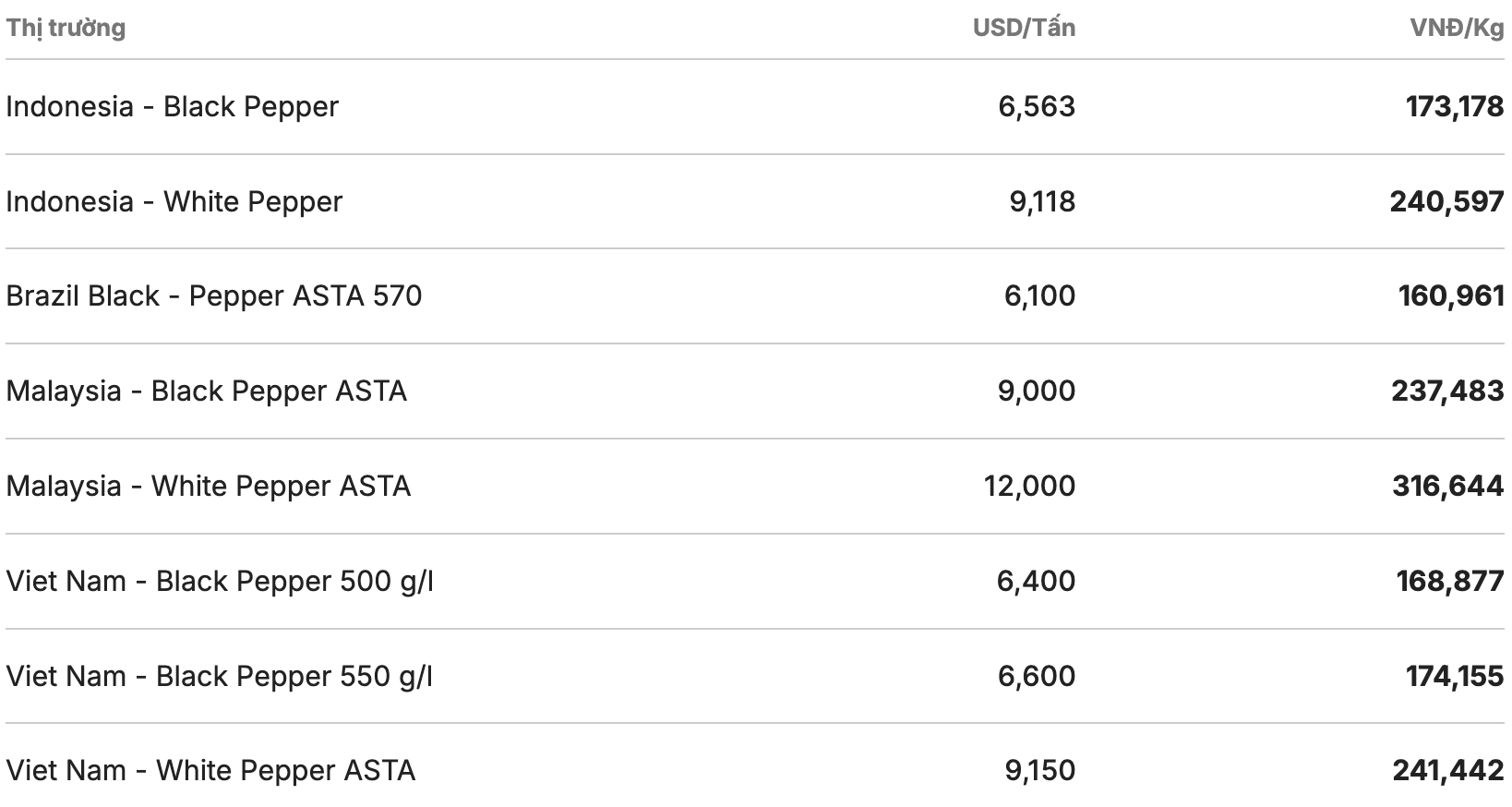
In the world market, pepper prices are stable in countries. The Indonesian exchange - one of the most vibrant markets is no exception. These two items are traded in the range of 6,563 - 9,118 USD/ton (equivalent to 173,178 VND/kg - 240,597 VND/kg).
Meanwhile, the Brazilian market stood at 6,100 USD/ton (about 160,961/VND/kg). In the opposite direction, black and white pepper continued to remain unchanged, trading at 12,000 USD/ton and 9,000 USD/ton.
Notably, in Vietnam's pepper export market, black pepper prices of 500 g/l and 550 g/l suddenly decreased after the day, remaining at the threshold of 6,400 - 6,600 USD/ton. In the same direction, ASTA white pepper prices continued to maintain a decrease of 200 USD/ton, offering for sale at a price of 9,150 USD/ton (equivalent to 241,442 VND/kg).
Perspectives and forecasts
Although entering the harvest stage in some regions, the actual amount of goods flowing out to the market is not too abundant. Farmers and level 1 agents tend to keep goods to wait for better prices, especially when forecasts show that Vietnam's pepper production in 2026 may decrease by 15-20%.
Weather conditions that cause prolonged drought and old garden areas are the main reasons why domestic supply falls into a difficult period. Meanwhile, demand from major markets such as the US and China is recovering strongly to fill the depleted reserves. The mismatch between consumption demand and supply capacity is forecast to push this industry into a new cycle of price and stability challenges.


