
Domestic pepper prices: Unchanged
As of 11:30 am today (April 20), domestic pepper prices maintained a stable state, averaging 140,300 VND/kg. Currently, key areas trade in the range of 139,500 - 141,000 VND/kg.
Domestic pepper prices maintained the price range at the end of last week's session. Currently, the listed price areas are as follows:
Gia Lai province is anchored at the threshold of 139,500 VND/kg.
Ho Chi Minh City put it on the market at a price of 140,000 VND/kg.
Dak Lak and Lam Dong continue to be the 2 provinces offering the highest purchase price in the country with a price of 141,000 VND/kg.
World pepper prices: UNCHANGED
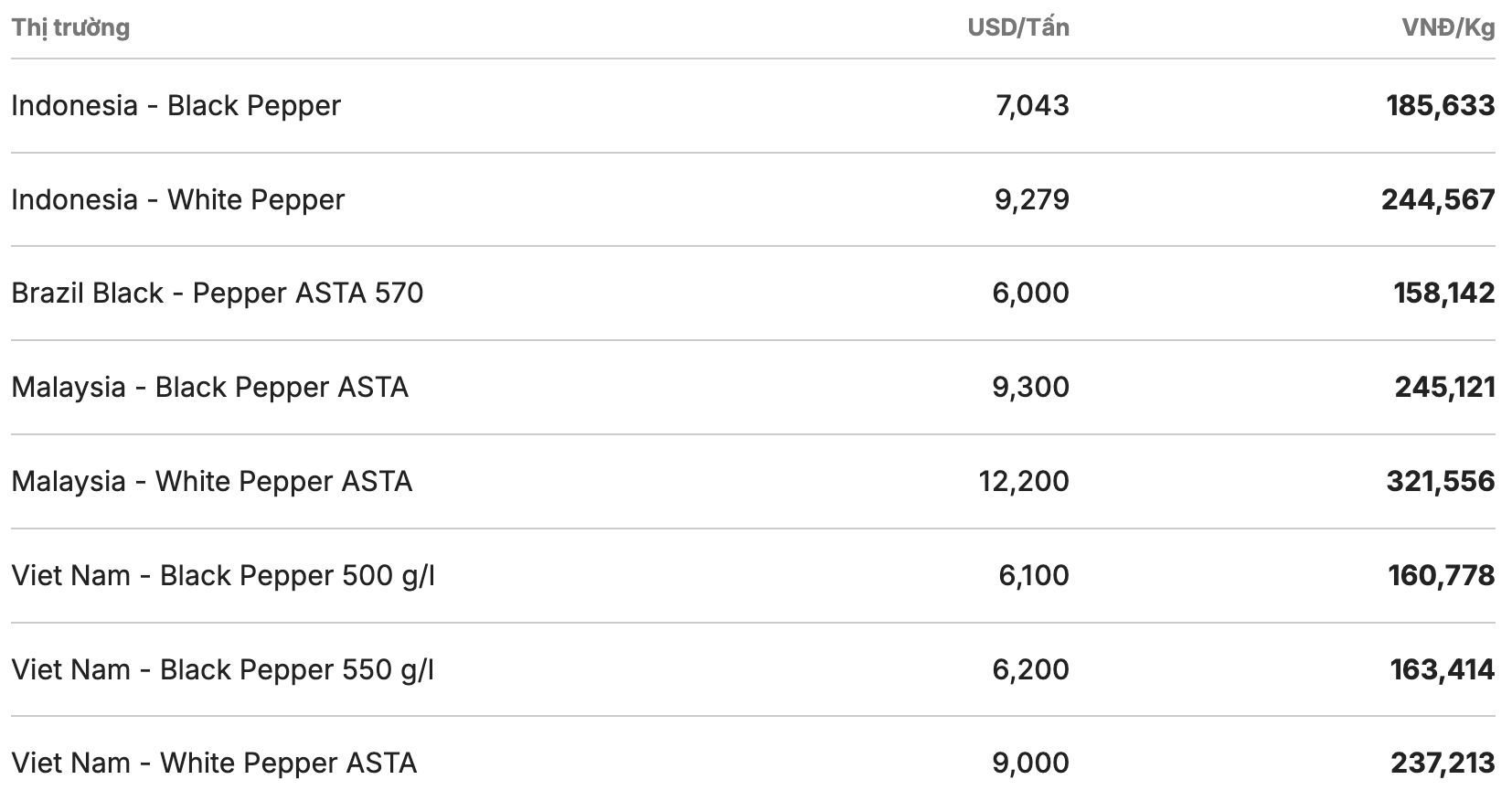
In the world market, pepper prices remain unchanged in countries. The two items of black and white pepper from Indonesia are no exception, trading in the range of 7.043 - 9.279 USD/ton (equivalent to 185.633 VND/kg - 244.567 VND/kg).
The Brazilian market is listed at the 6,000 USD/ton mark (about 158.142 VND/kg). Notably, black and white peppers maintain an increase of 100 - 200 USD/ton, trading at the 12,200 USD/ton and 9,300 USD/ton marks.
In Vietnam's pepper export market, the price of black pepper of 500 g/l and 550 g/l remains unchanged at 6,100 - 6,200 USD/ton. In the same direction, ASTA white pepper is offered for sale at 9,000 USD/ton (equivalent to 237.213 VND/kg).
Assessments and forecasts
The domestic harvest season is entering its final stage, with most of the area completed by the end of March due to lower yields. Vietnam's pepper imports also recorded more than double the same period last year in the period from January to March, reaching 21,000 tons, in order to maintain exports in the context of reduced output.
Along with that, Vietnam's pepper exports in the first quarter increased by 39% compared to the same period last year, reaching 66,000 tons. The US is the largest market with 16,800 tons (up 64%), while China increased more than 4 times from 2,000 tons to 8,500 tons. The United Arab Emirates - the second largest market in 2025 increased from 2,700 to 3,200 tons, and exports to the Middle East region increased from 4,500 to 5,300 tons (equivalent to an increase of 18%).


