
Domestic pepper prices: Deep drop
As of 1:30 PM today (February 25), domestic pepper prices plummeted, averaging 148,500 VND/kg. Currently, key areas are trading in the range of 148,000 - 149,000 VND/kg.
Areas recording deep decreases, currently the pepper price list of provinces and cities is as follows:
Gia Lai and Dong Nai both decreased by another 1,000 VND/kg, anchored at the threshold of 148,000 VND/kg.
Lam Dong and Dak Lak decreased the most by 2,000 VND/kg, bringing it back to the mark of 149,000 VND/kg.
Ho Chi Minh City, after a day of unchanged prices, today has a downward trend of 1,500 VND/kg, launched to the market at a price of 148,500 VND/kg.
World pepper prices: Sideways
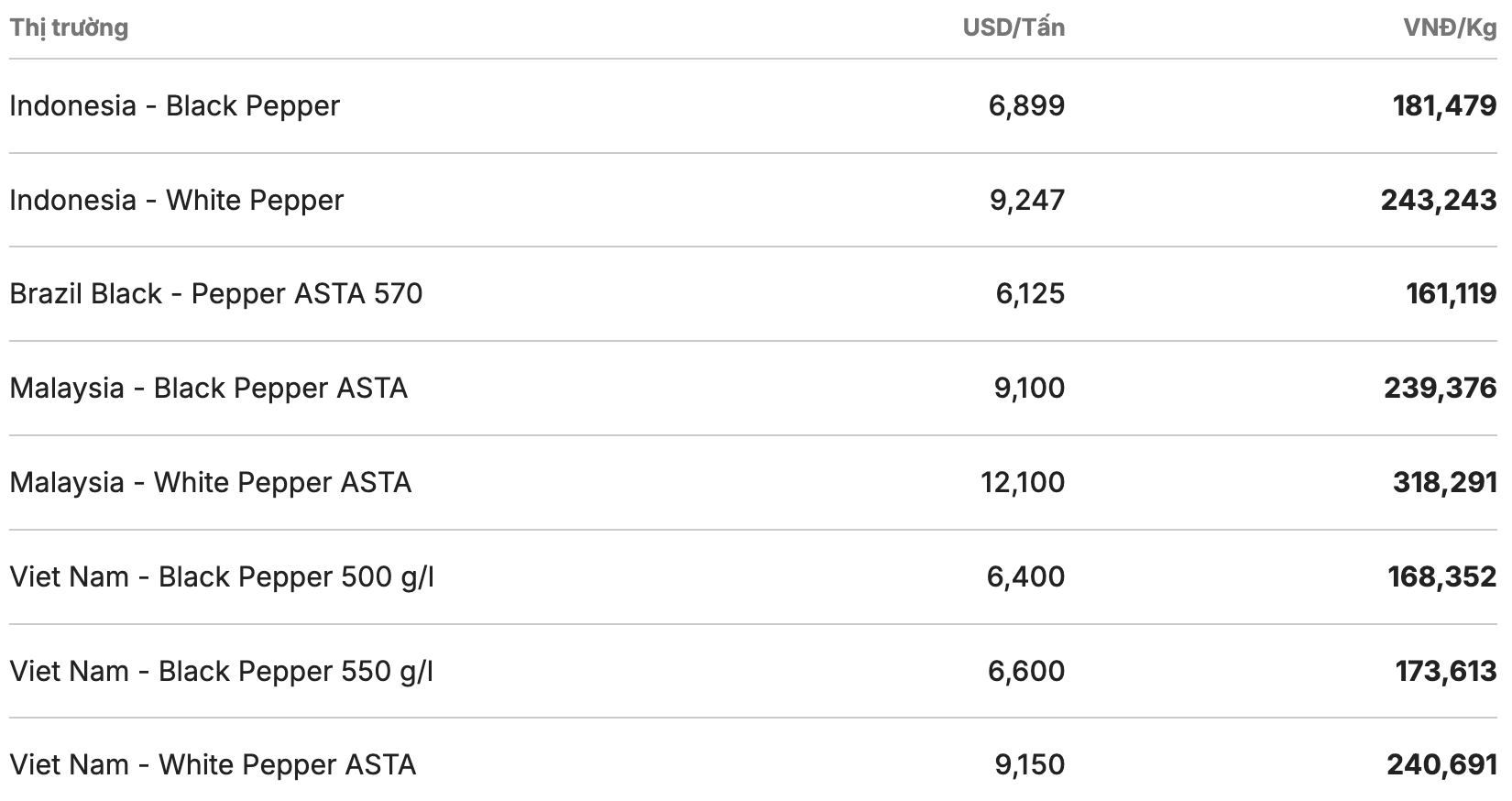
In the world market, pepper prices maintained a series of sideways movements. The Indonesian exchange - one of the most active markets - reversed and increased sharply. Black and white peppers traded in the range of 6,899 - 9,247 USD/ton (equivalent to 181,479 VND/kg - 243,243 VND/kg), increasing by 16 USD/ton and 21 USD/ton respectively.
The Brazilian market maintained a slight increase of 25 USD/ton, listed at 6.125 USD/ton (about 161. 119 VND/kg). Notably, black and white peppers maintained an increase of 100 USD/ton, trading at 12. 100 USD/ton and 9. 100 USD/ton.
In Vietnam's pepper export market, the price of black pepper of 500 g/l and 550 g/l is maintained at 6,400 - 6,600 USD/ton. ASTA white pepper price continues to be offered for sale at 9,150 USD/ton (equivalent to 24,691 VND/kg).
Assessments and forecasts
Weather conditions are a factor affecting the quality of pepper and slowing down the harvest and drying progress. This partly prevents the actual supply to the market in the early stages of the season from increasing as expected.
According to Peppertrade analysts, pepper production prospects in 2026 face many significant challenges due to unfavorable weather conditions. The drought at the beginning of the year, followed by prolonged heavy rains during the rainy season, has affected yields, especially in old pepper gardens. Therefore, many growing areas are expected to only achieve average yields, with total output possibly decreasing by about 15-20% compared to 2025.


