
Domestic pepper prices: Continue to decrease
As of 11:30 today (December 3), domestic pepper prices continued to decrease, trading between 147,000 - 149,000 VND/kg, an average decrease of 600 VND/kg compared to the previous trading session.
The regions simultaneously recorded a decrease of VND 1,000/kg. The price list on the market in specific key areas is as follows:
Gia Lai depreciated VND 1,000/kg, listed at VND 147,000/kg.
Dong Nai and Ho Chi Minh City alone remained unchanged, setting the mark of 148,000 VND/kg.
Meanwhile, Dak Lak and Lam Dong continued to decrease by VND 1,000/kg, bringing the market around VND 149,000/kg.
World pepper prices: Increase and decrease alternately
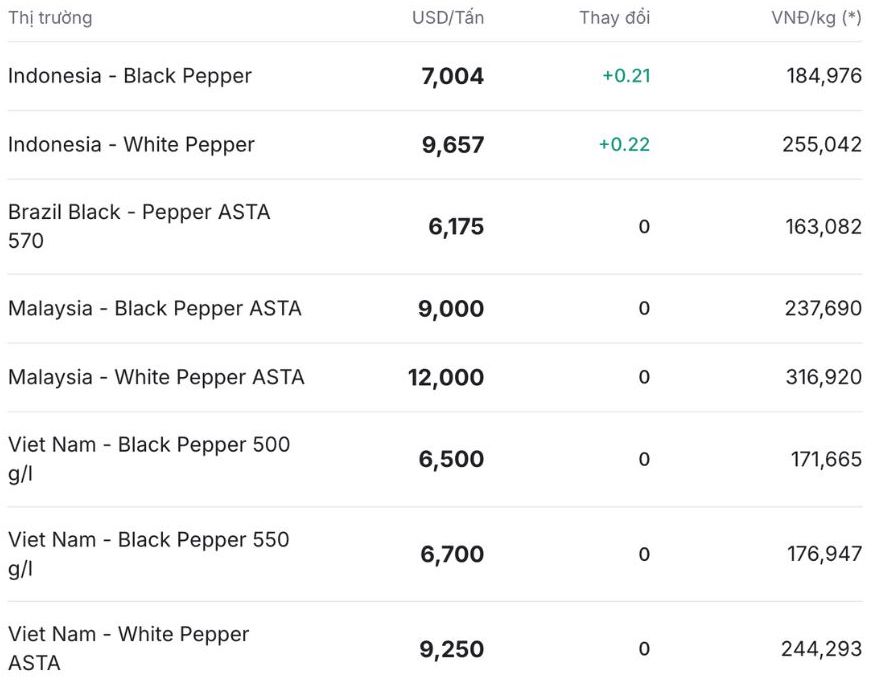
In the world market, pepper prices are mostly stable in the regions. In particular, the Indonesian exchange - one of the most vibrant markets - reversed and increased prices. Currently, these two items are traded between 7,004 - 9,657 USD/ton (equivalent to 184,976 VND/kg - 255,042 VND/kg).
On the other hand, the Brazilian market has maintained a stable streak, currently holding at 6,175 USD/ton (about 163,082 VND/kg). Meanwhile, black and white pepper are traded at 12,000 USD/ton and 9,000 USD/ton.
Notably, in the Vietnamese pepper export market, the price of 500 g/l and 550 g/l black pepper is anchored at the high level of 6,500 - 6,700 USD/ton. ASTA white pepper prices are currently at 9,250 USD/ton (equivalent to 244,293 VND/kg).
Assessment and forecast
According to the International Pepper Association, the global pepper output in the 2025-2026 crop year could reach about 533,000 tons if the weather is stable. Vietnam alone is forecast to be the world leader with an output of 190,000-193,000 tons, an increase of nearly 10% compared to the previous crop. However, pepper products still face challenges when the cultivated area is difficult to expand due to limited land fund, green standards requirements and high production costs.
VPSA Research Agency stated that global supply and demand are still in a balanced state. However, fluctuations in logistics costs, taxes and technical barriers will continue to be factors affecting prices. From now until the end of 2025, pepper prices are forecast to have a slight upward trend, especially when the inventory of many enterprises decreases to a low level.


