
Domestic pepper prices: Fall in price
As of 1 pm today (February 3), domestic pepper prices reversed to decrease in some areas, averaging 149,800 VND/kg. Currently, key areas are trading in the range of 149,000 - 151,000 VND/kg.
After many days of sideways movement, the current pepper price list for specific areas is as follows:
Dong Nai is anchored at the threshold of 149,000 VND/kg, down 1,000 VND/kg.
Ho Chi Minh City and Dak Lak both decreased by 1,000 VND/kg, down to 149,000 VND/kg and 151,000 VND/kg.
Gia Lai and Lam Dong remained unchanged, respectively bringing them to the market in the price range of 149,000-150,000 VND/kg. Among them, Gia Lai is the province with the lowest price.
World pepper prices: Stand firm in the price range
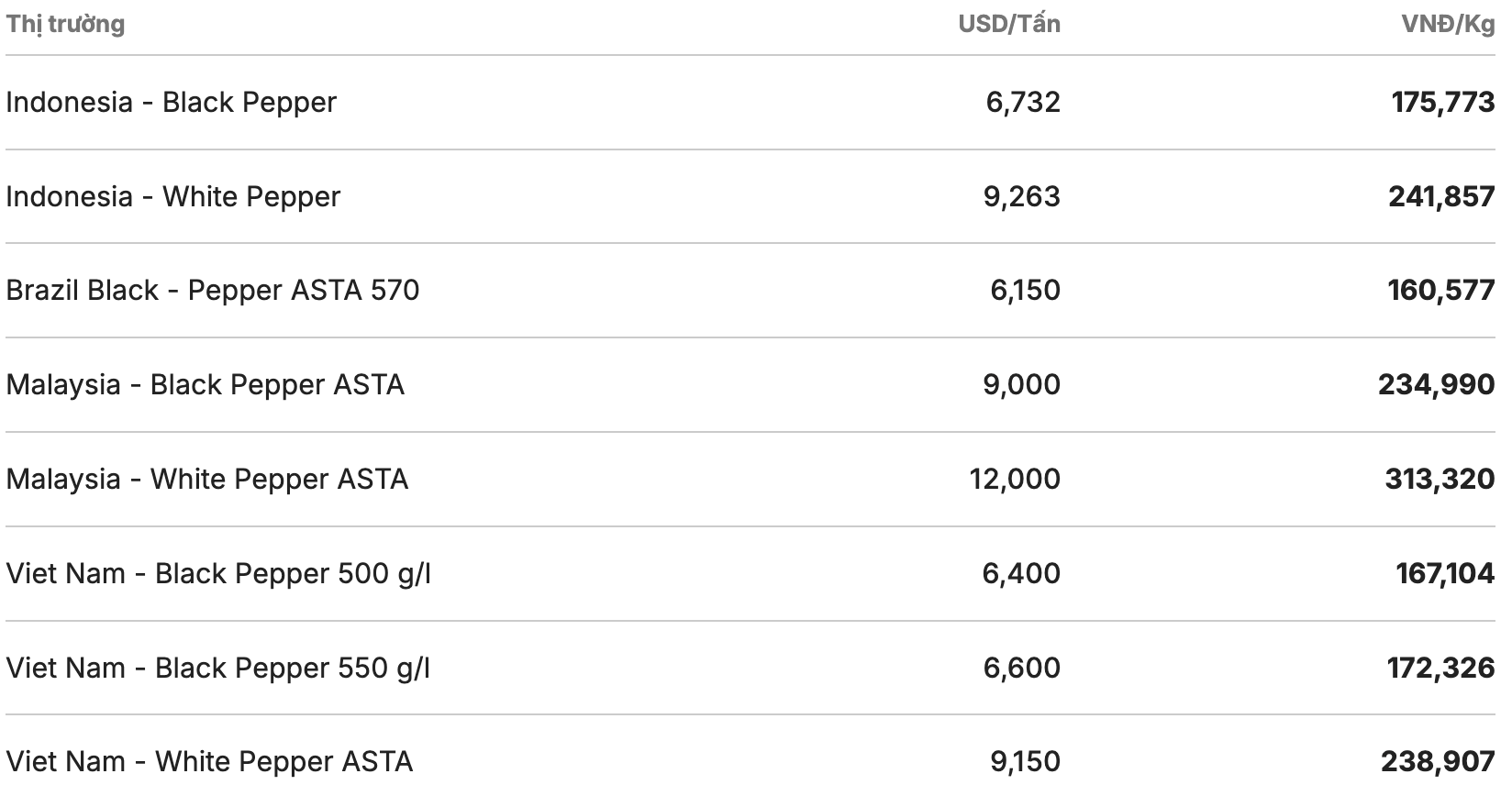
In the world market, pepper prices do not have much fluctuation. The Indonesian exchange - one of the most vibrant markets is no exception. These two items are traded in the range of 6,732 - 9,263 USD/ton (equivalent to 175,773 VND/kg - 241,857 VND/kg).
Meanwhile, the Brazilian market maintained its upward momentum, trading at 6,150 USD/ton (about 160,577 VND/kg). Black and white peppers continued to remain unchanged, trading at 12,000 USD/ton and 9,000 USD/ton.
Notably, in Vietnam's pepper export market, the price of black peppers of 500 g/l and 550 g/l is maintained at 6,400 - 6,600 USD/ton. ASTA white pepper price continues to be offered for sale at 9,150 USD/ton (equivalent to 238,907 VND/kg).
Assessments and forecasts
The diễn biến of the USD continues to affect the prices of goods, including pepper. The recovery trend of the USD will be a major barrier hindering the increase in pepper prices this week.
Commenting on the market, the Vietnam Pepper and Spice Plant Association (VPSA) said that because pepper prices are at a high level, demand from some countries is slowing down, especially the US market imposing corresponding tariffs on most other producing countries, so imports have decreased.
For the Vietnamese market, although still maintaining its leading position, the relative decline in market share in the US is a warning about increasingly clear competitive pressure from Indonesia and India. This also poses a requirement to continue to improve supply stability, quality and delivery capacity to maintain its key role in the world's largest consumer market.


