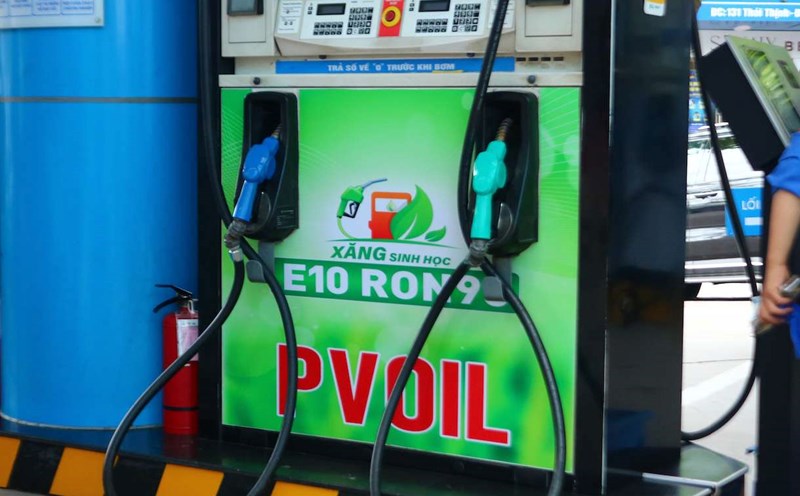
Restoring and improving the operational efficiency of ethanol plants
In the context of a volatile global energy market, especially due to the conflict in the Middle East, ensuring energy security has become an urgent task. Vietnam is still significantly dependent on fossil fuels, while the pressure to reduce emissions and implement international commitments on energy transition is increasingly clear. Therefore, the development and use of biofuels is not just a technical option, but a strategic decision.
Mr. Do Minh Quan - chief expert of the Petroleum and Gas Business Management Department, Department of Domestic Market Management and Development (Ministry of Industry and Trade) - said that according to reports from petroleum traders, in 2025, total gasoline consumption output reached about 11.37 million m3, including E5RON92 bio-gasoline and non-bleu gasoline. When E10 bio-gasoline is applied nationwide from June 1st, the demand for ethanol (E100) is expected to be about 1.1 million m3 per year.
Currently, Vietnam has 6 ethanol production plants with a total designed capacity of about 500,000 m3 per year, equivalent to more than 40% of the ethanol demand for blending biofuel nationwide. In the process of building a roadmap in Circular 50, the Ministry of Industry and Trade has calculated on the basis of balancing domestic production capacity and the ability to supplement ethanol sources from imports when necessary" - Mr. Do Minh Quan said.
According to representatives of the Ministry of Industry and Trade, Vietnam can import ethanol directly from the United States and Brazil, two countries that supply more than 80% of the world's ethanol production. Each year, these countries produce more than domestic demand by about 30-40 million m3, fully capable of meeting the additional demand for the Vietnamese market.
In addition, ethanol can also be imported through regional distribution centers such as Singapore or South Korea. The existing port and warehouse systems in Quang Ninh, Nha Be (Ho Chi Minh City), Van Phong (Khanh Hoa) or Da Nang are all capable of receiving large ethanol ships, ensuring the ability to receive the necessary amount of ethanol for biofuel blending activities.
In the coming time, the Ministry of Industry and Trade will continue to coordinate with ministries, branches and localities to implement solutions, restore and improve the operational efficiency of ethanol plants, and at the same time develop raw material areas to produce ethanol stably, gradually improving the domestic supply self-sufficiency rate.
Proactively negotiate with international partners to ensure E100 source
To prepare for the conversion phase to E10 gasoline, businesses have implemented many synchronous solutions, from upgrading technical infrastructure to expanding ethanol supply. According to Mr. Ho Ngoc Linh - Deputy Head of Petroleum Engineering Department, Vietnam National Petroleum Group (Petrolimex), Petrolimex currently has 7 blending warehouses ready to blend E10 gasoline nationwide. In addition, with a network of more than 2,800 gas stations, the Group has proactively cleaned tanks, prepared necessary infrastructure conditions and built a suitable conversion roadmap. In fact, Petrolimex is striving to accelerate the implementation progress earlier than the roadmap of Circular 50.
In addition to preparing warehouse and store infrastructure, Petrolimex has also sent delegations of officials to study experiences in Thailand, Philippines, the United States and some other countries to study business organization models, transportation and ensure the quality of E10 gasoline when supplied to the market" - Mr. Ho Ngoc Linh informed.
Mr. Ho Ngoc Linh said that Petrolimex determines that the demand for ethanol for blending E10 bio-gasoline of the entire system is currently about 45,000 - 50,000 m3 per month.
According to general assessment, domestic E100 production currently only meets about 20,000 m3 per month. Therefore, for the rest, right from the beginning of March, Petrolimex has proactively negotiated with partners from the United States, Singapore and South Korea to sign both long-term and short-term contracts, in order to ensure stable E100 supply to serve E10 blending, and at the same time meet the assigned energy security requirements" - Mr. Linh said.