
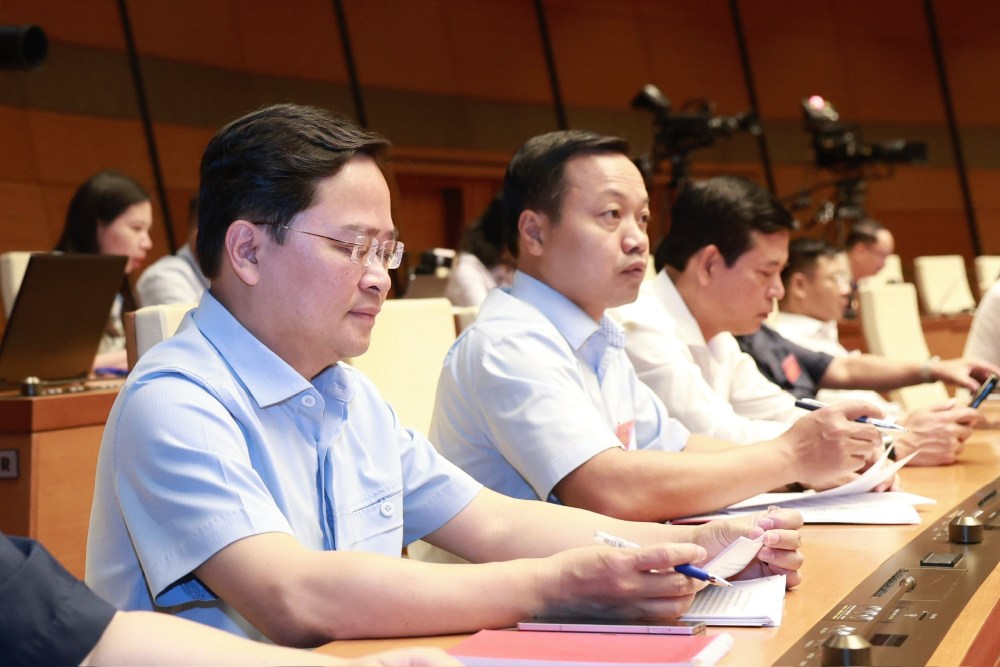
On the morning of June 30, the Politburo organized a national conference to study, study, thoroughly grasp and implement Resolution No. 10-NQ/TW of the Politburo on economic development with foreign investment capital.
At the conference, Politburo Member, Standing Deputy Prime Minister Pham Gia Tuc reported on the key and core contents of Resolution 10-NQ/TW.
The Standing Deputy Prime Minister clearly stated that strategic competition, breakthrough development of science, technology, innovation, artificial intelligence, digital transformation, green transformation, and the shift of supply chains and global capital flows are posing new requirements for the country's development model.
In that context, economic development with foreign investment cannot just stop at the goal of attracting more capital, but must aim to improve the quality, efficiency and spillover of international capital flows.
Government leaders summarize 6 major changes in development thinking.
First, shift from thinking about attracting foreign investment to developing an economy with foreign investment capital.
Second, shift from valuing capital scale to valuing quality, efficiency and added value. The focus is no longer on attracting more projects, but on selecting projects with advanced technology, innovation, modern management, with the ability to spread and make practical contributions to improving the productivity and competitiveness of the economy.
Third, shifting from input-based incentives to result-based incentives. Incentive policies are innovated in the direction of linking with the implementation of commitments on technology transfer, research and development, human resource training, linkages with domestic enterprises, green transformation and sustainable development.
Fourth, shift from single FDI development to synchronous development of the ecosystem of international capital flows. This is a prominent new point of the Resolution when placing direct investment, indirect investment, capital markets, international financial centers and new development spaces such as free trade zones, special economic zones.
Fifth, shift from investment management to creating an investment and development environment.
Sixth, shift from competition to attract investment between localities to coordinating development at the national level.
Regarding goals, by 2030, the Resolution sets a goal to create fundamental changes in the quality and efficiency of foreign-invested economic development, with 4 major orientations.
First, attract 200-300 billion USD of registered FDI capital, of which realized capital reaches 150-200 billion USD;
Second, improve the quality of capital flows, striving for 70-75% of new registered capital to come from developed economies and over 50% to focus on high-tech, innovation and digital transformation sectors;
Third, there are about 10,000 Vietnamese enterprises participating in the supply chain of foreign-invested enterprises;
Fourth, upgrade the stock market to emerging markets before 2030, creating a foundation to strongly attract international indirect investment capital flows.
The Standing Deputy Prime Minister summarized the objectives of the Resolution with a message: "Success in the new stage is not mainly measured by the number of projects or the scale of capital attracted, but by the quality of capital flows, technological capacity, level of innovation, linkages with domestic enterprises and practical contributions to the rapid and sustainable development of the country".
Government leaders also emphasized the renovation of awareness, unified thinking in the entire political system on foreign-invested economic development; strongly shifting from management thinking to development-creating thinking, considering foreign-invested economy as an organic part of the economy and an important driving force to improve national competitiveness.
Overcome the situation of localities competing, attracting investment chasing quantity. Resolutely not to trade the environment, resources, social security, and economic security for purely economic growth.


