
Japan is considered one of the countries that has successfully built a housing policy system for the poor and low-income people through a multi-layered support model, combining public housing, rent subsidy, housing subsidy and affordable housing programs. The article analyzes the legal basis, operating mechanism and effectiveness of the housing rental policy for the poor and low-income people in Japan; and at the same time proposes some solutions to apply Japan's experience to the practical conditions of Vietnam.
1. Housing rental policy for the poor and low-income in Japan
Japan is one of the Asian countries that has built a relatively complete and sustainable social housing policy system. Unlike many countries that only focus on supporting the construction of public housing or subsidizing individual rent, Japan develops a multi-layered support model, combining legal, financial and social welfare tools to ensure that all groups of people in difficult circumstances have access to suitable housing. This approach stems from the view that housing is not only a commodity in the market but also a basic social right, associated with human dignity and the right to enjoy a minimum living standard for citizens. That spirit is reflected in Article 25 of the 1947 Constitution of Japan, according to which the State is responsible for ensuring minimum civilized living conditions for all people through the social welfare system.
The most important foundation of the housing support system in Japan is the 1951 Public Housing Act. This law was enacted in the context of Japan's recovery after World War II, when millions of people fell into severe housing shortages. Through this law, the Central Government provided financial support to local authorities to build and manage public rental housing funds for low-income households. The noteworthy point is that the policy not only focuses on creating housing supply but also builds a mechanism to determine rental rates based on the affordability of each household. The rental price is calculated according to the formula associated with the actual income of tenants (total household income minus 380,000 yen multiplied by the number of households not including tenants and minus other special exemptions) (1), ensuring that the lowest-income households will enjoy the lowest rental rates. When household income increases, the rent level is also adjusted up correspondingly and gradually approaches market prices. This mechanism helps implement the principle of social justice, while avoiding rampant subsidies and inefficient use of public resources.
With flexible and affordable prices, housing quality is still very specifically regulated. Apartments must ensure a minimum area of 25 m2, meeting strict safety standards, especially earthquake resistance. Depending on actual conditions, local authorities can adjust appropriate standards. People who need to rent public housing must submit registration documents to local management agencies and be considered according to criteria on income, housing conditions and family circumstances to ensure fairness and effectiveness of policies.
By the 1970s, the number of public houses, mainly collective houses (danchi) in Japan, had reached nearly two million apartments, forming an indispensable part of the national social security system. During this time, the Japanese government declared that it had basically solved the housing shortage after the war. Along with economic development and improved people's living standards, the attractiveness of public housing areas gradually decreased as many households switched to owning private houses. From the 1980s, changes in housing needs and tastes caused public housing areas to no longer be as popular as before; by the 2000s, many degraded residential areas and low occupancy rates had been demolished or renovated (2).
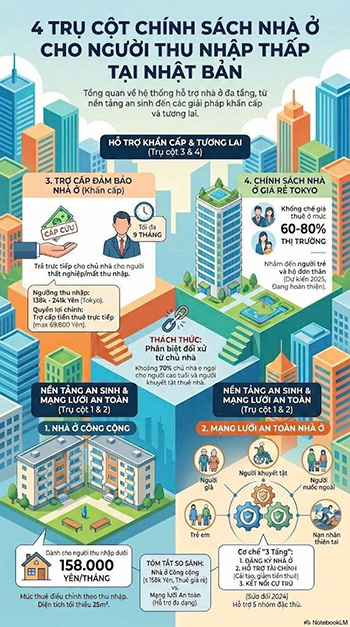
Stepping into the early decades of the 21st century along with economic development and population structure changes, the Japanese government realized that relying solely on public housing was not enough to solve new housing problems. Many groups of people, although facing difficulties in accessing the housing market, are not eligible for public housing. This policy gap has prompted the Japanese government to build a new, more flexible support mechanism. An important step in this process is the amendment of the 2017 Housing Safety Network Law and continued amendments in 2024 (3). The goal of this law is to expand the scope of support from traditional poor households to vulnerable population groups in the housing market. Supported subjects include low-income people (equal to or below 158,000 yen), the elderly, people with disabilities, families raising young children, victims of natural disasters, victims of domestic violence, foreigners and many other vulnerable groups. This reflects a change in Japan's policy thinking when shifting from an approach based mainly on income criteria to an approach based on vulnerability in access to housing.
An important highlight of the Housing Safety Network system is the combination of the public and private sectors. Instead of just building more public houses with state budget funds, the Government encourages private homeowners to register to participate in the system and rent houses to those in need of support (Safe Network Housing). Other mechanisms to create motivation for homeowners include registering houses for those in need of support, financial support (housing renovation, reduced rent and house rental guarantee fees) and support for residence connection through specialized organizations. The amended Law of 2024 continues to expand the system by adding the "Residential Support Housing" model, aiming to strengthen support for low-income people, the elderly, people with disabilities, families with young children and disaster victims. By March 2025, the system had more than 943,000 apartments registered to participate, with a network of more than 1. 000 resident support organizations and 155 housing support councils nationwide, contributing to expanding access to housing for vulnerable groups in society. This mechanism helps effectively utilize available housing resources in society, reduce the burden of direct investment from the public budget and rapidly expand the supply of affordable housing.
In addition to supporting housing supply, the Japanese Government also focuses on directly supporting tenants through the Housing Assurance Subsidy Program (Jūkyo Kakuho Kyûfukin) (4). This is a policy tool to help prevent housing loss due to job loss or severe income reduction (which may stem from shocks in the domestic economy). In Tokyo, the conditions for enjoying the subsidy apply to low-income households, for example, a one-person household with an income not exceeding 138,000 yen/month, a two-person household not exceeding 194,000 yen/month and a three-person household not exceeding 241,000 yen/month. At the same time, the total savings assets of the household must not exceed 504,000 yen for a one-person household, 780,000 yen for a two-person household and a maximum of 1 million yen for a three-person household or more. The maximum subsidy level ranges from 53,700 yen/month for a one-person household, 64,000 yen/month for a two-person household and 69. 800 yen/month for households of three to five people; in some central districts of Tokyo, the support level can be up to 86,000 yen/month (5). The subsidy is transferred directly to the homeowner and can last up to nine months. The subsidy recipient is obliged to register and actively seek employment through the Hello Work system, demonstrating the principle of linking housing support with the economic autonomy of the beneficiary. During the COVID-19 pandemic, more than 120,000 households in Japan benefited from this policy (6). This shows the important role of the program in preventing housing loss and ensuring social security for vulnerable population groups (including Japanese citizens and legally residing foreigners), especially during economic crises or natural disasters.
A new trend in Japanese housing policy is the promotion of affordable housing development by the Tokyo Government. From fiscal year 2025, the Tokyo Government is implementing a housing fund development program for rent with prices only about 60–80% of market prices (7). This policy is aimed at the group of residents considered to be a "gap" between access to welfare housing and the open housing market, meaning people with incomes too high to enjoy public housing but not yet able to access commercial housing. Rent rates are maintained at about 60–80% of market prices. For example, for an apartment with a market rent of 100,000 yen/month, tenants only have to pay about 60,000–80,000 yen/month depending on the specific level of support. Priority subjects include low-income households but not eligible to rent public housing, single-person households, young people working in the informal sector, unstable workers and new graduates facing great pressure on housing costs. Through the establishment of housing funds and cooperation mechanisms with the private sector, the program aims to expand the supply of low-priced rental housing, while filling the gap between public housing and commercial housing, thereby improving access to housing for vulnerable population groups in large cities. The formation of affordable housing funds shows a shift from the traditional welfare model to the modern governance model, in which the State plays a constructive role, orienting and creating mechanisms to mobilize resources from the private sector to solve social problems.
Despite many achievements, the housing system for the poor and low-income in Japan is still facing many challenges. One of the prominent issues is discrimination in the housing rental market (8). Many homeowners are still hesitant to rent out to the elderly, people with disabilities, foreigners or people in special circumstances. The main reasons stem from concerns about the ability to pay rent, risks arising during residence or costs related to asset management. To overcome this situation, the Japanese Government has promoted housing guarantee programs, simplified registration procedures and developed a network of residence support organizations to minimize risks for homeowners (9).
2. Lessons learned for Vietnam
In the current period, the policy of housing development for people, especially social housing, has always been the top concern of the Party and State (10) to ensure social equality, stabilize industrial human resources, develop sustainable urban areas, and affirm the superiority and good nature of our regime. In a working session with the Party Committee of the Government and relevant ministries and sectors on the implementation of Directive No. 34-CT/TW dated May 24, 2024 of the Secretariat on May 19, 2026, General Secretary and President To Lam directed that housing is for living, not for business or accumulation, housing policy in the new period must be designed with new thinking, new vision, ensuring everyone has a place to live (11). To realize these goals, housing policy should not only stop at the quantitative goal with the Project of 1 million apartments (12) associated with improving infrastructure quality and living environment, but also need to shift the focus to ensuring the right to settle as the root instead of being limited to the goal of supporting people to own real estate, identifying the "rented housing" model as one of the main pillars of national housing policy.
The housing rental policy for the poor and low-income people in Japan is a model with very important reference value for perfecting Vietnam's current housing policy. The policy overview shows a comprehensive approach, combining direct and indirect support, between public and private resources, between housing policy and social security policy; especially the flexibility and diversity in supporting investors (homeowners), tenants, in building attractive incentive mechanisms to strongly attract private capital to invest in the affordable housing segment or build a professional rental housing ecosystem, contributing to creating a sustainable, transparent, civilized, inclusive living space, ensuring the spirit of leaving no one behind in the urbanization process, all people have the opportunity to have a place to live suitable to their economic capacity, especially workers and low-income workers. From the experience of Japan and the practical conditions of Vietnam, some of the following axes of solutions need to be implemented synchronously.
First, implementing social housing policies from supporting ownership to ensuring access to housing. In the context of high housing prices, developing affordable rental housing, is it necessary to affirm that it is an important pillar to meet the needs of low-income workers?
Second, it is necessary to develop diverse housing support policies, including social housing development, rent allowances and housing cost support, housing fund development, and lowering rent ceilings. This helps expand the scope of beneficiaries and is suitable for many different population groups.
Third, it is necessary to strongly mobilize private sector resources in the development of rental housing. The State needs to improve preferential policies on land, taxes, credit, financial support and risk sharing mechanisms to encourage businesses to participate.
Fourth, housing policy needs to be linked to other social security policies such as employment, income, health, education and social infrastructure. Housing needs to be developed in the direction of creating a stable and sustainable living environment.
Fifth, it is necessary to prioritize the development of rental housing in industrial parks, economic zones and large urban areas. For large urban areas such as Hanoi, Ho Chi Minh City, and Hai Phong, ensuring housing for workers and laborers will also contribute to improving the quality of human resources and increasing investment attractiveness.
Finally, it is necessary to improve the database and enhance the capacity of state management of housing data, publicize and transparentize criteria and beneficiaries, prevent and handle policy fraud. A complete data system will help plan, implement and supervise policies more effectively.
Japan's experience shows that housing rental policies for the poor and low-income can only be effective when built on a solid institutional foundation, supported by a comprehensive social security system and with the active participation of the private sector. For Vietnam, researching, absorbing and selectively applying these experiences will contribute to perfecting housing policies in the direction of "houses are for living", "all people have the opportunity to settle down", especially for the poor, low-income, and vulnerable, ensuring inclusiveness, humanity and sustainable development.
-------------------------------------------------------------------------
(1). Job Circle Nippon, 2025. Necessary costs when renting a house in Japan. Job Circle Nippon. URL https://jobcirclenippon. vn/column/chi-phi-can-thiet-khi-thue-nha-tai-nhat/ (accessed 6. 22. 26).
(2). Knoroz, T., 2020. The Rise and Fall of Danchi, Japan’s Largest Social Housing Experiment [WWW Document]. ArchDaily. URL https://www. archdaily. com/933829/the-rise-and-fall-of-danchi-93japans-largest-social-housing-experiment (accessed 6. 22. 26).
(3). Relieving worries about renting houses for elderly singles and other subjects; The revised "Housing Security Network" Act officially takes effect [WWW Document], 2026. Japanese Government's online portal for public information. URL https://www. gov-online. go. jp/article/202511/entry-9947. html (accessed 6. 22. 26).
(4). Plaza Homes Ltd, 2025. Japan Rent Relief Grants - Housing Security Benefits [WWW Document]. PLAZA HOMES. URL https://www. realestate-tokyo. com/living-in-tokyo/immigration-government/rent-relief/ (accessed 6. 22. 26).
(5). As above
(6). Village House, 2022. How to get government housing assistance. URL https://blog. villagehouse. jp/vi/japanese-apartment-life/how-to-get-government-rental-assistance/ (accessed 6. 22. 26).
(7). Note. com, 2026. What is the Tokyo Metropolitan Government’s “Affordable Housing” Policy? |アイけんせつ [WWW Document]. note(ノート). URL https://note. com/ai_kensetsu/n/ndb5a61fce6f1 (accessed 6. 23. 26).
(8). Rika, 2025. Why Foreigners in Japan Often Face Rental Rejections. A-Realty Blog. URL https://arealty. jp/blog/foreigners-rental-rejection-japan/ (accessed 6. 23. 26).
(9). Sugasawa, T., Harano, K., 2023. A field experiment on discrimination against foreigners in the rental housing market in Japan examining the 23 wards of Tokyo. Journal of the Japanese and International Economies 69, 101273. https://doi. org/10. 1016/j.jjie. 2023. 101273
(10). Directive No. 34-CT/TW dated May 24, 2024 of the Secretariat on strengthening the Party's leadership over social housing development in the new situation.
(11). Nhan Dan e-newspaper dated June 19, 2026: Building housing development policies according to the new model, ensuring everyone has a place to live (https://nhandan. vn/xay-dung-chinh-sach-phat-trien-nha-o-theo-mo-hinh-moi-bao-dam-moi-nguoi-deu-co-cho-o-post963319. html).
(12). Decision No. 338/QD-TTg dated April 3, 2023 of the Prime Minister: Approving the Project "Investing in building at least 01 million social housing apartments for low-income people and industrial park workers in the period 2021-2030".


