
Strong human resource demand along with investment capital flow
According to a report just released by the Foreign Investment Agency (Ministry of Finance), in the first 7 months of 2026, foreign investors invested in 30/34 provinces and cities nationwide, with a total registered capital of more than 38 billion USD.
Notably, Ho Chi Minh City rose to lead the country in attracting FDI, with a total registered investment capital of more than 10.3 billion USD, accounting for 27.1% of the total registered capital of the whole country and increasing by 157.1% compared to the same period last year.
Meanwhile, Bac Ninh always maintains its leading position in the key economic region of the North and is regularly in the leading group in the country in attracting foreign investment capital. In 2024 alone, the province leads the country with more than 5.1 billion USD of FDI capital.
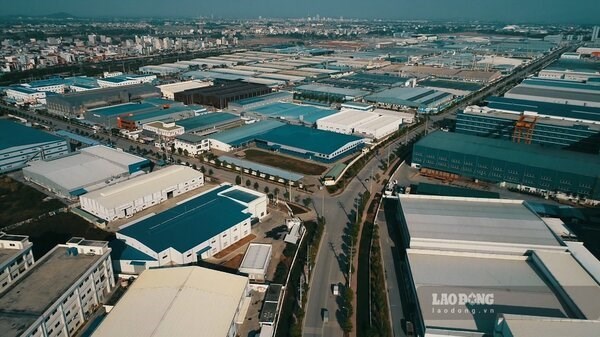
Large capital flows lead to increasing demand for human resources. In Bac Ninh, this problem is clearly showing when businesses need to recruit hundreds of thousands of workers in 2026.
According to the Bac Ninh Department of Home Affairs, in 2026, the total recruitment demand of businesses in the province is more than 260,000 people; from now until the end of the year, it will need about 120,000 workers, mainly at general education level in the fields of electronics and garment.
Human resource preparation must go ahead of the project
Mr. To Xuan Giao - Vice Chairman of the Vietnam Vocational Education Association - said that to solve the long-term human resource planning problem, forecasting human resource demand in the next 5-10 years cannot be based on feelings or raw data from previous years, but must closely follow 4 key criteria groups.
The first is the technology shift coefficient. It is necessary to clearly analyze to what extent the project uses automation technology, and the proportion of robots and artificial intelligence (AI) replacing manual labor to accurately quantify the needs for operating engineers and maintenance technicians.
The second is the capital flow drop point and disbursement progress. Localities need to clearly define time milestones and human resource needs for each stage of the project.
Third is the level of localization of the supply chain. Localities need to measure the potential for linkage with domestic supporting businesses to forecast human resource demand for supporting industries such as electronic components, precision mechanics and new materials.
Fourth is the green capacity and digitization standards. Criteria for digital skills certificates and environmental certificates (ESGs) need to be included in the forecasting framework to ensure that workers meet the increasingly strict standards of major export markets.
To avoid training that is not close to business needs, Mr. To Xuan Giao believes that there needs to be a breakthrough in the "State - School - Enterprise" coordination model.
According to him, the "three-house" model needs to be transformed into a common operating ecosystem, instead of just stopping at formal cooperation memorandums of understanding (MOU). In which, businesses must become the co-designer of the training program.
For educational institutions, Mr. Giao proposed operating according to the "Factory in School" model, bringing simulated production lines or industrial standard practice equipment into the training space. Lecturers also need to be rotated and go on field trips at businesses periodically to update new technologies.
Meanwhile, localities play a constructive and regulatory role. The government needs to allocate local human resource development funds to co-finance investment costs for high-tech practical equipment, and build specialized job exchanges associated with industrial park planning data.
These are solutions that need to be urgently implemented in localities that are focusing on developing high-tech industrial parks, thereby proactively preparing high-quality human resources, instead of waiting until the project comes into operation to start searching for and training workers" - Mr. To Xuan Giao emphasized.


