
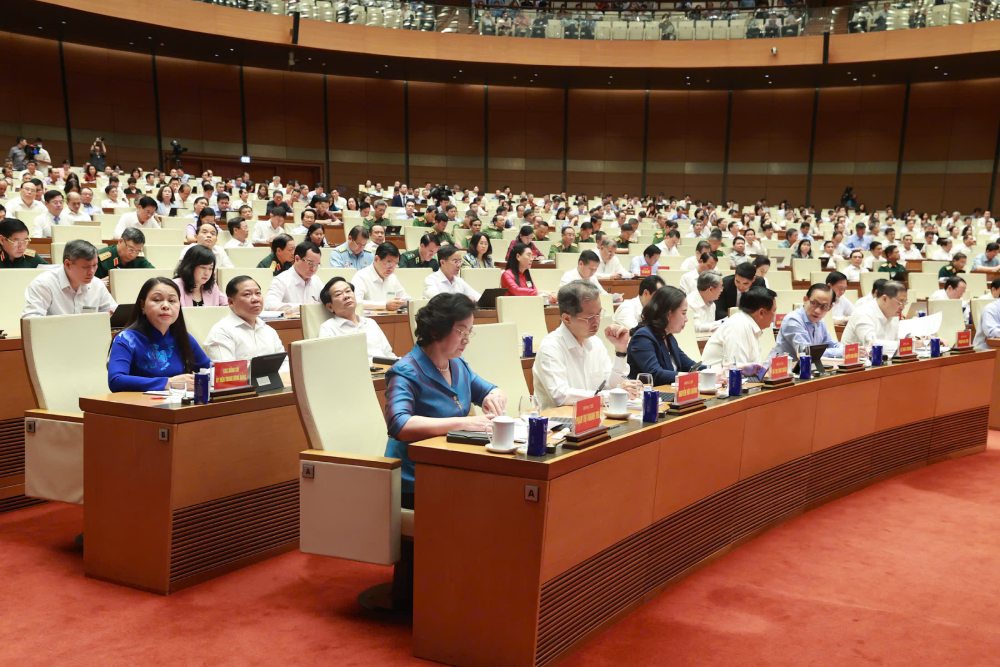
On the morning of July 1st, in Hanoi, the Politburo organized a national conference to summarize 1 year of operation of the overall organizational model of the political system and the 3-level government model.
At the conference, Politburo Member, Secretary of the Hanoi Party Committee Tran Duc Thang provided information on the results of 1 year of operating the new organizational model in the city.
According to Hanoi Party Secretary, regarding the arrangement of administrative units (UAs), the city has terminated the operation of 30 district-level UAs and reorganized 526 commune-level UAs down to 126 communes and wards (a decrease rate of over 76%).
The city also immediately consolidates the key leadership team, organizes training and fostering to consolidate the grassroots cadre force.
Regarding decentralization and authorization, it is implemented according to the principle "what is done well by subordinates is thoroughly assigned"; assigning tasks, assigning powers, assigning resources and guiding, absolutely not outsourcing. Currently, the city is implementing 1,311 tasks decentralized by the Central Government, of which the city has assigned 1,070 tasks to commune levels.
The city builds a modern administration based on digital transformation and data. Establish a unified management system from the city to the grassroots level; deploy the Hanoi Workspace workspace system and the iHanoi digital interactive platform for the government to receive people's opinions. The city provides 2,077 public services, with 1,118 eligible online procedures.
The city has innovated personnel work in the direction of shifting from standardized thinking according to conditions to management based on implementation capacity, evaluating cadres and civil servants using KPI and OKR.
The city focuses on regularly supervising new, difficult and backlogged tasks to handle them early, not allowing them to accumulate into violations.
Hanoi Party Secretary affirmed that the operation of the new model has brought positive changes in many fields.
Regarding management capacity, creating favorable conditions for the City to decide on major issues such as 100-year vision planning and removing bottlenecks for slow-progress projects and site clearance.
Regarding economic development, GRDP in 2025 and the first 6 months of 2026 reached the highest level in many years; digital economy accounted for a high proportion; public investment disbursement reached over 50%.
Regarding administrative reform, the rate of overdue dossiers decreased sharply from 44.63% (in 2025) to 4.2% (first 6 months of 2026).
Regarding people's satisfaction, real-time survey results show that the rate of satisfaction and very satisfaction of people reached 98.95%.
To make the 2-level local government a "center for creating development", the city focuses on 5 groups of tasks:
Review and classify commune-level administrative units according to their specific characteristics such as urban core areas, rapid urbanization areas, suburban areas, green rural areas to decide on appropriate professional apparatus. Research and build key commune-level administrative units, especially to lead and spread.
Hanoi continues to decentralize and authorize synchronously with the allocation of resources based on the implementation capacity of communes.
The city also reviews and arranges internal focal points, ensuring no intermediaries and researching the transfer of some public services to businesses and social organizations for implementation.
Improve the capacity of the contingent of cadres, especially at the grassroots level; encourage and have mechanisms to protect dynamic and creative cadres, but also resolutely handle cases of delays and evasion of responsibility causing trouble for people and businesses.
Regarding the completion of the data platform, the city coordinates with the Central Government to complete the common data; striving to complete the data bases under the city's authority in 2026 according to the Government's architecture.
The city strives to basically solve the problems arising from practice in the process of operating the new model by the end of 2026.


