
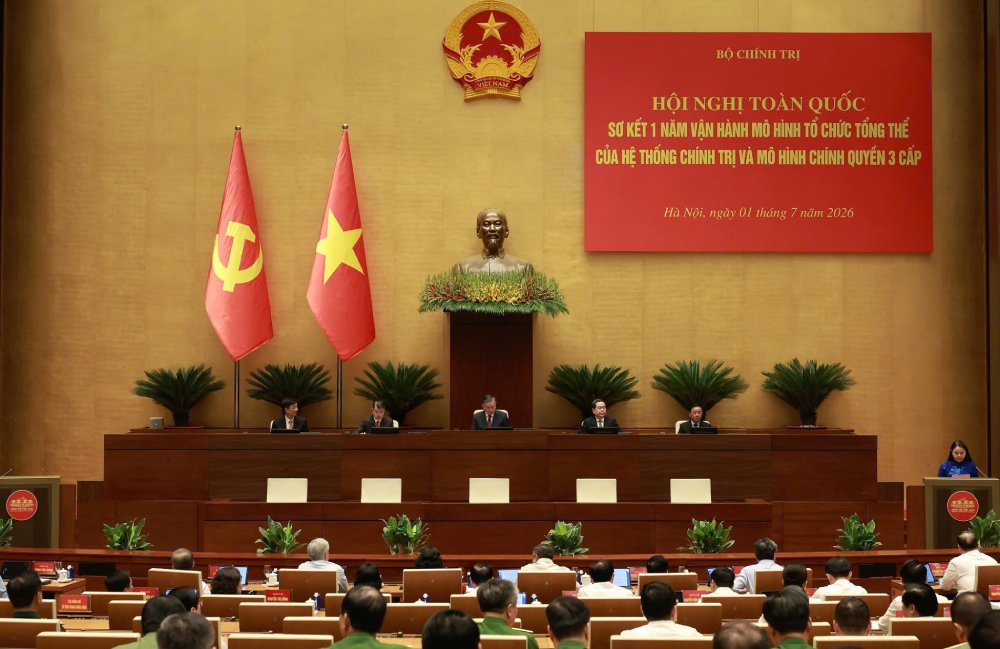
This morning (July 1), at Dien Hong room, National Assembly House, the Politburo organized a national conference to summarize 1 year of operating the overall organizational model of the political system and the 3-level government model.
General Secretary, President To Lam; Politburo members: Prime Minister Le Minh Hung, National Assembly Chairman Tran Thanh Man, Standing Secretary of the Secretariat Tran Cam Tu chaired the conference. Also chairing the conference were Politburo member, Secretary of the Party Central Committee, Head of the Central Organization Committee Nguyen Duy Ngoc - Head of the Preliminary Review Steering Committee.
The conference was held in a direct, combined online format to 3,651 bridge points nationwide.
2025 marks a historical turning point in the process of renovating the organization and operation of the political system when our country simultaneously implements the arrangement of the organizational structure, arranging administrative units and transitioning to a 2-level local government model.
This is a large-scale reform, with many unprecedented contents, implemented to build a modern, streamlined, efficient, effective and effective administration, meeting the requirements of national development in the new period.
Reality shows that after one year of implementation, the arrangement of the organizational structure and operation of the 3-level government has achieved important initial results.
The administrative apparatus at all levels has been streamlined; intermediate levels have been reduced; the functions, tasks, and authority of agencies have been gradually improved; decentralization and delegation of power mechanisms have been promoted.
One of the clear results after a year is that the state administrative apparatus has been strongly streamlined.
At the Central level, the organizational structure of the Government was streamlined from 22 ministries and ministerial-level agencies to 17 ministries and ministerial-level agencies. Organizations within ministries and ministerial-level agencies were reviewed, sharply reducing the number of departments, divisions, sub-departments and equivalent organizations; and at the same time ending the general department model.
Locally, the whole country currently has 34 provincial-level administrative units including 27 provinces, 7 cities; 3,321 commune-level administrative units including 2,621 communes, 687 wards and 13 special zones; and at the same time terminated the operation of 696 district-level units.
Along with organizational arrangement, the arrangement and restructuring of the contingent of cadres and civil servants is being implemented to ensure that the new apparatus operates continuously, without interrupting the service to people and businesses.
As of June 8, 2026, the total number of officials and civil servants present at ministries and ministerial-level agencies is more than 93,000 people; at localities is more than 215,000 people.
In the process of arrangement, the work of resolving regimes and policies for officials and civil servants affected is focused on. In 2025, the whole country has resolved regimes and policies for 209,598 people who quit their jobs due to organizational arrangement and staff streamlining.
An important highlight of the new model is the change in the role of grassroots government through promoting decentralization and delegation of power.
In general, to date, the number of tasks decentralized to local authorities has reached about 1,453 tasks, accounting for about 71.5% of decentralized tasks from the central government to localities.
The Government, the Prime Minister and ministries also solved 28.5% of tasks corresponding to the central government's administrative procedures; reflecting a strong shift in empowering localities in parallel with strengthening implementation responsibility.
The highlight is that the role of the commune-level government has undergone fundamental changes. If previously the commune level mainly performed grassroots administrative management tasks, now it has directly undertaken a large volume of state management tasks, providing public services and resolving administrative procedures.
This shows that the commune level has truly become the level of government directly handling the work of people and businesses, contributing to shortening the process of handling work, reducing intermediate levels and improving service efficiency.


