
Amending the Capital Law must be decisive, avoiding half-heartedness
In the afternoon of April 8, the National Assembly discussed in groups about the Draft Law on the Capital (amended); the Draft Law amending and supplementing a number of articles of the Law on Emulation and Commendation; the Draft Law on Belief and Religion (amended).
Speaking at the group, General Secretary and President To Lam affirmed that the amendment of the Capital Law is not simply to complete a specific law, but an opportunity, a strategic step to create a new institutional development model for the Capital with a special position: National political and administrative center, and at the same time a driving force for the country's development, a development locomotive.
The requirement is to delegate power more strongly, decentralize and decentralize power more thoroughly, and at the same time have clearer accountability, and stricter power control mechanisms. Empowerment must go hand in hand with control to ensure efficiency.
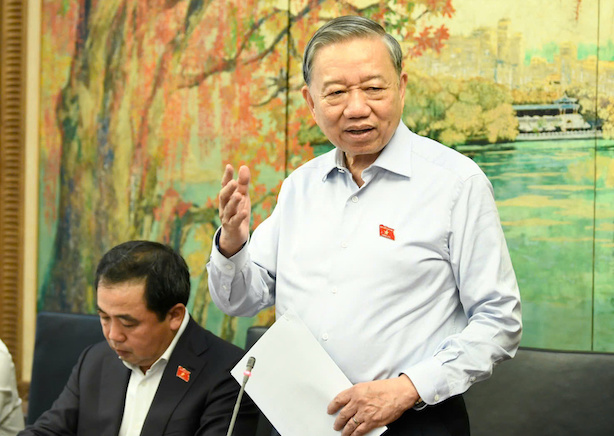
General Secretary and President To Lam acknowledged that in practice, the major bottlenecks of the Capital today, especially in planning, infrastructure, urban management, decentralization, delegation of power, mobilization of resources... have not been fundamentally resolved. Therefore, it is necessary to compare the regulations in the law to remove these bottlenecks and difficulties.
He emphasized that the capital's development plan in 100 years must clearly define the direction. The entire population of the capital needs to know the current situation and future 10 years later, 50 years later, 100 years later. The plan must be specifically expressed on the model, according to each development stage...
The General Secretary and President suggested that planning must identify core areas, development areas, satellite cities, modern urban area standards with full social infrastructure. It is necessary to determine traffic connections between areas: travel time, type of transportation (subway, urban railway...); It is necessary to amend regulations that are no longer appropriate, remove institutional bottlenecks...
Emphasizing the requirement for thinking innovation, he proposed a strong shift from management thinking to development-creating thinking; the law must create institutional space for the Capital to proactively design, test and implement policies suitable to its specific characteristics.
In law design, it is necessary to ensure stability in principle, while flexible contents should be assigned to the Government, even the city government to regulate to suit reality, avoiding rigidity and quickly becoming outdated.
Regarding decentralization and delegation of power, he affirmed that this is a key content, which must be substantive, clear and linked to implementation capacity and corresponding resources. Avoid the situation of delegating power but not meeting the conditions for implementation, leading to risks in the implementation process.
At the same time, it is necessary to clarify the scope of application of special mechanisms other than current laws, only applying in truly necessary areas, with strict control. Policy piloting must have conditions, deadlines, and specific monitoring and evaluation mechanisms, not to prolong or legitimize inadequacies in management.
The General Secretary and President also noted that there must be a mechanism to protect cadres who dare to think and dare to do, but accompanied by clear responsibility and control. In addition, it is necessary to strengthen regional linkages with appropriate mechanisms, because the Capital and localities in the region have interdependent relationships.
Another important requirement is to ensure human rights and citizens' rights in the process of strong decentralization, especially in the fields of land, investment, and urban development; all policies must be public, transparent, and harmonize interests between the State, businesses and people.
Law-making must be decisive, not half-hearted, not half-hearted," General Secretary and President To Lam stated, while emphasizing that the core of law amendment is balancing between empowerment and power control; between breakthroughs and discipline; between local interests and national interests.
If done well, the Capital Law will not only create a breakthrough for Hanoi but also become a typical institutional model, with spreading value throughout the country in the next development period" - he emphasized.
Emulation and commendation must be substantive, avoiding averageization

Regarding the draft Law amending and supplementing a number of articles of the Law on Emulation and Commendation, the General Secretary and President said that the amendment is necessary to create a new legal framework and promote development momentum.
He emphasized the viewpoint that law-making needs to strongly shift from process-based commendation to commendation based on substantive value and work efficiency. Commendation must be associated with innovation, high efficiency and the spirit of daring to think and dare to do, instead of accumulating achievements over time. Achievements must be measured, verified, have breakthrough and spread, avoiding the situation of average and formality.
Especially, it is necessary to focus on thoroughly overcoming the situation of achievement disease, rampant and formal commendation" - General Secretary and President emphasized, and at the same time, set out the requirement to harmoniously handle the relationship between encouragement and screening, between expanding subjects and maintaining standards, between decentralization of power and control of power. If commendation is expanded without maintaining standards, it will lead to "inflation" of titles; conversely, if too cautious, it will reduce emulation motivation.
In addition, decentralization in emulation and commendation needs to be linked to the responsibility of localities; prioritizing the recognition of people who directly work and are creative, thereby creating fairness and strengthening social trust.


