
Science and technology must go slow, take the lead
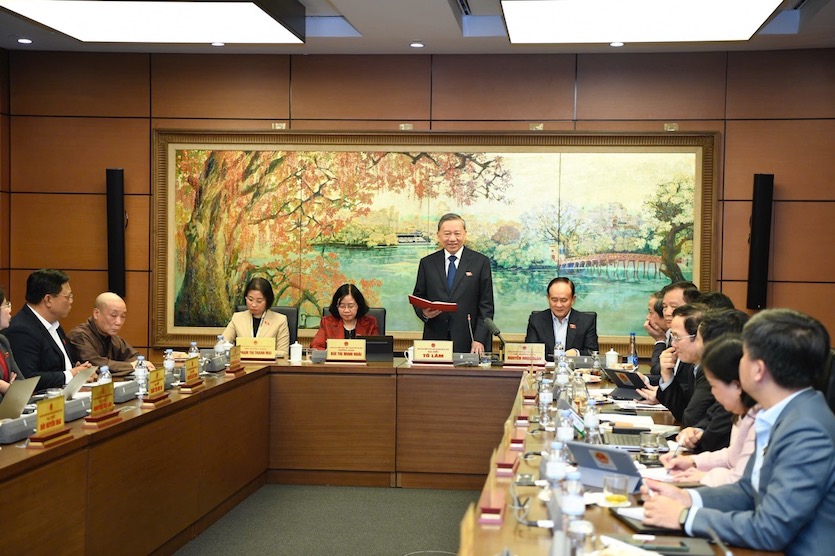
On the afternoon of November 4, the National Assembly discussed in groups the draft Document to be submitted to the 14th National Congress of the Party.
Speaking in the group, General Secretary To Lam said that currently, many countries are choosing the path of science and technology to promote rapid development.
With the current development speed, in just 10 years, many countries can achieve achievements that previously took hundreds of years to achieve thanks to science and technology.
"Without technology, it is impossible to develop" - the General Secretary emphasized.
According to the General Secretary, in the context of strong digital transformation, if we continue to rely on heavy industry or traditional automation, countries will quickly fall behind. Many countries are facing difficulties due to not being able to transform digitally. Large investment capital has not yet been recovered, production structure has not yet changed, causing them to slow down compared to the general development speed.
Some countries are looking to transfer outdated lines, factories, and equipment to other countries for digital transformation. Therefore, if we are not alert and skillful, we can easily become a "umsure of technology", receiving outdated heavy machinery and industry.
Therefore, the General Secretary requested that it is necessary to be wise and quick in science and technology development policies, need to grasp new trends, apply digital technology, artificial intelligence, and transform production models...
"I have the right to follow behind me, take the lead, and develop science and technology" - the General Secretary emphasized.
The General Secretary said that the national governance model in the coming period must be built on a transparent legal foundation and a reliable data system. Because without data, even technology and artificial intelligence cannot work.

The General Secretary set out the requirement to have a modern digital infrastructure, a streamlined apparatus, and qualified staff to meet the above requirements. That is the foundation of modern governance.
"All sectors, levels, and places must comply and must be implemented. This is a comprehensive revolution, not only education, healthcare, and culture need digital transformation" - the General Secretary stated.
Promoting double-digit growth must be through fundamental, sustainable solutions
Referring to the double-digit growth target, the General Secretary said that specific, strong and breakthrough solutions are needed.
The General Secretary said that economic growth depends on many factors: Financial and monetary policies, foreign investment, direct investment and indirect investment... Meanwhile, we still have many opportunities, many problems, and room to exploit to promote growth.
From there, the General Secretary raised the issue, it is necessary to determine the reasons why our growth has only stopped at the highest level of about 9% for many years and how to overcome that threshold.
However, the General Secretary also emphasized the requirement that growth must not only be high, but also stable and sustainable. Sustainable growth cannot come only from capital or fiscal policy, but must come from science - technology and innovation. It is necessary to study and calculate how much science and technology contribute to growth rate, productivity and the overall development rate.
The General Secretary especially noted that growth must be associated with sustainable development, not for environmental exchange, not for social stability. There must be comprehensive, carefully calculated, in-depth solutions that are both developed and ensure long-term stability and sustainability.
Criteria on development, environment, investment, growth and livelihood must be considered in a unified package.
This, according to the General Secretary, cannot be rushed because if not controlled well, it will affect the environment and sustainability of the economy. It is necessary to carefully review and fully assess, including indirect investment - which is increasingly having a big impact on the financial market and the national economy.


