
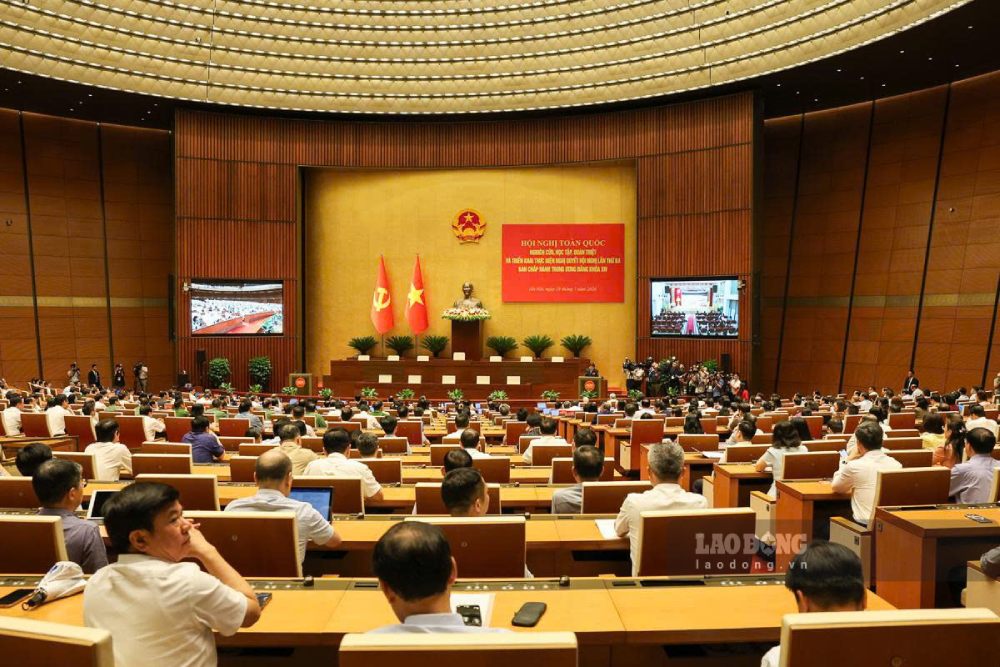
On the morning of July 29, a national conference was held in Hanoi to study, study, thoroughly grasp and implement the Resolution of the 3rd Conference of the 14th Party Central Committee.
At the conference, Politburo Member, Standing Deputy Prime Minister Pham Gia Tuc reported on the key and core contents of the Resolution on viewpoints, orientations, and amendments to the Land Law and related laws.
According to the Standing Deputy Prime Minister, land is still one of the areas with many problems, prone to complaints, denunciations, losses, waste, corruption, negativity and group interests.
Some mechanisms and policies are still inadequate, making land resources not fully effective, especially in terms of planning, land allocation, land lease, land use purpose conversion, land recovery, compensation, resettlement, land finance, and land prices.
Regarding the role of land, the Resolution has affirmed that land belongs to the entire people, and the State is the representative of the owner and uniformly manages it.
Absolutely do not privatize land and do not allow foreigners to receive transfers or transfers of land use rights in any form, except for Vietnamese people of Vietnamese origin residing abroad.
Regarding land allocation, land lease, and land use purpose conversion, continue to implement land allocation and land lease mainly through land use right auctions and bidding for land-using projects for land funds managed by the State.
Equality in land access between public and private sectors, clearly stipulating cases where auctions and bidding are required, cases where no auctions or bidding are required, and cases where investors voluntarily agree to receive land use rights.
Continue to implement land allocation and land lease for a limited term for commercial housing construction land for sale, mainly prioritizing apartment buildings. In which, for newly built apartment buildings, the term of use of apartment buildings is regulated according to the construction term of the project, associated with ensuring property rights; apartment building owners are entitled to fulfill financial obligations to build new apartment buildings according to regulations when the term expires. Limit the subdivision and sale of land plots in urban areas, especially large cities.
The land use term for leased housing, policy housing, and public service housing owned by the State is long-term. There are preferential policies in land allocation and land lease to encourage and attract the private sector to participate in developing the rental housing market at reasonable prices.
Regarding compensation, support, resettlement, and land recovery, more clearly stipulate the scope of land recovery in cases of real necessity for national defense, security, socio-economic development for national and public interests; do not stipulate too broadly leading to abuse but also do not stipulate too narrowly causing difficulties for essential projects.
The State recovers land for the remaining area of the project when the investor has agreed on most of the area and received the consensus of the majority of land users within the project implementation scope.
Regarding land prices, land finance and regulating land rent differences, the Standing Deputy Prime Minister emphasized that this is a difficult content, which localities are very concerned about. The Resolution affirms that land prices are decided by the State based on the development goals of each period, ensuring reasonable input costs for production and business activities, and improving the competitiveness of the economy.
The State promulgates land price lists, land price adjustment coefficients, land use fee rates, land rent rates, and compensation rates in accordance with actual conditions for each type of land, ensuring fairness, publicity and transparency.
Implement according to the principle that the Central Government develops framework criteria, principles, methods and mechanisms for inspection and supervision; localities decide land prices.
Regarding financial instruments and tax policies, research and apply a policy of regulating outstanding land rent for surpluses in real estate business and a higher tax policy for abandoned land that is not put into use to limit speculation, combat wastefulness, and sanitize the market.


