
Busy generation and financial uncertainty
Lan Anh (26 years old, an employee of a media company in Ho Chi Minh City) always considers herself a " Gen Z model in the technology era". Her busy schedule and continuous projects make her almost no time for traditional financial procedures. All of Lan Anh's expenses can be counted through an application linked to the banking app.
However, behind that convenience, Lan Anh almost does not remember what she spent in the month, often falling into a "wallet-sold out" situation and being completely vague when thinking about long-term financial plans.
"Every day I squeeze, transfer, and pay so quickly that I can't remember what I have spent. At the end of the month, when I opened the app and saw the balance almost touching the bottom, I was startled... Obviously, I spent a lot, but I couldn't manage my revenue and expenditure, so I didn't dare to think about things further" - Lan Anh admitted.

Financial experts believe that the root cause of the "fast payment - financial blindness" situation lies in the fact that digital consumption habits develop too quickly, while financial management skills cannot keep up.
The solution comes from the banking application itself
According to experts, the gap in financial management needs to be narrowed not only by financial education but also by support tools for real-time financial monitoring. This is the reason why many banks are strongly shifting the digital banking model with features that help users see themselves in each financial decision.
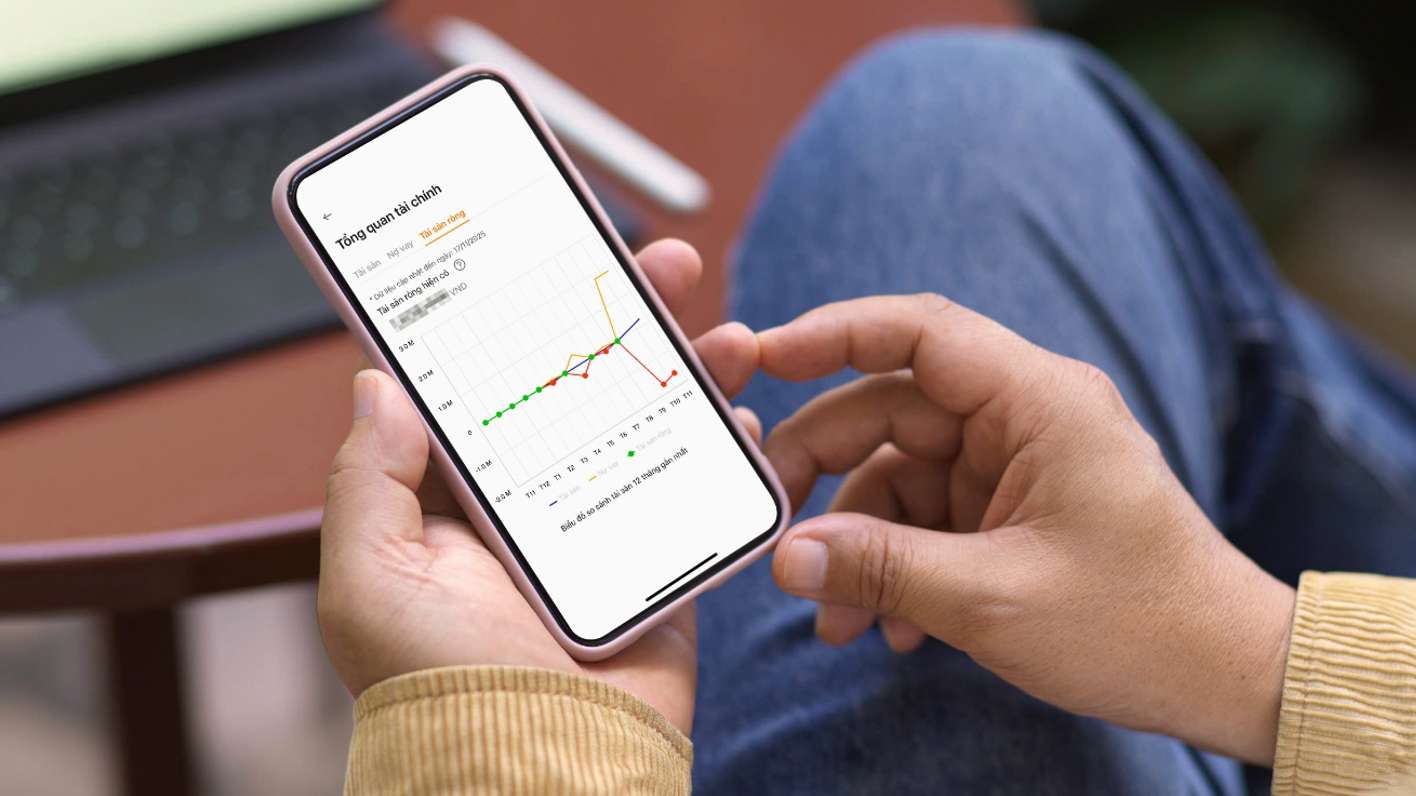
For example, SHB has launched the "General Financial Office" feature on the SHB SAHA app, where all of the user's savings, loan, account balance, etc. are displayed in a single interface. Instead of having to estimate or record disjointedly, users can immediately see their financial picture updated in real time.
In the Assets section, the automatic system synthesizes all payment account balances and savings deposits. Each category is expressed in its own color, helping users immediately know which items are accounting for a large proportion. Not only does the application display absolute numbers, it also shows a increase/ decrease compared to the previous month, helping users recognize their own consumption habits that they often ignore.
In the Debt section, SHB SAHA summarizes all outstanding credit card debt, installment and loan balances, divided according to the scale and available limit. With just one touch, users can immediately know how much they are borrowing, which outstanding debt accounts for the largest proportion, and the limited level of use to be able to adjust and plan to repay the debt appropriately.
The most important thing is the Net Assets section, where an automatic calculation application is used by taking total assets minus total debt. The data is shown in a monthly roadmap, showing how net assets have increased and decreased in the past 12 months.

SHB representative shared that the Bank found that customers, especially young people, are increasingly expecting more from a banking application. They not only need to trade quickly but also want to have a tool to help track their assets, debts and entire cash flow clearly and intuitively. This is the reason SHB developed the General Financial Office feature on the SHB SAHA application.
This feature does not provide investment advice or financial plans for customers, but acts as a miniature map, showing them where they are in their financial journey.
We want to bring customers a more complete, transparent and friendly financial experience. Helping customers 'see' their own financial picture is the foundation for sustainable financial health, emphasized the SHB representative.


