
SJC gold bar price
Closing the week's trading session, Saigon SJC Jewelry Company listed SJC gold price at 179.6-182.6 million VND/tael (buying - selling). The buying - selling difference is at 3 million VND/tael.
Compared to the closing session of last week (March 8th), the price of SJC gold bars at Saigon SJC Jewelry Company decreased by 2.4 million VND/tael in both directions.
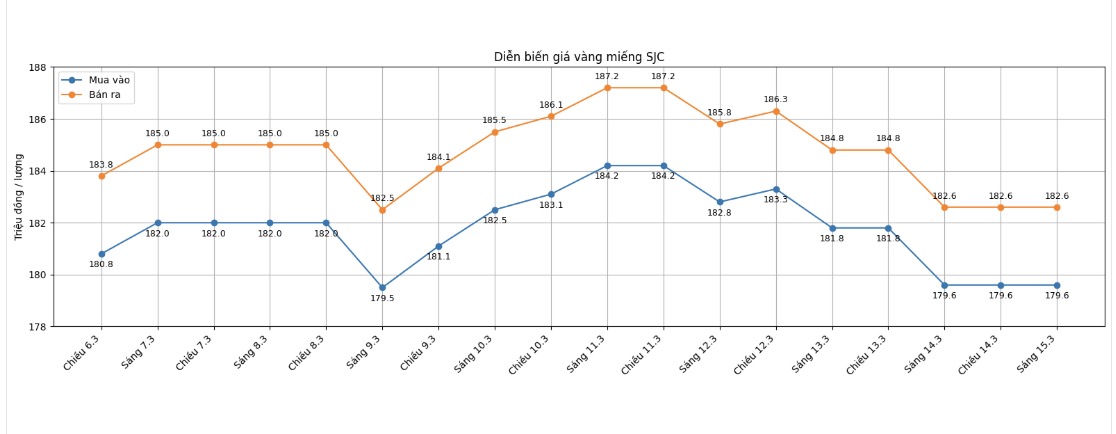
Meanwhile, DOJI listed SJC gold price at 179.6-182.6 million VND/tael (buying - selling). The buying - selling difference is at 3 million VND/tael.
Compared to the closing session of last week (March 8), the price of SJC gold bars at DOJI decreased by 2.4 million VND/tael in both directions.
If buying SJC gold bars on March 8th and selling them on today's session (March 15th), buyers at Saigon SJC and DOJI Jewelry Company will lose 5.4 million VND/tael.

9999 gold ring price
At the same time, DOJI Group listed the price of gold rings at 179.6-182.6 million VND/tael (buying - selling), down 2.4 million VND/tael in both directions compared to a week ago. The buying - selling difference is at 3 million VND/tael.
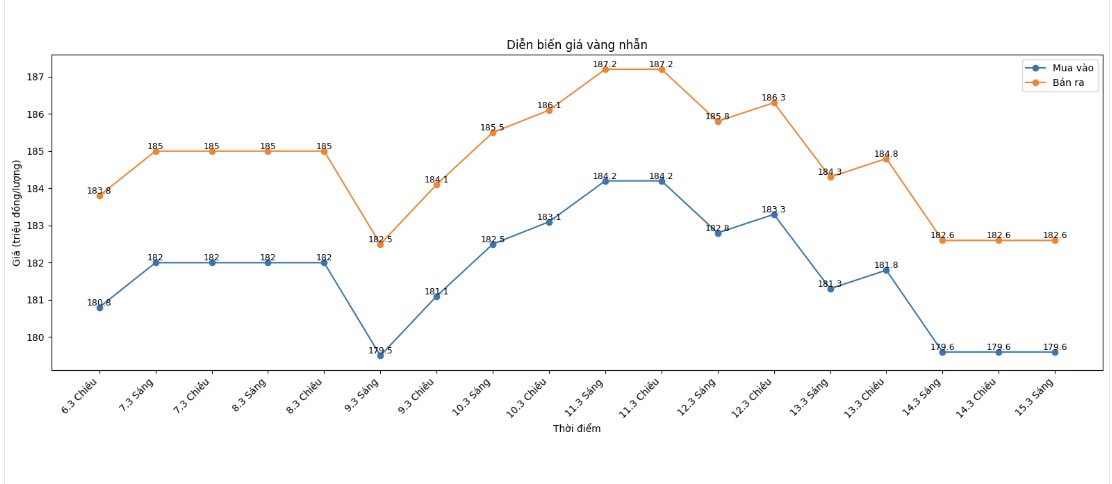
Phu Quy Jewelry Group listed the price of gold rings at 179.5-182.5 million VND/tael (buying - selling), down 2.5 million VND/tael in both directions compared to a week ago. The buying - selling difference is at 3 million VND/tael.
If buying gold rings on March 8th and selling them today (March 15th), buyers at DOJI will lose 5.4 million VND/tael; while buyers of gold at Phu Quy will lose 5.5 million VND/tael.

World gold price
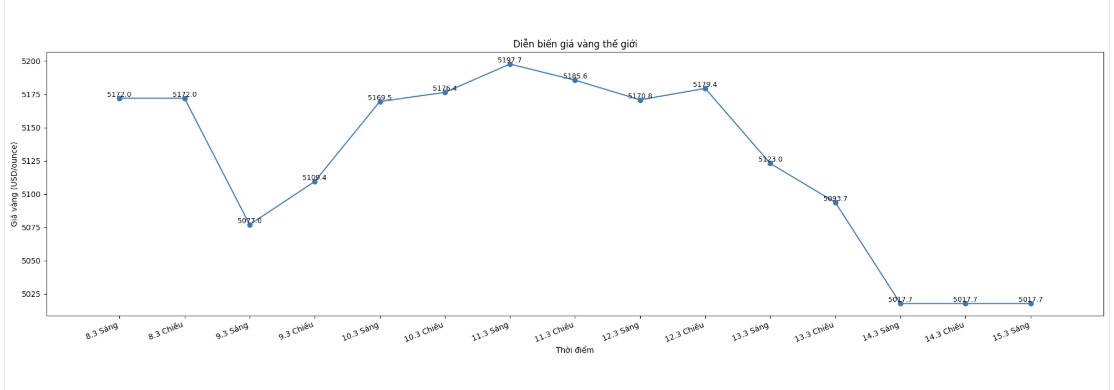
Closing the week's trading session, world gold prices were listed at 5,017.7 USD/ounce, down 154.3 USD compared to a week ago.
Gold price forecast
Last week, world gold prices fluctuated strongly when continuously fluctuating in the range of 5,000-5,240 USD/ounce. The precious metal started the week at 5,159.26 USD/ounce, quickly plunged to near 5,036 USD/ounce in the first session of the week, before rebounding and reaching a peak of nearly 5,240 USD/ounce on Tuesday.
However, the upward momentum did not last long. Profit-taking pressure and concerns that the Middle East conflict could be prolonged and more complicated caused gold prices to turn down in the last 3 sessions of the week, falling closer to the psychological support threshold of 5,000 USD/ounce.
This development shows that the gold market is still in a very sensitive state to geopolitical information, and is also affected by fluctuations in US bond yields, energy prices and monetary policy expectations.
According to Kitco News' weekly gold survey, Wall Street analysts are currently almost evenly divided on short-term price trends: 40% forecast prices to increase, 40% forecast prices to decrease, and 20% believe gold will move sideways. Meanwhile, individual investors still lean towards a more positive scenario, with 63% of opinions expecting gold prices to rise next week.
Mr. James Stanley - senior market strategist at Forex. com - said that gold holding the 5,000 USD/ounce mark is a noteworthy sign.
According to him, this is a sign that the market is gradually accepting a new high price level, thereby leaving open the possibility that buyers will continue to try their hand in the coming sessions if this support level is not broken.
In the opposite direction, Mr. Rich Checkan - Chairman and CEO of Asset Strategies International - is cautious. He believes that next week is a sensitive time when the US Federal Reserve (FED) holds policy meetings.
Although it is likely that the FED will keep interest rates unchanged, the market may still react in a disadvantageous direction for gold in the short term, causing precious metal prices to bear more adjustment pressure.
In general, in the coming week, the 5,000 USD/ounce mark will continue to be an important support zone for world gold. If this price zone is maintained, gold may recover. Conversely, if selling pressure increases, the precious metal is likely to face another short-term correction.
Gold price data is compared to a week earlier.
The world gold market operates through two main pricing mechanisms. The first is the spot market, where prices are quoted for transactions and immediate delivery.
The second is the futures contract market, where prices are set for futures delivery. Due to year-end closing activities, December gold futures contracts are currently the most actively traded type on the CME.
See more news related to gold prices HERE...


