
The US Department of Commerce said retail sales in February increased by 0.6%, reversing the 0.1% decrease in January after the adjustment. This result is significantly better than analysts' forecasts, which expected retail sales to decrease by 0.5%.
For the year, retail sales increased by 3.7%, higher than the 3.2% increase recorded in the previous month. Core retail sales, excluding cars, increased by 0.5%, also exceeding the forecast of 0.3%.
Notably, the control group - excluding sales from car dealerships, building material stores, gas stations and stationery stores - increased by 0.5%. This is a data group that directly impacts US GDP and also exceeds market expectations.
Usually, positive consumer data will put pressure on gold prices. The reason is that as US consumers continue to spend heavily, the US Federal Reserve (FED) will have more room to maintain a higher interest rate level for longer to control inflation. This increases the opportunity cost of holding gold, an unprofitable asset.
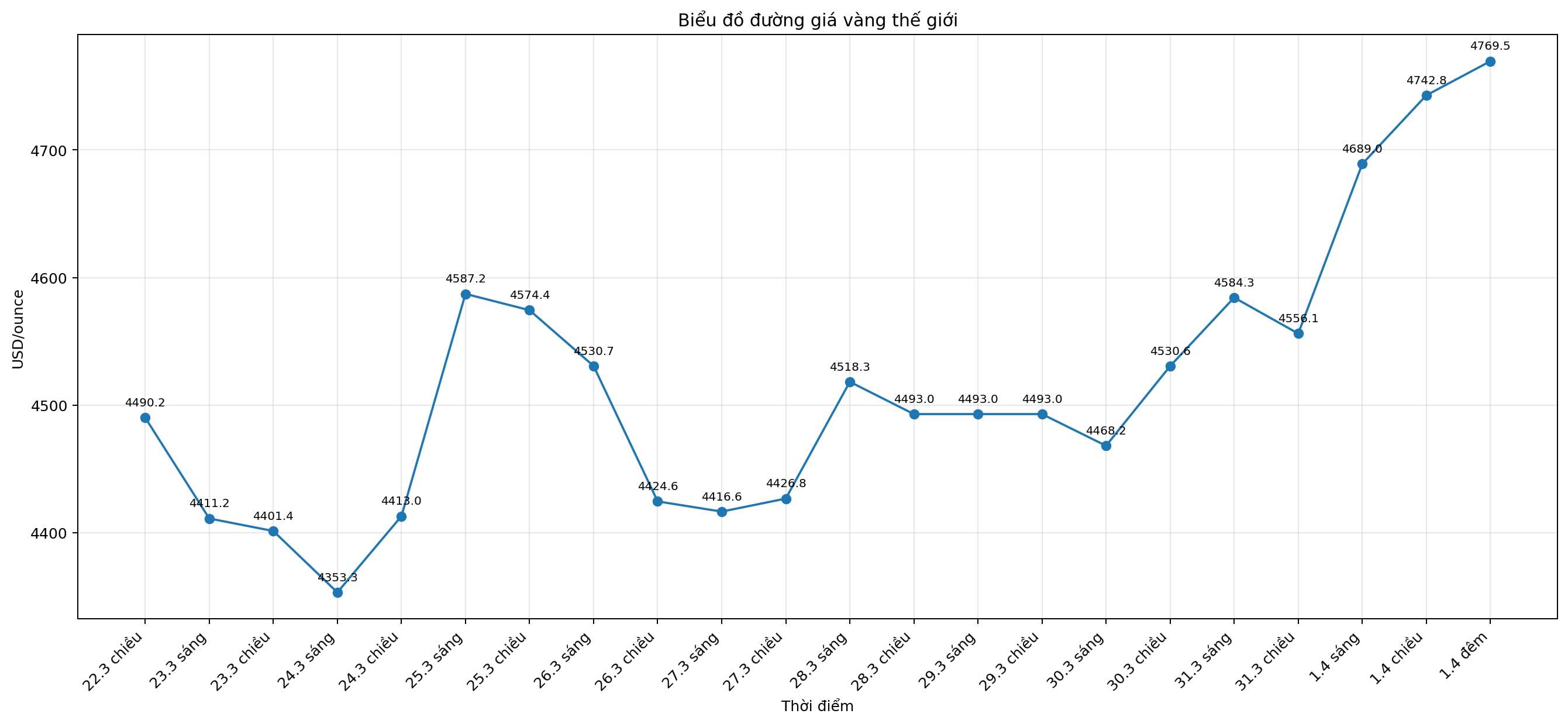
However, contrary to the familiar rule, spot gold prices still increased sharply to 4,735.90 USD/ounce, equivalent to an increase of nearly 1.5% in the day.
Not only the consumer sector, the US labor market also sends positive signals. ADP's report shows that the US private sector created 62,000 jobs in March, higher than the forecast of 41,000 jobs. The figure for February was also adjusted up to 66,000 jobs.
According to Ms. Nela Richardson - Chief Economist of ADP, recruitment activities are generally stable, although job growth is more concentrated in certain sectors, especially healthcare. She also said that the wage increase for job seekers in March has improved significantly.
After this report, gold prices slightly adjusted compared to the peak in the night session but still maintained firmly above 4,700 USD/ounce. Spot prices were recorded at 4,729.3 USD/ounce, up more than 1% during the day.
The ADP report also shows that the salary picture is differentiated. The income of workers who continue to stay in their old jobs has remained almost unchanged for 3 consecutive months. Meanwhile, the group of job-shipping workers enjoys an annual salary increase of up to 6.6%.
In another development, the US manufacturing sector continued to show expansion. The US Institute for Supply Management (ISM) said that the manufacturing PMI index in March reached 52.7 points, higher than February's 52.4 points and exceeded market forecasts.
In principle, the index above 50 points shows that manufacturing activity is growing. Thus, the US manufacturing sector has extended its expansion streak to the 17th consecutive month.
However, the details inside the report show that the picture is not entirely favorable. The new order index decreased from 55.8 to 53.5 points. The job index also slightly decreased from 48.8 to 48.7 points, reflecting that the labor market in the manufacturing sector has not really recovered.
More notably, price pressure is rising sharply again. The ISM price index jumped to 78.3 points from 70.5 points in February. This is a signal that inflation is still a major concern for the US economy.

Ms. Susan Spence - Chairwoman of the ISM Manufacturing Business Survey Committee - said that uncertainty in the manufacturing sector is becoming increasingly clear. In addition to prolonged concerns about US economic policy, businesses have for the first time mentioned the Iran war as a new factor affecting business operations. According to her, 64% of the opinions in the March survey were negative; of which about 20% mentioned tariffs and about 40% mentioned the conflict in the Middle East.
In that context, gold continues to be supported by safe-haven demand. Although US economic data shows that the economy is still resisting well, the market seems to be focusing more on prolonged inflation risks and global geopolitical instability.
With strong buying power still maintained, investors are closely monitoring the next signals from the FED as well as inflation and geopolitical tensions, factors that may continue to orient the trend of the gold market in the coming time.


