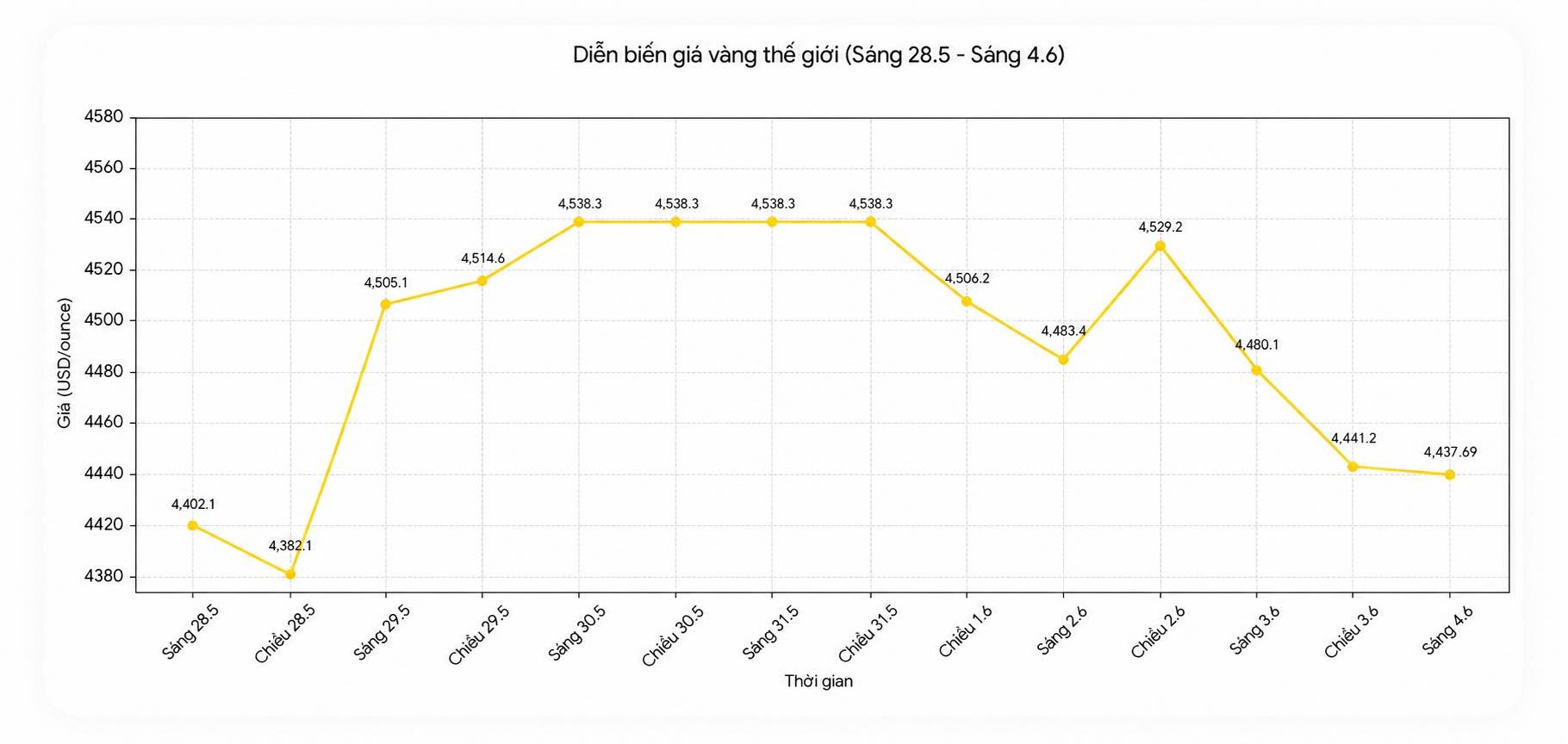
Gold prices are heading for their second consecutive week of decline as instability surrounding the negotiation process to end the conflict in the Middle East continues to cast a shadow over market sentiment.
The precious metal fell below the threshold of 4,450 USD/ounce in Friday's trading session, thereby heading towards a decrease of about 2% in the week. This is also the week that witnessed the most tense developments in the region since the ceasefire was established in early April.
On Thursday, Iranian-backed Hezbollah rejected the US-mediated ceasefire proposal between Israel and Lebanon. Previously, the region also recorded missile and drone attacks on Kuwait and Bahrain, along with a US airstrike on an oil tanker en route to Iran.
Negotiations aimed at ending the larger conflict in the Middle East are currently deadlocked after signs of reaching an agreement appeared last week.
US President Donald Trump said peace talks have entered the "final" stage, while Iranian Foreign Minister Abbas Araghchi affirmed "no significant progress has been made".
Entering its fourth month, the conflict disrupted energy flows through the Strait of Hormuz, pushed oil prices higher and increased concerns about global inflation.
In that context, central banks are likely to maintain high interest rates for a longer period or even continue to tighten monetary policy. This is a disadvantage for gold and precious metals because it does not bring yields.
Mr. Nicholas Frappell – Global Organization Market Director at ABC Refinery commented:
Recognizing that the issue related to the Strait of Hormuz is increasingly far from being resolved has increased the risk of an energy shock. This means monetary policy will tighten and this is a factor putting pressure on gold.
According to Mr. Frappell, gold prices are currently trading below many important technical thresholds on both the daily and 4-hour charts, showing that the short-term trend is still leaning downwards.
Since tensions escalated at the end of February, gold prices have fallen sharply and have mostly fluctuated in a narrow range recently. As of the last session of the week, the precious metal is still about 16% lower than before the conflict broke out.
Meanwhile, Ms. Mary Daly – President of the San Francisco Federal Reserve Bank said that the US economy still has too much uncertainty to be able to make a clear assessment of the next direction of interest rates.
We are ready to react in both directions, depending on what the economy shows," she said at the Bloomberg Technology Conference on Thursday.
As of 10:03 a.m. in Singapore, spot gold price decreased slightly by 0.03% to 4,437.69 USD/ounce.
On other precious metals markets, silver prices fell 1.6% to 72.70 USD/ounce. Platinum and palladium also simultaneously weakened.
Meanwhile, the Bloomberg Dollar Spot Index – a measure of the strength of the USD – was almost flat after falling 0.1% in the previous session.