
After taking profits and temporarily standing out of the market in May, Schroders at the end of August raised its rating for gold prices and re-established its position in this precious metal.
The London-based asset manager said that gold investment opportunities in the medium term are increasingly attractive, despite real yields still being high and precious metal prices just experiencing a significant increase.
In the latest multi-asset outlook, Schroders (a global asset and investment management group in the UK) raised its rating for gold to positive, based on a combination of strong structural demand, improved speculative positions and persistent concerns related to inflation, public debt as well as the stability of currencies.
According to Schroders, high real yields, demand from institutions returning and the position of short-term investors becoming more balanced have prompted this organization to return to the gold market. Although prices have just increased sharply, Schroders believes that gold still brings attractive risk-reward relationships in the medium term.
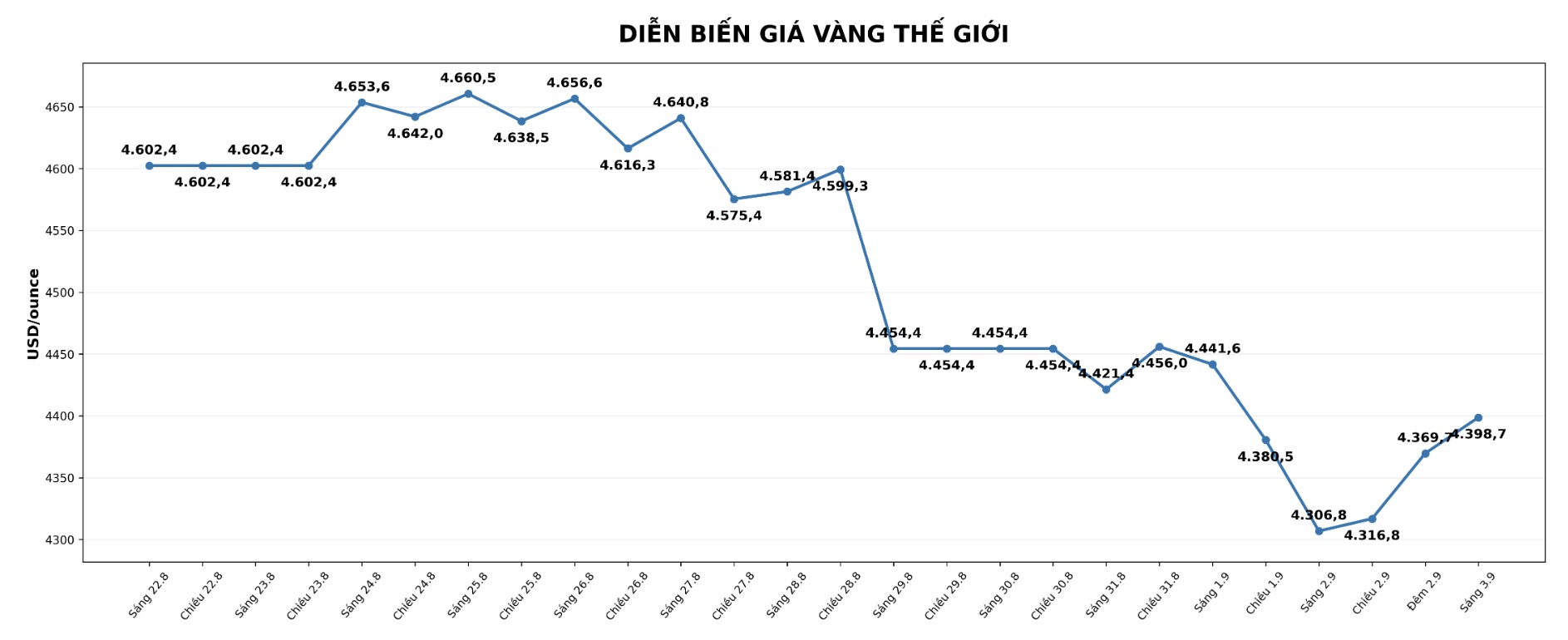
Positive views appeared in the context of the gold market regaining momentum thanks to growing concerns about the rate of US public debt growth, thereby promoting defense demand against the risk of a decline in USD purchasing power. Last month, gold prices tested the resistance zone just below 4,700 USD/ounce.
However, gold prices then fell sharply from the recent peak when US Federal Reserve (Fed) Chairman Kevin Warsh continued to emphasize the goal of stabilizing prices and bringing inflation back to the target level of 2%.
Despite selling pressure, gold still maintained at a significantly higher level than the bottom set in July. The nearest spot gold price was recorded around 4,381.5 USD/ounce, up more than 1% during the day.
It is noteworthy that Schroders remains optimistic about gold while maintaining a relatively positive outlook on the global economy and risky assets. This organization continues to prioritize stocks, based on global growth expectations maintaining resilience and business profits remaining solid.
Usually, increased real yields will be detrimental to gold because the precious metal does not generate periodic income. However, the decision to return to the market shows that Schroders assesses that other fundamental factors are strong enough to compensate for this traditional obstacle.
One of the important drivers is demand from institutions, along with structural buying power from central and Chinese banks.
Schroders believes that gold continues to be supported by strong demand from central banks, China and prolonged concerns about inflation, government debt as well as monetary stability.
The demand of central banks has become one of the important pillars of the gold market in recent years as foreign exchange reserve managers are promoting asset diversification.
In addition, concerns related to the size of government debt and the stability of currencies continue to strengthen the role of gold as a monetary asset and portfolio diversification tool.
It is noteworthy that the current theoretical environment is not favorable for precious metals: high real yields, the possibility of US interest rates still increasing and the prospect of the USD strengthening. Schroders has even re-established a position to buy USD against low-yield currencies such as Japanese yen and Swiss franc.
The continued increase in interest in gold shows that Schroders believes that the long-term investment foundation of the precious metal is becoming less and less dependent on traditional macroeconomic relationships in the short term.
Schroders also maintains a positive outlook on commodities in general, including energy and industrial metals. However, accelerating inflation and a significant decline in economic activity are seen as two major risks for the current outlook.
In both scenarios, the portfolio diversification role of gold may continue to be strengthened. From this perspective, investors do not necessarily have to wait for interest rates or real yields to decrease to have a basis for holding gold. Structural demand along with growing concerns about debt, inflation and monetary stability are still factors supporting the medium-term outlook for the precious metal.
The article only provides market developments, not investment recommendations. The gold market may fluctuate strongly, investors need to be cautious, limit leverage and consider carefully before making a decision.


