
Recorded at 5:00 am this morning (Vietnam time), world gold prices were listed around 5,017.7 USD/ounce, down 74.3 USD/ounce compared to the previous day. This development shows that the precious metal is under adjustment pressure after a period of strong increase before.
According to the JOLTS report of the US Department of Labor, the number of unfilled jobs in January increased to 6.95 million, significantly higher than the 6.55 million in December and exceeding analysts' forecast of 6.76 million.
This data shows that labor demand in the US is showing signs of improvement. However, the number of unfilled jobs is still near the lowest level since April 2021.
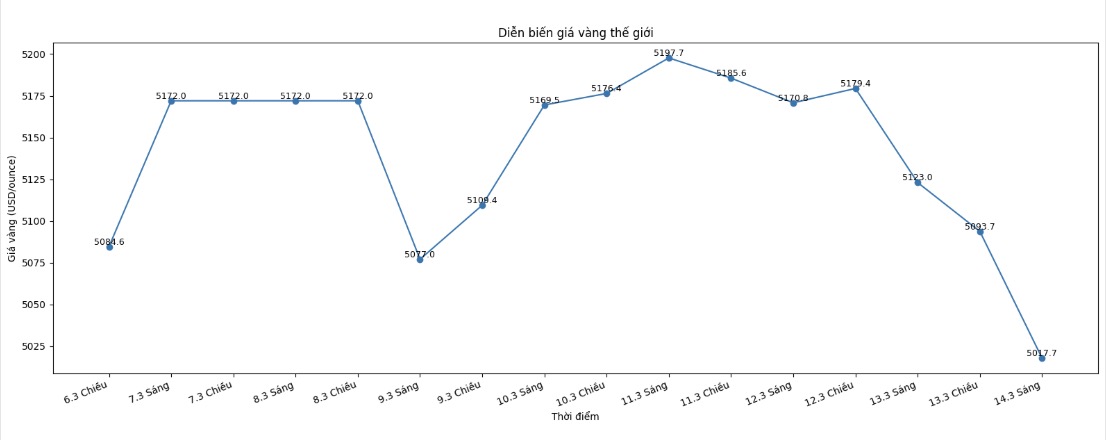
Experts believe that the labor market still maintains a relatively stable state, which may make the US Federal Reserve (FED) more cautious in reducing interest rates this year, especially when inflationary pressure is forecast to increase again. Expectations for high interest rates have created selling pressure on gold.
In the JOLTS report, the number of people recruited in January remained almost unchanged, at 5.3 million, with the recruitment rate remaining at 3.3%. The number of self-dismissals reached 3.1 million, while the number of cases of dismissal and dismissal was 1.6 million, not much fluctuating.
In another development, a consumer psychology survey released by the University of Michigan showed that the preliminary consumer sentiment index in March reached 55.5 points, down from 56.6 points in February but higher than economists' forecast of 55 points.

According to Ms. Joanne Hsu - Director of Consumer Survey at the University of Michigan, consumer sentiment has decreased by about 2%, to the lowest level since the beginning of the year. Gasoline prices are considered the most obvious factor affecting people's spending, while the spillover effect to other items is still uncertain.
Notably, inflation expectations for the next year have increased to 3.4%, ending a 6-month consecutive decline. This level is significantly higher than the pre-pandemic period, when expected inflation usually fluctuated in the range of 2.3% – 3.0%.
In addition, many consumers from different income and age groups said that personal financial prospects in the future are decreasing, with a decrease of about 7.5% nationwide.
According to experts, the combination of a relatively healthy labor market and expectations of inflation rebounding may cause the FED to delay loosening monetary policy. This reduces the attractiveness of gold - a non-performing asset and contributes to downward pressure in the short term.


