Last week, the gold market recorded strange developments when world gold prices rebounded quite strongly, while domestic gold prices fell deeply. Notably, in many sessions, world gold fluctuated strongly but domestic gold prices reacted quite weakly. This caused the gap between domestic gold prices and converted world gold prices to gradually narrow.
Closing the trading session last week (April 12), Saigon Jewelry Company SJC listed the price of SJC gold bars at 169.4 - 172.4 million VND/tael (buying - selling), down 2.1 million VND/tael in both directions compared to the closing session last week (April 5). DOJI also listed SJC gold bars at 169.4 - 172.4 million VND/tael, down 1.6 million VND/tael in the buying direction and down 2.1 million VND/tael in the selling direction compared to a week ago.
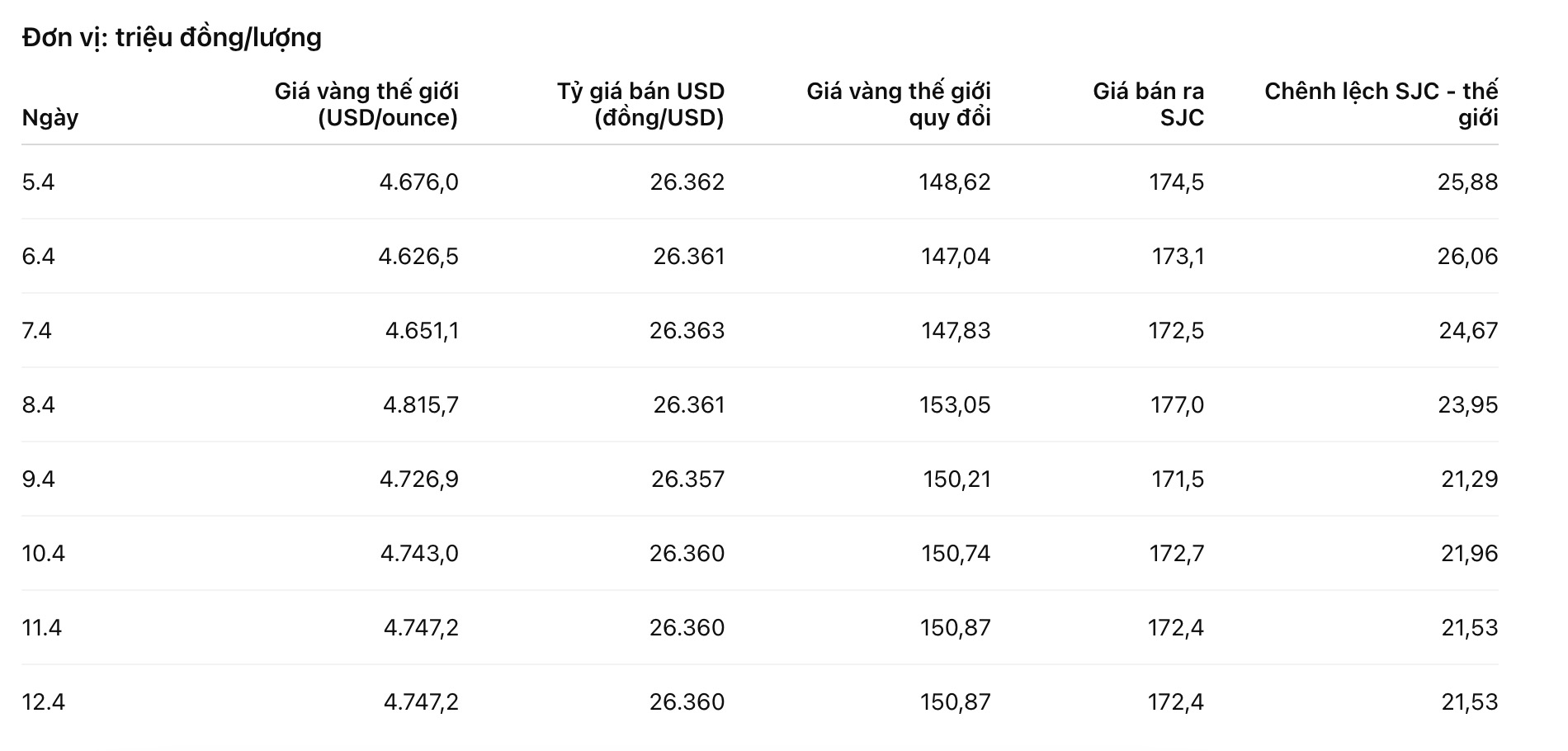
Meanwhile, world gold prices from 4,676 USD/ounce on April 5 have increased to 4,747.2 USD/ounce after a week. Converted according to Vietcombank's USD/VND exchange rate, world gold prices are equivalent to about 148.62 million VND/tael on April 5 and increased to 150.87 million VND/tael on April 12.
Thus, the converted world gold price increased by about 2.25 million VND/tael in one week, completely opposite to the decrease of 2.1 million VND/tael of the domestic SJC gold selling price.
This development shows a clear "out of sync" between the two markets. If on April 5, the selling price of SJC gold was about 25.88 million VND/tael higher than the converted world gold price, then by the end of the week the difference was only about 21.53 million VND/tael.
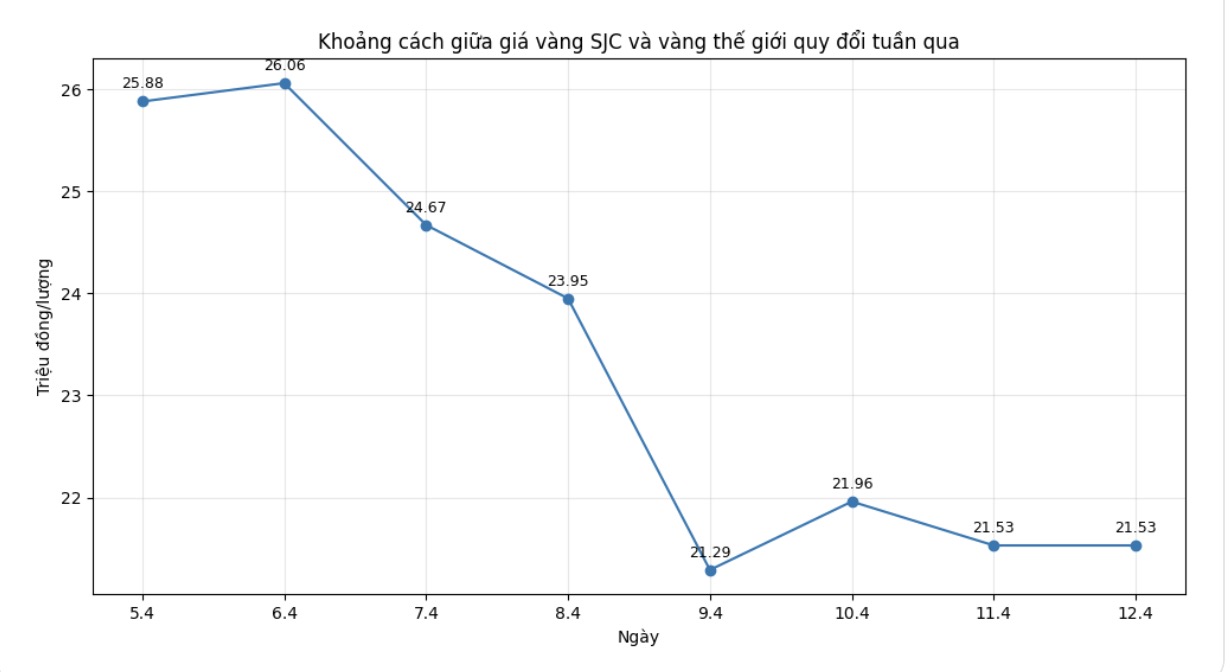
Going deeper into each session, the imbalance between world gold and domestic gold is very clear. On April 6, world gold prices decreased by about 49.5 USD/ounce compared to April 5, equivalent to a decrease of about 1.58 million VND/tael after conversion, while the selling price of SJC gold only decreased by 1.4 million VND/tael.
On April 7, world gold recovered by about 24.6 USD/ounce, equivalent to an increase of about 0.79 million VND/tael, but the selling price of SJC continued to decrease by about 0.6 million VND/tael.
Most notably, in the April 8 session, world gold prices surged by about 164.6 USD/ounce compared to April 7, equivalent to an increase of about 5.22 million VND/tael after conversion, while the selling price of SJC gold only increased by 4.5 million VND/tael.
By April 9, the world gold price decreased by 88.8 USD/ounce, equivalent to a decrease of about 2.85 million VND/tael, but the selling price of SJC plummeted to 5.5 million VND/tael, a sharp decrease of nearly double the decrease of the converted world gold price.
On April 10, world gold increased again by 16.1 USD/ounce, equivalent to an increase of about 0.53 million VND/tael, while the selling price of SJC only increased by 1.2 million VND/tael. On April 11, world gold was almost flat, only increasing by 4.2 USD/ounce, equivalent to about 0.13 million VND/tael, while the selling price of SJC decreased by 0.3 million VND/tael. By April 12, both world gold and domestic gold remained unchanged.
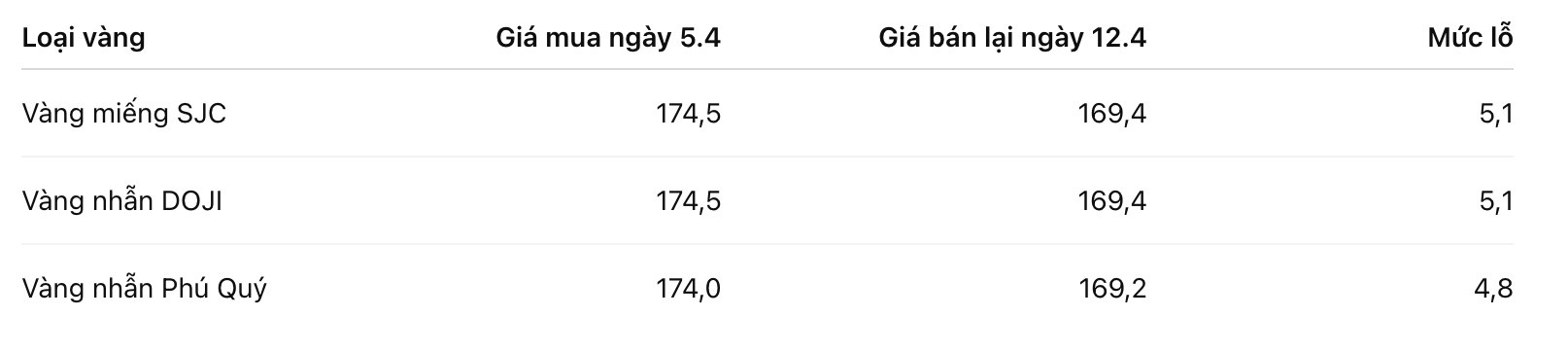
As a result, investors suffered heavy losses after only one week of holding. If buying SJC gold bars on April 5 at a selling price of 174.5 million VND/tael and reselling on April 12 at a buying price of 169.4 million VND/tael, buyers lost 5.1 million VND/tael.
With gold rings, if bought at DOJI on April 5 and resold on April 12, the loss level also reached 5.1 million VND/tael; while people buying gold rings at Phu Quy lost 4.8 million VND/tael.
The biggest risk of the gold market at this time is not only price fluctuations, but also the fact that domestic gold prices react inconsistently to world developments, along with the widening buying-selling spread.
There were sessions when international gold prices increased sharply, but domestic gold prices increased slowly, and there were also sessions when world gold prices still stood at high levels, but domestic gold prices fell deeply.
In the context of the buying - selling price difference maintaining around 3 million VND/tael, short-term gold buyers are almost unlikely to make a profit, even when the world trend is still going up.
The table below compares world gold prices after conversion and SJC gold bar prices through each trading session of the week, thereby showing that the difference between the two markets is tending to narrow.
Note that the data in the table is only relative, because the converted world gold price depends on the USD/VND exchange rate at each time, while domestic gold prices are also continuously adjusted by businesses according to market developments. Therefore, the difference at each time milestone is relative: