
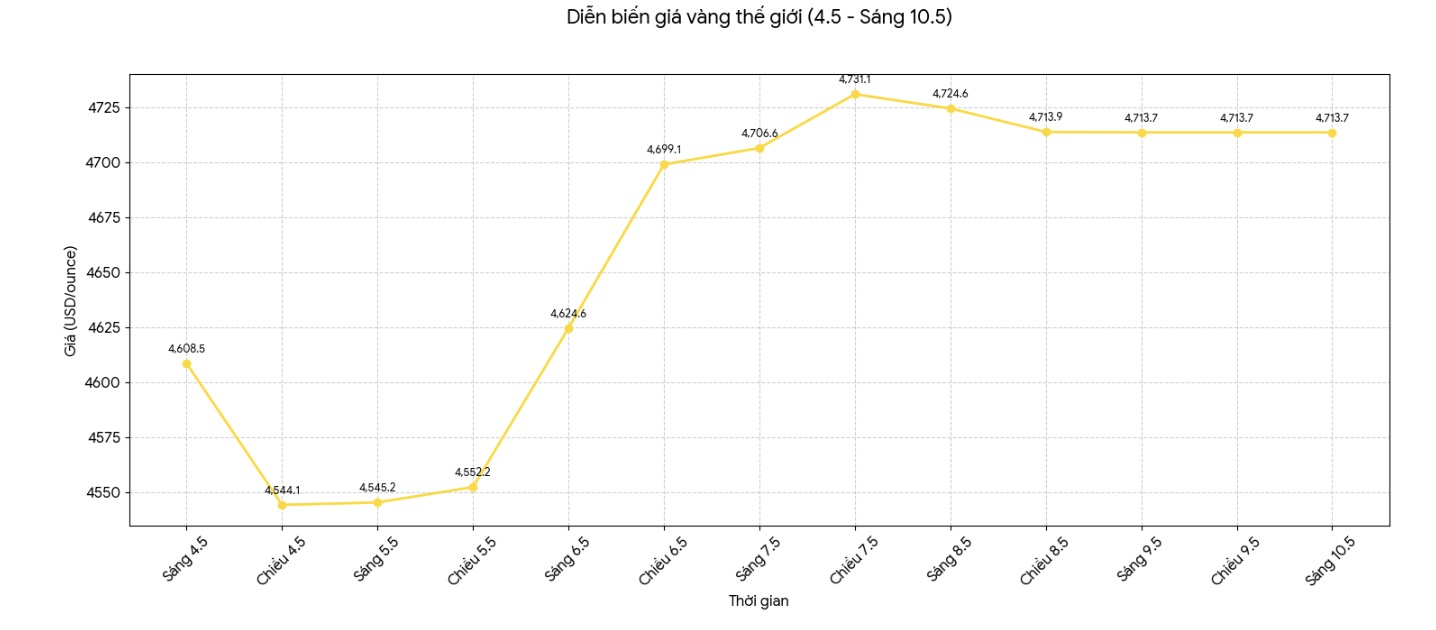
World gold prices recovered strongly this week, regaining the 4,700 USD/ounce mark after two consecutive weeks of decline, amid market concerns about the Middle East conflict and inflationary pressure.
At the end of the week, spot gold prices traded around 4, 722.6 USD/ounce, up more than 2% compared to the previous week. Although it has not been able to break the prolonged sideways trend, many experts believe that the current recovery is quite positive as it appears in the context that the market still faces many instability factors.
The driving force supporting gold comes from the fact that the US and Iran both signaled some progress in peace negotiations. Although before the end of the week, the two sides continued to have a number of retaliatory attacks, the market generally assessed that the conflict has not spread beyond control.
Notably, oil prices have not increased as much as previously feared. WTI oil is currently still maintained below the threshold of 100 USD/barrel, helping to reduce inflationary pressure and create conditions for gold to recover.
Mr. Neil Welsh - Director of Metals at Britannia Global Markets - said that the fairly "calm" response of the market to Middle East tensions shows that investor sentiment is changing.
According to this expert, investors tend to see current escalations as local rather than systemic risks, thereby helping gold prices become more stable even though oil and stocks fluctuate in different directions.
Mr. Ole Hansen - Commodity Strategy Director at Saxo Bank - also said that the market is gradually betting on the possibility of conflict being controlled. However, he noted that the process towards a comprehensive peace agreement still faces many obstacles.
Besides geopolitical factors, the gold market is also affected by US economic data. The report released on May 9 showed that the US economy created 115,000 jobs in April, higher than market forecasts. The unemployment rate remained unchanged at 4.3%, while wage pressure was lower than expected.

Positive labor data helps the Fed have more room to maintain high interest rates to control inflation. According to CME's FedWatch tool, the market currently assesses about 14% of the Fed's ability to raise interest rates by the end of this year, up from 9% last week.
However, many experts believe that gold still maintains its attractiveness due to concerns about weakening economic growth and the risk of recession if the Fed continues to tighten policy for too long.
Technically, Mr. Nick Cawley - an analyst at Solomon Global - said that if gold prices surpass and close above the peak of April 17 at 4,890 USD/ounce, the market may head towards the psychological milestone of 5,000 USD/ounce.
Next week, investors will focus on monitoring a series of US economic data including existing home sales, consumer price index (CPI), producer price index (PPI), retail sales and weekly unemployment claims. These are considered factors that could strongly impact interest rate expectations and the next trend of gold prices.


