
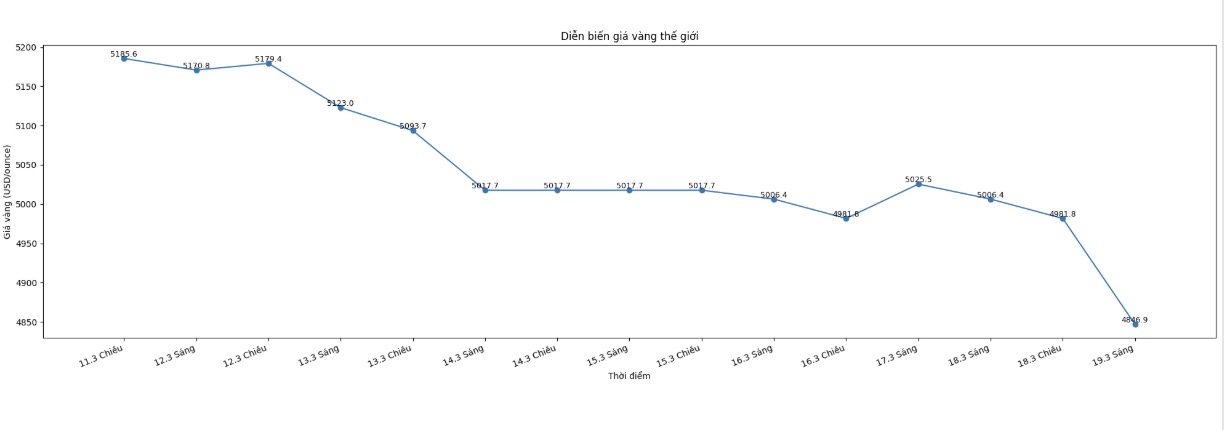
The world gold market has just experienced a volatile trading session when the price of this precious metal suddenly plummeted sharply, losing important support levels.
Notably, this is a rare time in recent times that gold has broken through the psychological threshold of 5,000 USD/ounce, making investor sentiment more cautious than ever.
There are many combined reasons leading to this sharp decrease, notably the hot increase in US inflation data, the monetary policy stance of the Federal Reserve (Fed), along with geopolitical and global financial market fluctuations.
Great pressure from US inflation rising higher than expected
The direct and most important reason for the sharp drop in gold prices comes from the US Producer Price Index (PPI) report in February. Accordingly, the PPI increased by 0.7% compared to the previous month, much higher than the forecast of 0.3% by economists. This is the strongest increase in many months, showing that inflationary pressure in the US economy is heating up again.
Not only stopping at the overall index, the core PPI (excluding food and energy) also increased by 0.5%, exceeding the forecast by 0.3%. Year-on-year, manufacturing inflation has increased by 3.4%, the highest level since the beginning of 2025. These figures raise concerns that inflation has not been controlled as expected, forcing policymakers to maintain a tighter stance for longer.
For gold - which is considered an inflation hedging asset - it will usually benefit when prices increase. However, in the current context, high inflation leads to expectations that interest rates will remain high, which puts back pressure on gold prices.
Fed keeps interest rates unchanged and is not in a hurry to relax
At the same time as releasing inflation data, the Fed concluded its monetary policy meeting and decided to keep interest rates in the range of 3.50% - 3.75%. Although the agency still signals that it may cut interest rates in the future, the easing time may be delayed due to increased inflationary pressure.
This disappointed the market, because before that many investors expected the Fed to send a clearer "goose" signal. Instead, the Fed appeared cautious and emphasized that the US economy is still growing stably, the labor market is solid, while the risk of inflation is still present.

When interest rates remain high, the opportunity cost of holding gold – a non-interest-generating asset – will increase. This makes cash flow tend to leave gold to switch to better-generating assets such as bonds or the USD.
USD strengthens and bond yields rise
Another important factor contributing to pulling gold prices down was the appreciation of the USD and US government bond yields. After the PPI data was released, the USD Index rebounded, while the yield of 10-year term bonds rose to about 4.2%.
A strong USD makes gold - valued in USD - more expensive for international investors, thereby reducing demand. At the same time, rising bond yields also make gold less attractive because investors have more safe profit-generating options.
Impacts from geopolitical tensions and oil prices
Usually, geopolitical instability such as the conflict in the Middle East will support gold prices. However, this time the market reacted in a different direction. The war between the parties in this region has caused oil prices to rise sharply, leading to concerns about escalating global inflation.
This factor indirectly disadvantages gold, because it reinforces the view that central banks, especially the Fed, will not rush to ease monetary policy. When high interest rate expectations persist, gold continues to face selling pressure.
Technical pressure and market sentiment
Gold losing the 5,000 USD/ounce mark is of great technical significance. This is an important psychological support threshold, and when it is broken, automatic sell orders have been activated, causing prices to fall deeper.
According to analysts, the next support zone for gold is around 4,800 USD/ounce and deeper is 4,670 USD/ounce. Meanwhile, to regain the upward momentum, gold needs to overcome the resistance zone of 5,000 USD/ounce - which is still quite far away at present.
In addition, market sentiment is also shifting to a "risk avoidance" state for gold in the short term. Investors tend to take profits after the previous strong increase period, combined with unfavorable macroeconomic factors, creating a sell-off wave.


