
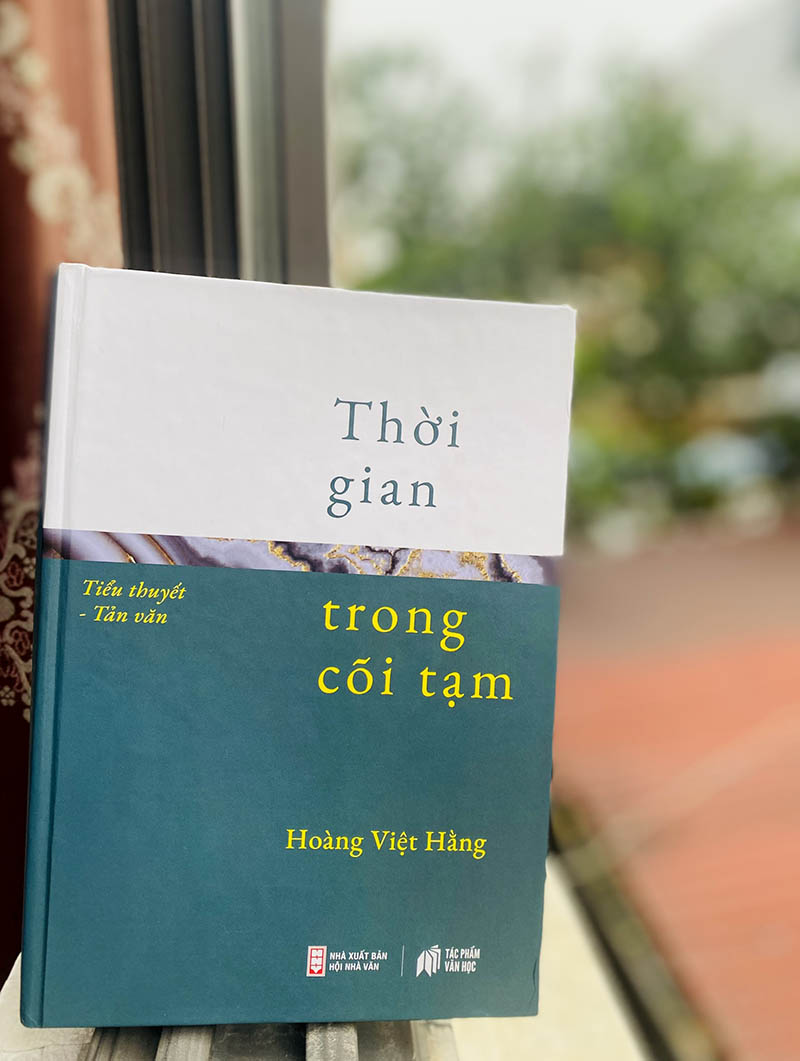
Writer Hoang Viet Hang is known for poetry, but she has many prose works that have left their mark. In which, the novel "Time in a Temporary World" is like a memoir recording the flow of memories of author Hoang Viet Hang herself, through the character Ngoc Nu.
Reading "Time in the Temporary Realm" you will encounter Ngoc Nu with unforgettable youth memories, with love for Hanoi in difficult times, with gratitude and burden for each human fate in the temporary realm of humanity. Although the writer wants to hide it, sincerity is still revealed in the literature, revealing the longing that the author sends into memories, into the roads he has traveled in Hanoi in difficult times.
Telling true stories that have happened, author Hoang Viet Hang writes with a sincere pen, sometimes - a feeling that can be seen, touching the comfort she gives to the fates of people she has met.
According to Buddhist beliefs, a person's life is just like a temporary realm in the human world. A person's life comes and goes, comes without carrying anything, and when they leave, they cannot carry any bad reputation or money – no matter how hard they try their whole life. A human life, whether long or short, is just a small grain of dust in infinite time.
During that time in the temporary realm, the character Ngoc Nu (as the author's embodiment) has lived his own life, has gone through ups and downs, ups and downs, on each turning point in life, Ngoc Nu has met countless human fates, witnessed hardship and tragedy.
The author has changed the names of real characters (especially celebrities) but kept the names of each place, street name, ward, and name of each project that has participated in construction in Hanoi.
The story spans from when Ngoc Nu was young to when she grew up, doing many jobs.
In the chapter "Memories of the Cultural Palace", the character Ngoc Nu recounts the time she worked at the Palace, monitoring the construction when the project was built in 1978. Every timeline coincides with the history of the Vietnam-Soviet Friendship Cultural Palace.
In 20 years of youth, author Hoang Viet Hang and her fellow workers have worked at a series of construction sites, participating in the construction of large projects in Hanoi such as the Central Children's Hospital, the Vietnam-Soviet Friendship Cultural Palace, the Central Circus, Kim Lien collective area, Trung Tu collective area...
The Cultural Palace is built on the land of the old Hanoi auction house (where fairs and exhibitions are held). In 1978, this project was still a desolate land, dug and buried like a desert. The construction progress was very slow due to lack of materials. It was not until 1985 that the Cultural Palace building was inaugurated.
The memory of the character Ngoc Nu about the fate of the workers participating in building the Cultural Palace is still intact, the hardship of the period of hunger and hardship, the danger when building large projects, accidents have occurred... Causing Ngoc Nu's perspective later when passing through the Cultural Palace to still be heavy and thoughtful.
Hoe - the name of a construction worker, 21 years old, who fell from a scaffolding. Life and death come as quickly as a stone thrown into a pond. Hoe - very poor, all dreams are unfinished when age stops at number 21. In every word recounting Hoe's tragic fate, there are tears of the author.
That is also My - the person who fastened concrete platforms in the basement faster than anyone else. My is pretty, obedient, and loves a handsome welder unilaterally. Later, My witnessed the welder loving a design engineer in the technical department. A year later, My quit her job. My left. Only later did I know that My had shaved her hair and become a monk at a small, remote pagoda in a remote mountainous area in Phu Tho.
That is also Mr. Huu Loan - nickname "Huu Loan concrete", who for many years has been an emulation soldier at the Cultural Palace. Mr. Huu Loan is like the eldest brother of the group of workers, gentle, proper, and a skilled and creative worker.
Mr. Huu Loan has participated in building circuses in Thong Nhat Park, building the Vietnam-Soviet Friendship Cultural Palace, each project contains love, passion - and is preserved forever as a heritage in his memory.
So that many years later, when he was old, Mr. Loan still took a bus to the Cultural Palace to admire, touch each stone pillar, each wall, and remember the days he had taken flight here. He looked at the crowd flocking to the Palace to watch music, feeling that he and the construction workers of this project had been left behind by time, had been forgotten by the times, and no one remembered them anymore.
Ngoc Nu witnessed and recounted the fate of each worker who made the works that changed Hanoi. They came and left the temporary realm with so much longing, heavy hearts, suffering... but then everything became nothing. Only the works still stand tall there - like a symbol of the time Hanoi was still hard, sparsely populated on the streets.
Whether with poetry or prose, topics about love, about the quiet space of the life-death distance, the limits of the mortal world and the realm of death, about the brevity of human life... are always imbued in Hoang Viet Hang's writings.


