
From a thousand-year-old trading port to a treasure of coastal heritage
Located on the right bank of Cua Dai, belonging to Duy Nghia commune, southeastern Da Nang area, Trung Phuong has long been identified by researchers as an ancient port city with a special position in the history of trade in the Central region. Archaeological discoveries, ancient documents and cultural traces still preserved to this day show that this place used to be an important connecting point on the international maritime trade route stretching from the Indian Ocean to the East Sea.
It is no coincidence that many scholars believe that Trung Phuong may have been one of the predecessors of Hoi An trading port later. The geographical location right at Cua Dai Chiem, where the Thu Bon, Truong Giang rivers and the inland waterway system converge, has created a special advantage for Trung Phuong in terms of trade, maritime logistics and cargo transshipment. Researcher Vo Van Thang, of the Da Nang City Historical Science Association, said so.
According to Mr. Thang, archaeological surveys over the years have discovered traces of ancient anchors, Cham tiles, Chinese and Japanese ceramics, and many artifacts dating from the 1st to the 17th centuries. This shows that this place was once a vibrant space for economic, cultural and religious exchange.
Doctor of History Le Thi Mai, lecturer at Da Nang University of Education, said that not only is there a port city, Trung Phuong is also associated with a unique cultural heritage system such as Thanh Luong Pagoda, ancient Cham wells, An Luong wharf, Noi Rang market, Bau Trung Phuong, Bau Au and traces of the ancient Khe Thuy river. These landmarks form a continuous heritage complex, reflecting the history of residence, trade and development of coastal communities for thousands of years.
However, most of that value is still in research works or folk memories. Trung Phuong is currently only known as a provincial-level archaeological site, while the potential to become a unique cultural and tourist destination of Da Nang has not been exploited commensurately.
Turn heritage into a driving force for development
After adjusting administrative boundaries and expanding development space, the southeast of Da Nang is facing many new opportunities. In that context, preserving and promoting the value of Trung Phuong ancient town is not only a cultural task, but also a requirement for sustainable socio-economic development.
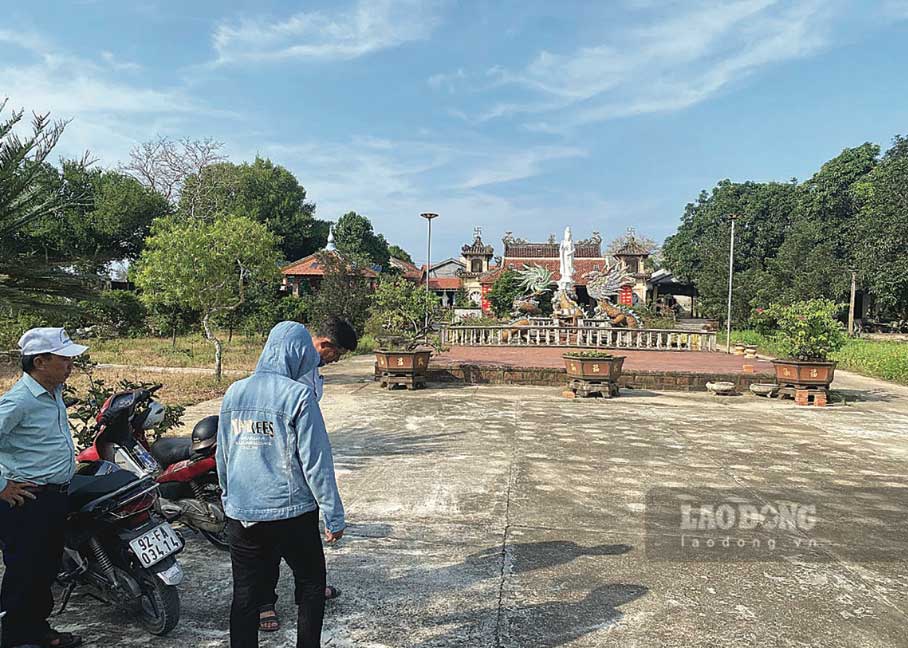
The first necessary thing is to build an overall research program on the space of Trung Phuong ancient town port. The current archaeological results are just the beginning. It is necessary to continue surveying, excavating, digitizing data, mapping heritage and fully identifying the cultural space scope related to Trung Phuong, from Cua Dai, An Luong, Thuan Tri to Bau Au, Khe Thuy and neighboring Cham Pa relics.
Secretary of Duy Nghia commune, Mr. Nguyen Van Hoa, said that the locality will organize activities to "awaken" Trung Phuong ancient port city. From there, the locality will coordinate with the cultural sector to develop an overall project to restore, preserve and promote the value of Trung Phuong port city. In particular, this is a practical activity to concretize the policy of implementing Resolution 80-NQ/TW of the Politburo on developing Vietnamese culture of Duy Nghia commune.
On that basis, Da Nang can form a coastal heritage tourist route south of the city. This tourist route will connect Trung Phuong with Hoi An, Cu Lao Cham, Tra Kieu, Dong Duong and other cultural destinations of the Quang Nam - Da Nang region in the past. This is a direction suitable for the trend of experiential tourism, cultural tourism and community tourism that is developing strongly.
Mr. Hoa said that the local idea is to form a "real-scene museum" or a thematic exhibition house about the ancient Trung Phuong port city. This space will introduce the history of the trading port, the ancient international maritime route, the life of coastal residents, the fish sauce making profession, the seafood catching profession, the memory of Bau boats and archaeological artifacts that have been discovered.
In parallel with that is the restoration of local cultural stories. Legends about Hai Pho, ghe bau verses, sea chants, Trung Phuong - Cua Khe fish sauce making, or traces of trade with Indian, Chinese, and Japanese merchants can all become unique tourism products.
In particular, the Bau Trung Phuong and Bau Au areas need to be considered as important components of the coastal cồn - bàu cultural ecosystem. If reasonably planned, this can become an eco-tourism space combined with historical education, contributing to creating a unique identity for the southeastern region of Da Nang.
However, all development plans must be based on conservation. In recent years, the coastal area of Trung Phuong has continuously been affected by landslides and climate change. Many sections of the coastline have been seriously eroded, directly threatening historical traces and people's lives.
Therefore, investing in landslide prevention works, restoring coastal ecosystems and protecting natural landscapes needs to be implemented synchronously with tourism projects. This is not only a solution to protect heritage, but also a prerequisite for sustainable development.
Further, Trung Phuong can become an important link in the strategy to build Da Nang into a "Heritage - Creative - Rich Identity City". When Hoi An has become a global brand, awakening the layers of historical sediment on the right bank of Cua Dai will contribute to completing the cultural picture of the entire region.
Heritage only truly lives when it becomes a part of contemporary life. For Trung Phuong, preservation is not about keeping what is left, but about evoking historical memories, transforming cultural values into development resources.


