From kitchens pursuing fine dining to high-class Vietnamese culinary spaces, the answer is gradually becoming clear: Tradition is not in contrast to modernity, if recounted with contemporary thinking.
Traditional cuisine associated with the story of cultural preservation
In Hanoi, in the space of an ancient villa over a hundred years old, Ha Thanh Mansion does not choose to "recreate" Northern cuisine as a piece of static nostalgia. Instead, the restaurant sees traditional cuisine as a vibrant flow, which needs to be nurtured and continued in modern life.
Our core culinary philosophy is always associated with the story of cultural preservation," shared Mr. Luong Minh Thanh, Marketing Director of the restaurant. "After COVID-19, many Vietnamese restaurants in general and traditional culinary spaces are no longer as numerous as before. That makes us ask ourselves: What will we do to make those familiar flavors not gradually fade away, so that the traditional Northern Vietnamese meal still has a place in today's rhythm of life?
From that concern, the path that the restaurant chooses is not noisy innovation, but persistence. The restaurant's menu preserves many dishes associated with Hanoi's culinary memories of the past - dishes that were once very familiar in everyday life but are now rare, such as crab and banh duc soup, "vo vo" stir-fried with pumpkin vegetables... These dishes are restored through the process of researching documents, exchanging with elderly artisans and experiencing reality in old villages and eateries.
Hanoi cuisine is not just about dishes, but a place that crystallizes the culture of behavior, lifestyle and elegance of the ancient Trang An people. From the selection of seasonal ingredients, proper processing, to the rules of display and enjoyment, all reflect moderation, sophistication and respect for traditional values," said the restaurant representative.
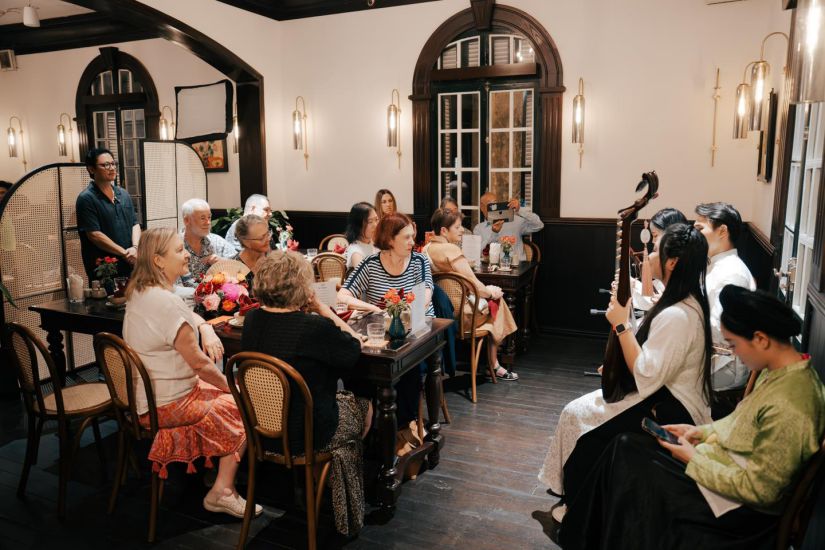
Therefore, the modernity in this Vietnamese kitchen does not come from changing the flavor structure, but from the way the experience is organized. The space of the ancient villa is preserved, the sound of traditional music echoes in the evenings, the service rhythm is slow... all create a multi-sensory journey, where diners not only eat a delicious dish, but also step into a slice of old Hanoi culture, recounted in today's language.
When classical quintessence is told with contemporary thinking
In the opposite direction, in the global world of fine dining, the connection between tradition and modernity takes place in a different way. La Maison 1888 - a French restaurant that won 1 Michelin star in Da Nang - is an example showing that international high-class cuisine can still dialogue with local culture with respect and sophistication.
For each consultant chef, La Maison 1888 carries a different story and culinary philosophy. Currently, the restaurant is introducing the Joie de Vivre style - the emotional spirit of glamorous Paris - under the hands of Michelin-starred chef Christian Le Squer.
Christian Le Squer is famous for his classic French haute cuisine platform, forged from three-Michelin kitchens in Paris. However, what makes his mark is not in the immutable reproduction of classic dishes, but in the way he combines traditional techniques with modern creative thinking, creating dishes that both retain classic quintessence and have a fresh, emotional and surprising impression for diners.
My cuisine is like haute couture (high-end tailored) in fashion" - the chef shared. "Each dish is a well-studied work in terms of flavor, texture and color, both retaining the classic quintessence and bringing new and surprising emotions.
That spirit of combination is clearly shown in the menu of La Maison 1888. French techniques such as sous-vide slow cooking, gratin or complex reduced sauces are used as a basis, but ingredients are expanded to local products: fresh seafood from Da Nang sea, wild vegetables, Vietnamese herbs... This intersection is not aimed at "vietnamizing" French cuisine, but to create a subtle dialogue between the two cuisines.
Spaghetti Debout - spaghetti standing with truffle mushroom cream - is considered a typical example. The handmade pasta uses French techniques combined with imported truffles, but the presentation and feeling of the flavor are contemporary, visually and emotionally rich. In addition, the restaurant's menu is constantly updated seasonally, reflecting the philosophy of respecting ingredients and the natural movement of cuisine, instead of being fixed in classic recipes.
With the vegetarian menu, the restaurant also chooses a similar approach: Using local organic vegetables, but applying French techniques to maximize the flavor, creating subtle and complete experiences.
From kitchens preserving Northern cuisine to fine dining spaces with the Paris spirit, restaurants are proving that tradition does not need to be copied verbatim, but can be a material for responsible creativity. For today's chefs, modernity does not mean demolition, but deep understanding to innovate just enough.
As more and more restaurants in Vietnam are recognized by the Michelin Guide, the story of connecting tradition and modernity has also become part of a longer-term strategy: Bringing Vietnamese cuisine to the world through cultural depth.
In that journey, many restaurants choose to go slowly, go deep, patiently preserve core values, and at the same time open their hearts to contemporary thinking. They are silently creating the foundation for a modern Vietnamese culinary identity but without losing roots - long-lasting enough to go far and sophisticated enough to be listened to by the world.