
When time is measured by horse hooves
In human history, before having engines, gears and electricity, horses were the "high technology" of mankind. Horse hooves shortened space, connected lands, opened up trade, communication and even conquests. In the East, the image of "one day a mile" is not an exaggeration of poetry, but very truthfully reflects the role of horses in feudal dynasties.
Horses bring people the first feeling of speed beyond natural ability. When riding a horse, people not only move faster, but also change their thinking about time, about the ability to conquer space. Therefore, in the cultural subconscious, horses are associated with breakthroughs, with the urgent rhythm of decisive moments.
In today's life, when speed is measured in gigabytes or km/hour, the image of the horse still retains its symbolic value. It reminds us that: To go fast, you must have a foundation of endurance; to overcome, you must have coordination between humans and your "means".
Not born to stand still
Unlike many familiar animals, horses are rarely associated with a static state. Horses are moving. They are hooves spreading in the wind. The posture also contains the willingness to break through. In Eastern culture, horses often appear with great aspirations: to open up territory, establish a career, and dominate the four directions.
The image of Saint Giong riding an iron horse to rise to become a hero is a profound symbol. The horse in that legend is not only a means of fighting the enemy, but also the embodiment of national will, of the desire to stand up to protect the country when the times demand it. The horse carries in itself a resonance strength: the strength of animals and the strength of humans, the strength of individuals and the strength of the times.
In ancient literature, the image of "going a horse" is also synonymous with entering a great journey of human life. It can be a journey of fame, a journey of aspiration, or simply a journey of self-affirmation in the human world. The horse therefore becomes a symbol of people who are not satisfied with contentment, do not accept a closed circle, but always look forward.
Going far thanks to perseverance
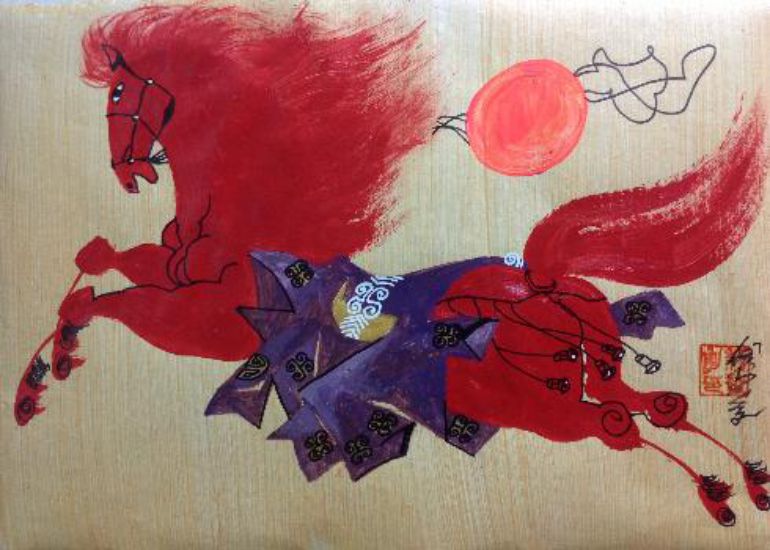
If it's just speed, horses can get tired early. But what makes horses a symbol of success is perseverance and loyalty. In history, horses have not only rushed fast in moments, but also accompanied people on long journeys, through high mountains, deserts, battles and time.
Eastern culture has a saying "nhân bất hiền bất giao, mã bất lương bất kỵ" - a bad person does not associate, a bad horse does not ride. A good horse is a horse that knows how to keep pace, knows how to listen to control, knows how to put in effort at the right time. Success, therefore, does not come from hastiness, but from the ability to travel long distances, from the harmonious coordination between will and discipline.
In traditional beliefs, the image of "success upon arrival" does not accidentally become a popular wish every beginning of the year. The horse returning not only brings news of victory, but also the results of a journey full of effort. Success here is not temporary luck, but the result of dedication, sweat and steadfast steps.
The symbol is not old
Today, horses no longer play a central role in traffic or battles. But in spiritual life, the horse symbol has never outdated. In business, people refer to "war horses" to refer to aggressive personnel who are under high pressure. In sports, the image of galloping horses evokes the idea of resilience, to broken limits. In fine arts and feng shui, horse paintings are still hung as a reminder of the spirit of advancing.
From another perspective, horses also remind people of balance. Horses are healthy when they are properly exercised, when there is space to run, and when they are well cared for. Modern humans, in the midst of speed, sometimes also need to learn from horses: know how to run fast when needed, but also know how to conserve strength to go far.
Let's go...
Spring, in the final analysis, is like a horse's hooves opening a new journey. It carries a fresh rhythm, urging people to shake off stagnation to move forward. Therefore, the horse in culture is not only a symbol of the years, but also a symbol of the spirit of life: Living proactively, living with aspirations, living with goals.
Decoding the image of the horse, we realize one simple but profound thing: Speed is only meaningful when associated with direction; aspiration only becomes beautiful when associated with responsibility; and success is only sustainable when built with long-term effort.
Perhaps because of this, among many symbols in the cultural treasure, the horse still persistently gallops in the minds of Vietnamese people - like a gentle but strong message every Spring: Go on the road, but don't forget to go firmly.


