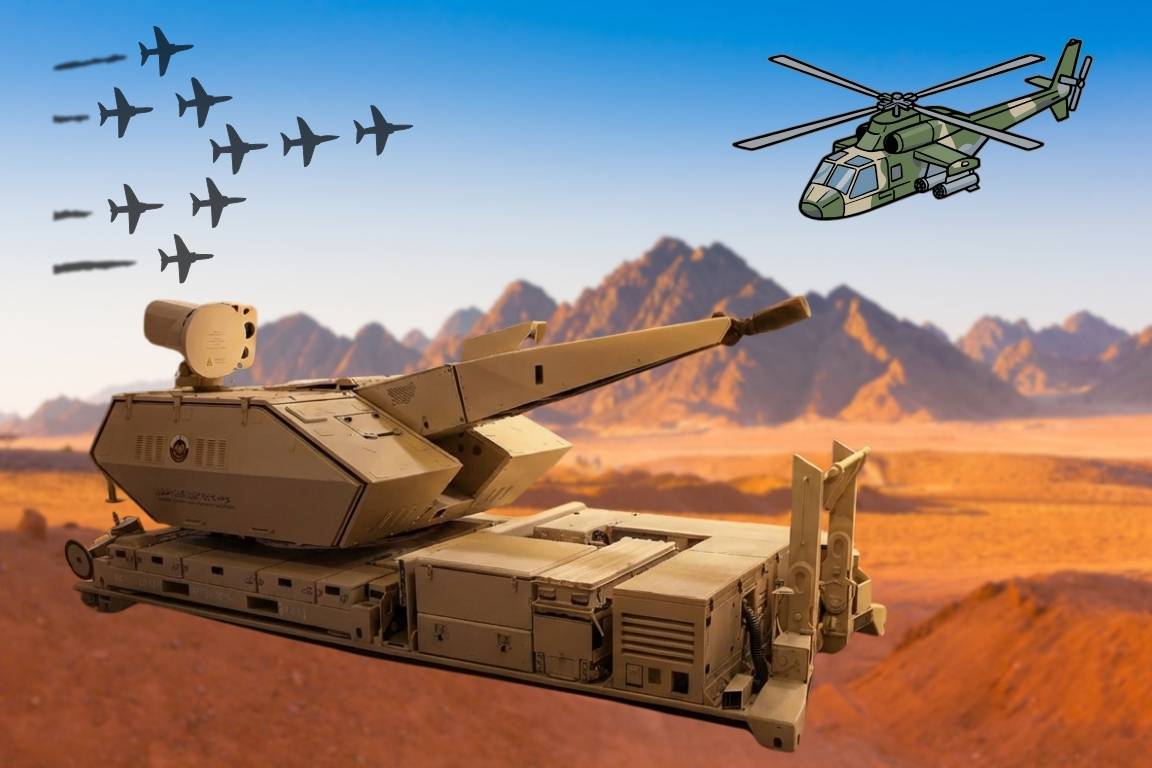
At the DIMDEX 2026 International Maritime Defense and Security Exhibition held in Doha (Qatar), Qatar introduced the Skynex 35 mm short-range air defense system developed by Rheinmetall Group, to cope with the increasing threat from unmanned aerial vehicles and low-altitude aircraft.
The appearance of Skynex at the 9th DIMDEX shows that air defense and missile defense are becoming central topics in regional security discussions, in the context that many Gulf countries are facing the risk of being attacked by cheap UAVs, cruise missiles and mixed forms of attacks.
The Skynex system is designed to protect key targets such as air bases, seaports and high-value national infrastructure. This is a close-range, network-connected air defense system, operating based on the Skymaster combat management center, allowing data collection from multiple sensors, automatic threat assessment and fire coordination in a short time.
Skynex's main weapon is the Oerlikon Revolver Gun Mk3 35mm automatic cannon, capable of firing at high speeds and effective ranges of up to 4km. The highlight lies in the AHEAD airborne explosive that can be programmed, allowing the creation of a "cloud" of metal fragments to destroy small, highly mobile targets such as unmanned aerial vehicles or low-flying missiles. This solution is considered to be much lower in cost than using interceptor missiles, while still ensuring defense effectiveness.
Qatar once announced Skynex in an air defense exercise in 2022, showing that the system had passed the testing phase and put into practical operation. The display at DIMDEX 2026 reflects the increasing urgency in the defense strategy, as recent conflicts show that UAVs and cheap attack weapons are being used to overload expensive air defense systems.
In Qatar's multi-layered defense structure, Skynex plays the role of a close-range defense layer, supplementing long-range interceptor systems. This approach helps increase the ability to continuously protect fixed targets and enhance deterrence capabilities, especially in the context of energy infrastructure, military bases and command centers increasingly becoming targets in regional escalation scenarios.