
The Ministry of Agriculture and Environment has just sent a document to the People's Committee of Ho Chi Minh City regarding the request to support completing procedures to increase the capacity of the Da Phuoc Waste Treatment Complex Project (Hung Long commune) of Vietnam Waste Solutions Co., Ltd. (VWS).
Previously, the Ho Chi Minh City People's Committee requested the Ministry of Agriculture and Environment to support completing procedures to increase the burial capacity at Da Phuoc landfill from 24 million tons to 41 million tons of domestic solid waste, and at the same time adjust the fertilizer processing technology with a capacity of 100 tons/day and night.
According to the Ministry of Agriculture and Environment, in Official Dispatch No. 699 dated April 2, 2025, the Ministry determined that the total waste reception capacity of the Da Phuoc Waste Treatment Complex according to the approved environmental dossiers is 24 million tons.
In fact, currently and at the request of Ho Chi Minh City, Da Phuoc landfill has received about 31.5 million tons.
The project owner receiving and treating domestic solid waste exceeding the total receiving capacity mentioned above is not consistent with the environmental dossiers and procedures approved by competent authorities" - the Ministry of Agriculture and Environment stated clearly.
From there, the Ministry proposed that the Ho Chi Minh City People's Committee assign specialized units to organize inspections, consider handling violations (if any) according to legal regulations and report the results to the Ministry.
The Ministry of Agriculture and Environment also noted that the buried volume parameters in the basic design dossier only show the maximum buried capacity according to the construction design plan. To operate on that scale, the investor must fully comply with environmental laws and implement the contents in the environmental dossier that has been approved.
In case there is an adjustment or change to increase the scale of solid waste reception in environmental dossiers, the project owner must carry out corresponding environmental procedures to adjust and change.
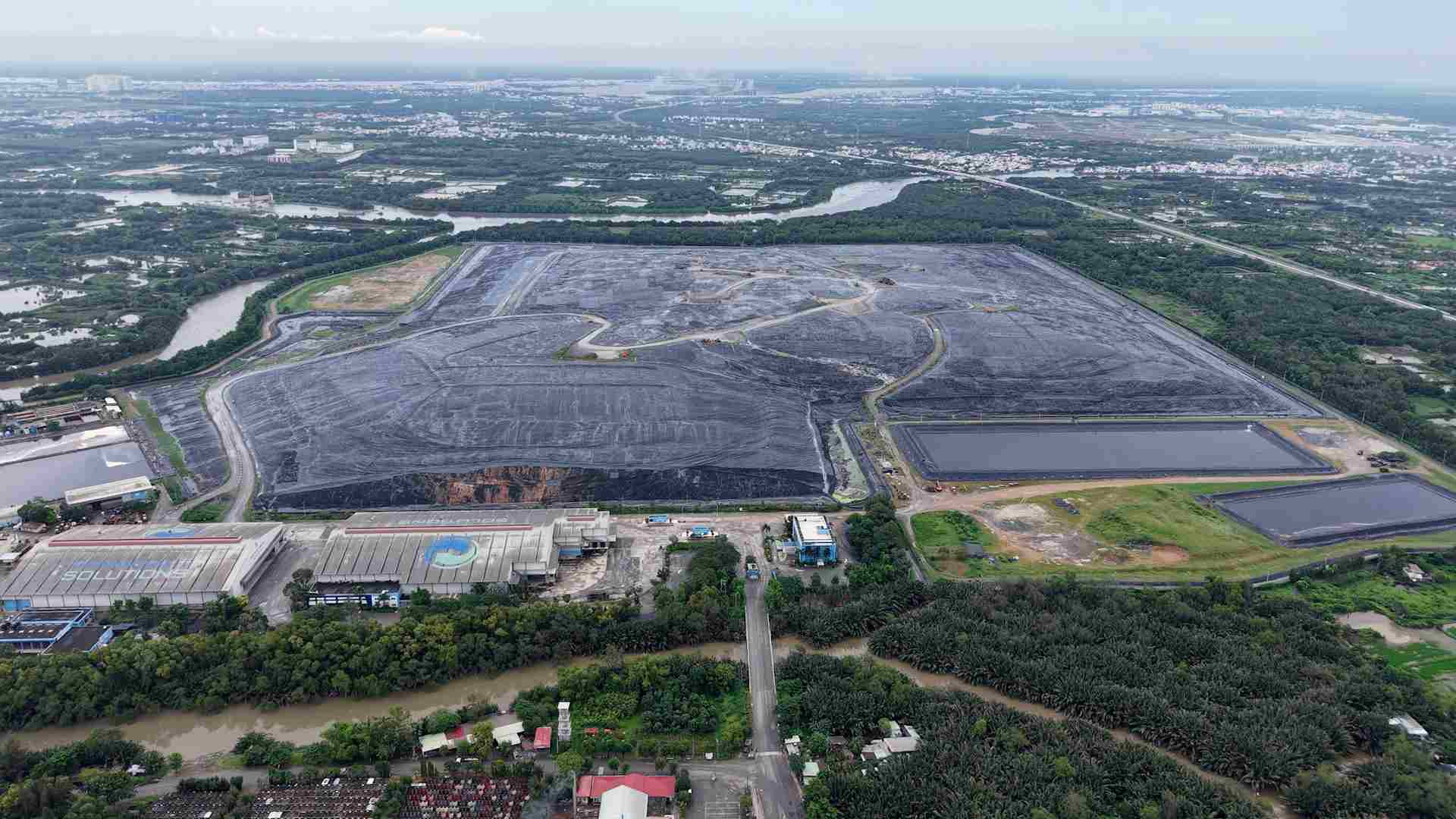
In addition to the capacity issue, the Ministry of Agriculture and Environment said that the supplementary environmental impact assessment (EIA) dossier sent by VWS in June 2025 shows that the enterprise has not yet completed planting enough 7.03ha of isolation green trees as required in Decision No. 394 of the Ministry of Natural Resources and Environment (formerly) and the Certificate of Completion of Environmental Protection Works in 2020.
The Ministry of Agriculture and Environment requests the Ho Chi Minh City People's Committee to urge the investor to fully implement the committed environmental protection works and measures to minimize the impact of landfilling activities on the surrounding air environment.
Regarding long-term orientation, the Ministry of Agriculture and Environment said that it still supports attracting foreign investors to participate in the field of domestic solid waste treatment in Vietnam. However, the consistent policy of the Government and the National Assembly is to gradually reduce the rate of waste treatment by landfilling, promote waste sorting at source, recycling, reuse and energy recovery combined treatment.
According to a report by the Ho Chi Minh City People's Committee, in 2025, about 58.7% of domestic solid waste in the area was still treated by direct landfill.
Currently, the city only has 2 waste incinerators operating, one of which does not recover energy. Some waste incineration and power generation projects have completed investment procedures but have not been put into operation.
In the context of Ho Chi Minh City's administrative boundaries being expanded after the arrangement of provincial-level administrative units, the Ministry of Agriculture and Environment proposed that Ho Chi Minh City accelerate the progress of waste burning projects for electricity generation that have been approved for investment, and soon put them into operation to reduce the rate of domestic waste landfilling, and at the same time prioritize land funds for waste treatment projects using advanced and modern technologies in the coming time.


