
On June 24, Tam Anh General Hospital System was awarded 3 international certificates at the same time by CUREXO - a reputable proactive joint replacement robot manufacturer in the world in the field of robot joint replacement surgery AI CUVIS-Joint, becoming the first unit in Vietnam to achieve this milestone.
Three certifications include: Excellent Center for Robot AI Joint Replacement Surgery, International Training Center for Robot AI Joint Replacement and International Lecturer for Clinical Training on Robot AI Joint Replacement Surgery.

Mr. Cho Young Jean - International Trade Director of CUREXO robot company, said that to achieve this certification, Tam Anh General Hospital has met 4 strict criteria, firstly, the unit owns modern surgical equipment and an advanced diagnostic imaging system synchronized with the robot system. Secondly, the high and stable frequency of robot use proves the effectiveness and ability to provide post-operative care and good closed recovery in the same hospital. Thirdly, the actual records of successful joint replacement surgeries prove the excellence in effectiveness, safety in surgery and high recovery after surgery. Finally, the hospital has good experts, capable of teaching and transferring robot surgery techniques to other international doctors.
CUVIS-Joint robot was put into use by Tam Anh General Hospital from the end of March 2026. In just over 2 months, this system has supported doctors to successfully perform nearly 100 knee and hip joint replacements with a success rate of 100%, including many cases of severe knee joint deformities, soft tissue contractions, arched legs or X-shaped legs for many years, elderly patients, osteoporosis...
Like the case of Ms. Phuong (65 years old) who has suffered from knee osteoarthritis for many years, having been treated with medication, joint injections and physical therapy, but the condition is getting worse. Nearly a year ago, she replaced her right knee joint with traditional methods.
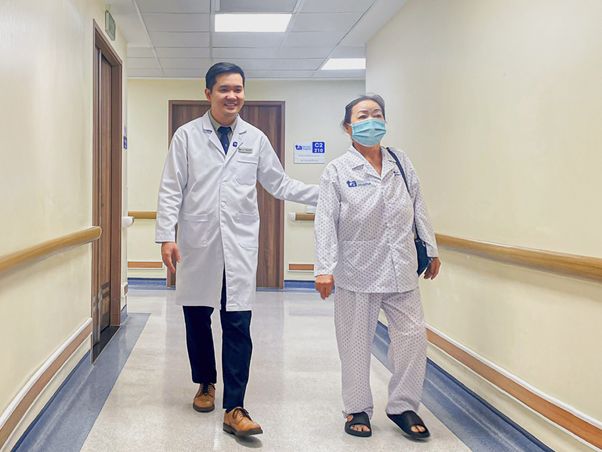
This time, when the remaining knee joint was severely degenerated, she underwent surgery with an AI robot at Tam Anh General Hospital. Less than 3 hours after surgery, she was able to practice walking with the support of medical staff. One day later, she was discharged from the hospital.
I recovered faster than the previous surgery, the feeling is much less painful," Ms. Phuong shared.
TTƯT. TS. BS. CKII Le Van Tuan - Director of the Center for Trauma and Orthopedics, Tam Anh General Hospital System, Ho Chi Minh City, said that AI robots support doctors in planning individualized surgery for each patient based on 3D CT images, helping to accurately determine the location of bone removal, artificial joint size, limb axis and soft tissue balance.
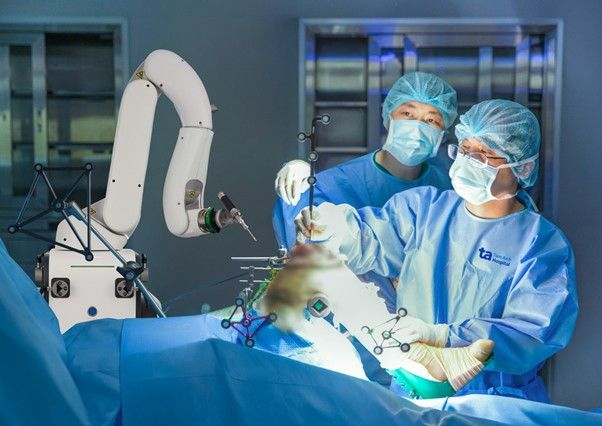
Unlike semi-active systems, CUVIS-Joint can support doctors or proactively perform many stages in surgery according to a plan approved by the doctor. This technology helps limit errors in bone removal and joint placement, reduce soft tissue damage, and optimize postoperative movement amplitude. Thanks to this, patients experience less pain, less blood loss, and can exercise early after surgery.
According to MSc.BS. CKI Dang Khoa Hoc - Head of General Trauma and Orthopedics Department, AI robots are clearly effective in difficult cases such as heavy arched legs, X-shaped legs, obesity, limb axis deformities or previous surgical interventions.
In complex cases, relying only on traditional mechanical instruments, doctors still have to estimate many parameters. AI robots help display full important data and support real-time calculations, thereby improving accuracy," said Dr. Hoc.
In addition to robot surgery, Tam Anh General Hospital System also deploys a combination of modern techniques such as dynamic shaft knee replacement, mechanical shaft knee replacement... Artificial joints such as Medial Pivot, UC (Ultra Congruent) joint, PS, CR, semi-constrained joint have components like real joints, increase mobility amplitude, easy rotation, and long lifespan.
Tam Anh General Hospital system performs about 1,200 joint replacements each year with a high success rate thanks to a team of experienced doctors and a modern equipment system. The introduction of new generation robots into application further improves efficiency, increases surgery capacity, and meets the increasing needs of domestic and international patients.


